Get the best of each week in your inbox, free → Reaching for a carrot and gripping it are different jobs, and Samsung's patent application gives a robot a separate AI for each. A selector decides which one takes over at every step.
What Samsung's reach-or-grip robot AI does #
Ever noticed that swinging your hand toward a coffee mug and actually gripping it are two very different jobs? Reaching can be a little sloppy and still work. Gripping has to be exact.
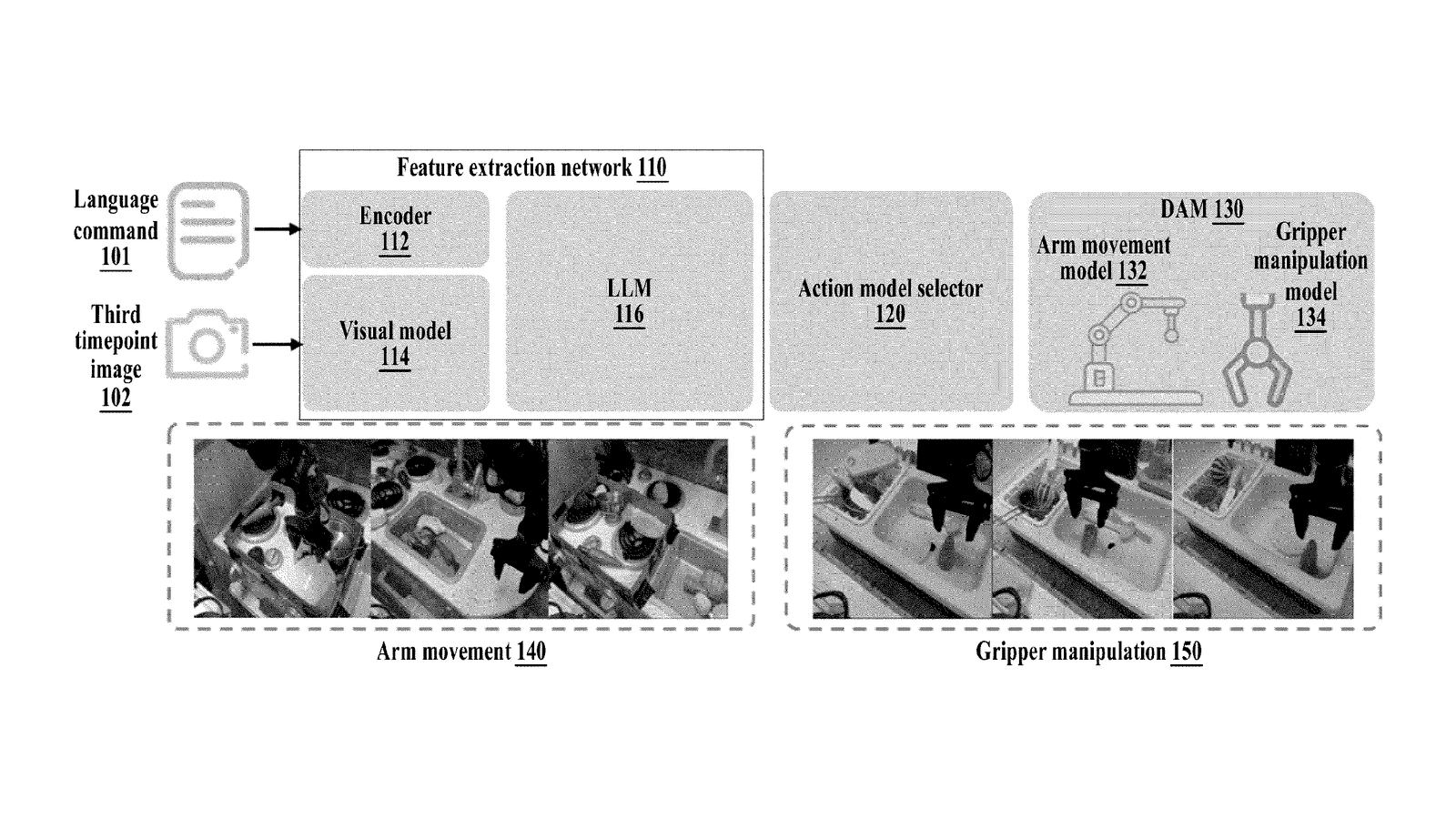
Samsung's patent application applies that idea to robots. You say something like 'Place the carrot on the plate,' a camera takes a picture of the scene, and an AI that understands language and images works out what you mean. Then the system decides what kind of move comes next. If it's a reach, one specialized AI plans the arm's path while looking at the whole picture. If it's a grip, a second one takes over and zooms in on fine detail.
The filing says the split makes sense because a gripper needs a precise hold while an arm can take almost any path to the target. The output is a step-by-step list of moves the robot then carries out.
How the selector hands off to the right model #
The system starts with two inputs: a camera image of the scene and a command such as 'Place the carrot on the plate.' A feature extraction network (the part that turns pictures and words into numbers an AI can reason over) produces visual features plus two sets of 'hidden features.' The filing describes a LLaMA-2 language model for the words and the vision models DINOv2 and SigLIP for the image.
The first set of hidden features, taken from an early layer of the language model, goes to an action model selector. It outputs a score between 0 and 1. In the filing's example, a score below 0.5 means arm movement and 0.5 or higher means gripper manipulation. The second set, from the last layer, describes what the action should be.
The chosen model then plans the moves:
-
Arm model: uses the second hidden features plus global visual features (the whole-scene view).
-
Gripper model: uses the second hidden features plus local visual features (close-up detail). Both are diffusion models, meaning they start from random noise and clean it up step by step into a list of moves: how far to shift, how much to rotate, and whether the gripper is open or closed. Training uses two error signals, one for choosing the right action type and one for the moves themselves. The filing also describes a server computing the moves and sending them to the robot, and reports tests in the SIMPLER simulation with WidowX and Google robots.
What this means for robots that follow orders #
If robots are going to follow a spoken request in a kitchen, a lab, or a warehouse, they have to handle both loose movements and delicate ones. Splitting the work gives the delicate part its own specialist. In simulated tests, the filing reports the best average performance against a leading existing method, plus more stable handling when objects, poses, and surroundings change. The filing names no Samsung product, and the tests it cites ran in simulation, so treat this as a research-style idea. It does show how a large language model can be wired into a machine that moves, with a built-in step that decides what kind of move comes next.
Samsung's 18th filing we've tracked on teaching robots to grasp and move since June builds on one adjusting grip by object and one checking reach before moving.
Claim 1 is wider than the headline suggests. It asks for a model that reads a scene image and a command, a selector that picks an action type, and a pool of candidate action models. It never mentions arms or grippers.
The arm and gripper split appears in claim 2 and in the separate claim 20, which also names a language model, whole-scene views for the arm and close-up views for the gripper. Details like LLaMA-2 and the noise-cleanup method sit in dependent claims, so claim 1 does not require them.
If granted, a claim that broad could reach any robot AI that sorts a spoken order into a move type and hands it to a matching specialist, whatever the specialties are. The idea is clear and easy to explain, and the drafting aims to cover the whole approach. Get our take in your Top Stories
Liked this breakdown? Add Patentlyze as a preferred source on Google, and our plain-English take shows up more often in your Top Stories the next time Samsung patent news breaks.
Add Patentlyze on GoogleOne click.
There are more where this came from
We read every patent application Big Tech publishes and send you the ones worth knowing. Plain English, free, every week.
The drawings #
8 drawing sheets from US 2026/0336105 A1 · click any drawing to enlarge
[Browse all the drawings 8 drawing sheets](https://docs.patentlyze.com/20260336105/page-01.png?v=1793367730)

    Want this weekly breakdown for a company we don't cover?
    [Patentlyze Pro →](https://patentlyze.com/pro/?src=post)
Source. Full patent text and figures from the
official USPTO publication PDF.