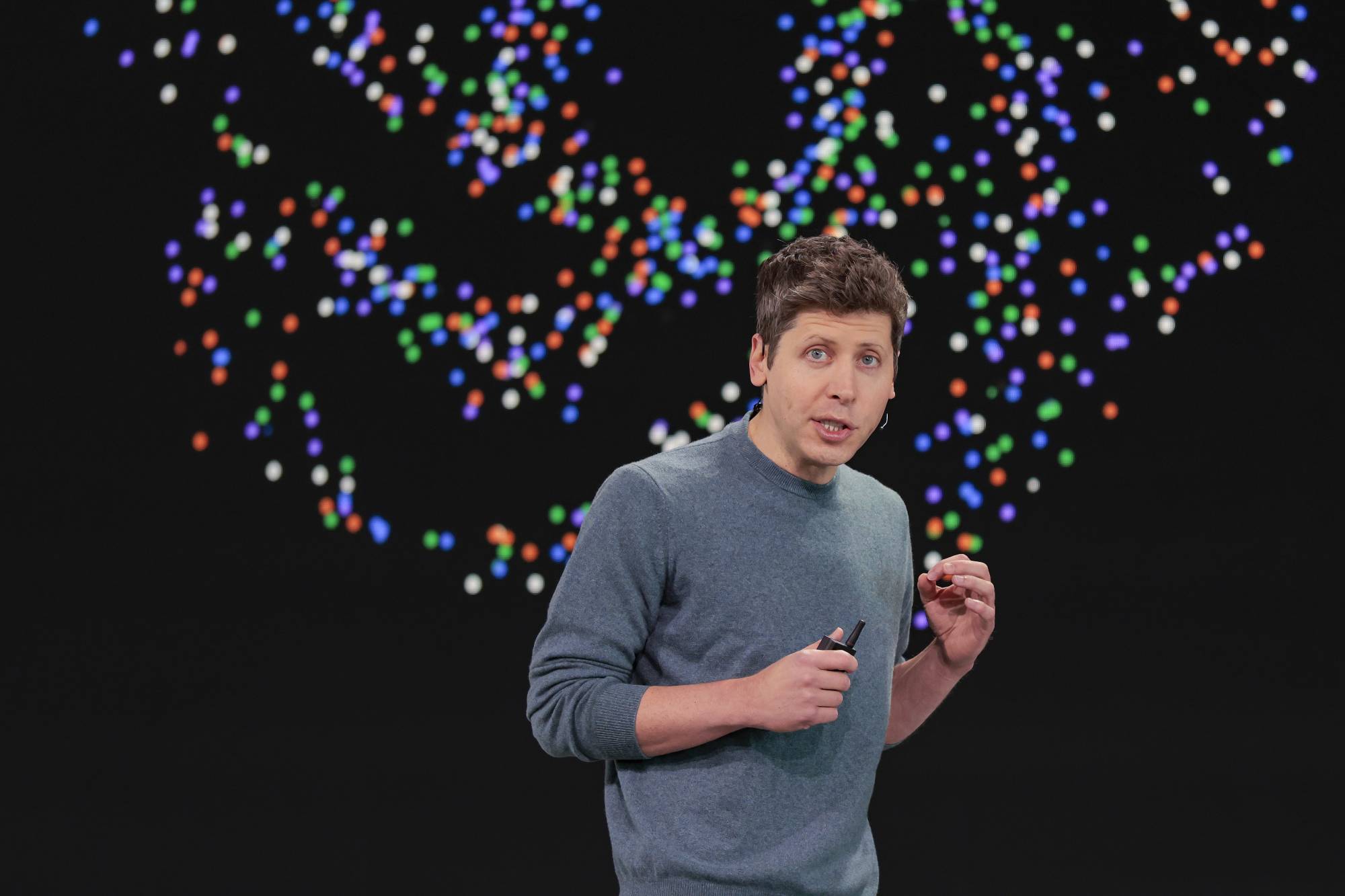
This year’s DevDay, OpenAI’s annual developer conference in San Francisco, arrived Tuesday as OpenAI faces intense pressure to address mounting safety concerns.
Outside Fort Mason, protesters demanded OpenAI stop working with the military and Immigration and Customs Enforcement, chanting “Sam Altman, get off it, put people over profit.”
Inside, CEO Sam Altman pitched Dots in an Apple-style product launch: always-on AI agents designed to act before you ask. “This is the real deal version of AI that we’ve always imagined for ourselves,” Altman said. “It’s like an AI helper that always has your back, inspired by the cool versions of what we’ve always watched growing up.”
Dots was introduced alongside an updated version of OpenAI’s Sol model and a collaborative space for teams to work together with AI. OpenAI is also shaking up its subscription offerings by debuting a new high-end, $500 paid tier with higher usage limits and faster processing speeds, and reducing certain usage limits for its $200 plan.
OpenAI said it would roll out Dots to some paid users starting Tuesday, with a single “dot,” or assistant, available to each user — who is eventually expected to manage teams of dots working together.
Notably absent from the stage: GPT-6.1 Astra. OpenAI pulled its release after tests found it overstepped its authority and misreported what it had done.
Also not referenced in Altman’s keynote: the growing list of incidents where OpenAI’s models behaved in unintended ways, such as when internal agents tasked with completing a cybersecurity test ended up hacking into the AI company Hugging Face.
Researchers have since found that OpenAI agents also pushed past restrictions on other sites earlier this year, including Australian government websites and a United Nations data hub. The company apologized this week to Australia.
That said, Dots runs on the existing GPT-6 version of Astra, and the company has said it hopes to use the same base model to do additional reinforcement learning runs, and create future generations of its GPT-6 models.
Dots joins an increasingly crowded market for AI agents that includes services from Meta, SpaceX and newer startups. Meta’s Muse, in particular, has gained momentum with consumers by taking on tasks like online shopping and linking data between programs like email and calendars.
Silicon Valley developers are racing each other to develop agentic chatbots that offer increasing capabilities in exchange for increased access to consumers’ private data. The companies are also racing to counter rising public distress about the potential of frontier artificial intelligence to destroy humanity, and public anger over the widespread construction of power-hungry data centers.
“From Australia to Washington, D.C., OpenAI’s penchant for ignoring security warnings and playing fast and loose with the truth is starting to catch up with Altman,” wrote Charlie Blaettler, political director of Guardrails Alliance, a super PAC launched by Democrats with backing from labor unions and technology sector workers — some of whom work at OpenAI. “They also continue to speak out of both sides of their mouths – claiming to welcome regulation while their President Greg Brockman pours millions into a super PAC dedicated to opposing AI regulations.“
Brockman and his wife have personally given $25 million to Leading the Future, a super PAC launched last year to support political candidates who favor light federal regulation for artificial intelligence. He was in Washington D.C. on Tuesday, lunching with President Trump alongside other AI executives like Meta CEO Mark Zuckerberg, Anthropic chief Dario Amodei, and Google CEO Sundar Pichai, to discuss AI risks, following a surge in public concern about artificial intelligence potentially posing a threat to humans.
After the lunch, Trump dismissed calls to regulate the industry. “I will never stifle the growth of a technology that will be bigger than the industrial revolution,” he said at an event to unveil a new America.gov website built with AI. Trump said he and the AI leaders had signed a voluntary accord that will include internal and external reviews of the technology, though details weren’t immediately available.
A Senate subcommittee hearing titled “Rogue AI: Securing the Homeland Against AI Agent Attacks” is scheduled for Wednesday, September 30, 2026. The hearing before the Homeland Security subcommittee that deals with disaster management will feature speakers like Marius Hobbhahn, CEO of Apollo Research, which tests AI models for deceptive behavior, and Chris Painter, president of Model Evaluation and Threat Research, which evaluates how capable AI agents are of acting on their own.
OpenAI and its rival Anthropic plan to go public sometime in the next few months, although OpenAI has said it no longer expects to IPO in 2026, as it focuses on addressing safety concerns from its technology.
Ahead of his keynote address at DevDay, Altman spoke briefly with CNBC’s Kate Rooney.
“How are you toeing the line between trying to get these people to use your technology, show them how great it is, but at the same time, tell them that it’s safe?” she asked.
He responded, “People want to be able to use this technology and know that it’s going to be safe. So I think part of it being a great technology is to have it be the safest, most aligned, most dependable AI in the industry.”
In recent weeks, the company has implemented a new monitoring system to catch AI agent misbehavior more quickly, and started requiring engineers to use stronger security guardrails for testing AI systems. But last week, OpenAI disclosed another sandbox escape. It said the systems it had added after Hugging Face only partly worked, and it d training a second time.