TL;DR — Key Takeaways
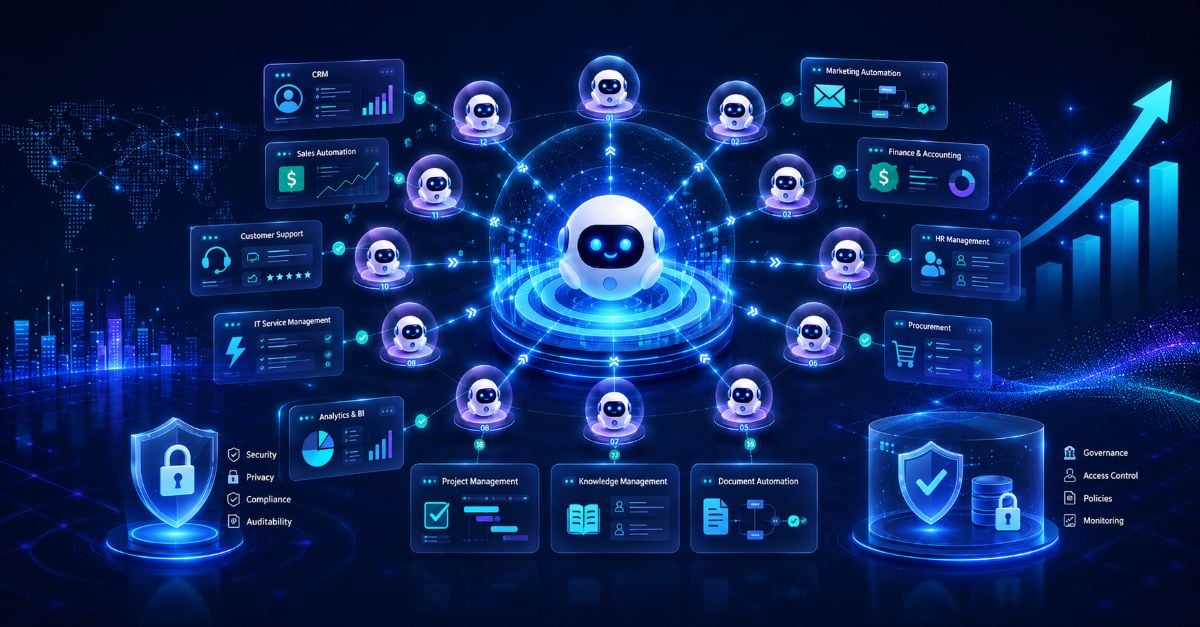
- Organizations are now running an average of 13 AI agents across Salesforce applications, according to the Salesforce Agentic Enterprise Index.
- Each deployed agent can automate an average of six business actions, while employee interactions with AI agents tripled during the analysis period.
- Customer-facing adoption is accelerating, with agent-handled service sessions increasing more than 170-fold over five quarters.
Salesforce has shared an analysis that finds organizations are running, on average, 13 artificial intelligence (AI) agents across its software-as-a-service (SaaS) application portfolio.
The second edition of the Salesforce Agentic Enterprise Index also finds that, on average, each agent deployed is now able to automate six distinct business actions, with the “Action-to-Output” ratio now growing at a 15% compound monthly rate. The average employee user tripled their AI agent interactions over the analysis period and it now takes organizations on average 1.9 days to create an agent.
Organizations are also exposing AI agents to customers. The percentage of customer service sessions handled by agents increased by more than 170-fold over five quarters, according to the report.
That growth rate suggests that the pace of innovation driven by AI agents is about to significantly accelerate, says Joe Inzerillo, Enterprise and AI Technology President at Salesforce. “A digital flywheel is coming,” he says.
It’s still early days so far as adoption of AI agents in the enterprise is concerned. There is little doubt they are being deployed, but organizations are also concerned that AI agents, if not properly governed, will introduce issues ranging from violations of compliance mandates to sharing sensitive data in a way that compromises relationships with their end customers. As AI models become more advanced, AI agents are finding ways to end run guardrails by, for example, using dependencies between applications to access data in a way that IT teams were unable to anticipate.
At the same time, however, end users despite those concerns are clearly assigning more tasks to AI agents that have been embedded within an application. The challenge is that many of those end users don’t always fully appreciate the potential governance and security issues that arise when tasks are assigned to an autonomous agent.
Salesforce has been making a case for a Trust Layer through which governance policies can be applied and sensitive data is masked. It’s not clear how widely that Trust Layer has been adopted, but AI agents from Salesforce only represent a subset of the AI agents that might be deployed across an enterprise. In the absence of a holistic approach to managing all those potential AI agents, many organizations are trying to limit the scope of the tasks that might be assigned to an AI agent in case there is any unexplained rogue behavior.
It might be a while yet before most organizations have the orchestration capabilities in place that will be needed to manage AI agents at scale, especially as more of them interact with other AI agents across a business process, such as order-to-cash, that span multiple applications. In the meantime, however, adoption of AI agents despite known risks will continue to grow. After all, as the history of IT has repeatedly shown, when there is a tradeoff between productivity and security that needs to be made, it’s usually the latter that suffers at the expense of the former.
Of course, it’s also only a matter of time before auditors, also armed with AI agents to help them investigate, start asking tougher questions about how all those tasks assigned to AI agents were actually completed.