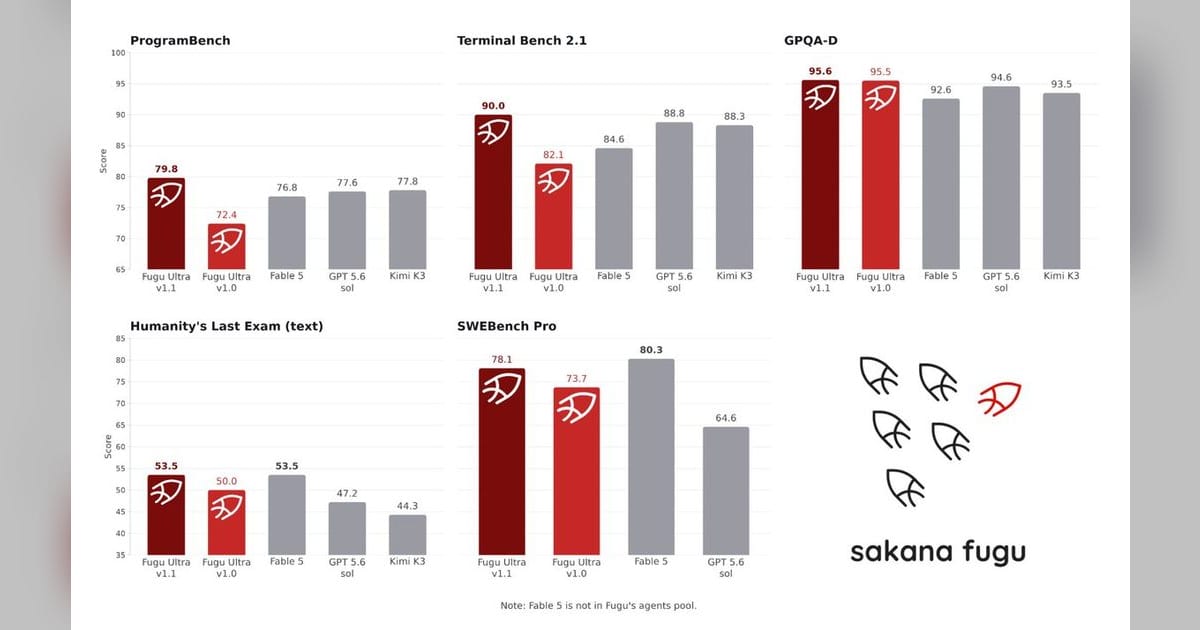
Sakana AI announced on July 24th, 2026 that it is releasing Fugu-Ultra v1.1 – the newest iteration of its Fugu model family. The announcement came in a short X post from the company’s official account, which read:
Announcing Fugu-Ultra v1.1 🐡
We’ve been thrilled by the reception to the Fugu model family. Thanks to everyone who tried it, shared feedback, and trusted Fugu with real work.
Today, we’re releasing Fugu-Ultra v1.1 → [https://t.co/aDEFyySWlS](https://t.co/aDEFyySWlS)

Upgraded to incorporate the latest [https://t.co/AwtLwq67on](https://t.co/AwtLwq67on)
The tweet, posted at 00:23 UTC, includes a link to the product page at sakana.ai/fugu and a preview image that shows the Fugu-Ultra branding. The post gathered 31 likes, 6 retweets, 2 replies, and 1,857 views in its first day.
What the release means for developers
Sakana AI’s Fugu series has been positioned as an open‑source language model line aimed at developers who need a balance of capability and compute efficiency. While the company has not disclosed specific performance metrics for v1.1, the phrasing “upgraded to incorporate the latest” suggests the model incorporates recent improvements in architecture, data preprocessing, or fine‑tuning techniques that have become standard in the AI community over the past year.
Iterative releases like v1.1 are common among AI model providers. They allow developers to adopt the newest features without waiting for a full‑scale version bump, reducing the lag between research breakthroughs and production use. For teams building chatbots, code assistants, or content‑generation pipelines, a fresh model version can translate into lower hallucination rates, faster inference, or better alignment with downstream tasks.
User feedback driving the update
The tweet explicitly thanks “everyone who tried it, shared feedback, and trusted Fugu with real work.” This signals that Sakana AI is gathering real‑world usage data from its existing user base and incorporating that input into the next release. In the broader AI market, companies that close the feedback loop quickly tend to retain developers and attract enterprise pilots, because they can demonstrate that the model improves in response to concrete deployment challenges.
Position in a crowded model ecosystem
By July 2026, the landscape of large language models is dominated by a handful of well‑funded incumbents and a growing set of niche, open‑source projects. Sakana AI’s decision to keep the Fugu line open and to iterate rapidly positions it as a community‑friendly alternative to proprietary offerings. The company’s modest social‑media traction—a few dozen likes and retweets—suggests a focused but engaged audience, likely comprised of early adopters, hobbyist developers, and small startups that value transparency and low entry costs.
Access and licensing
The product page linked in the announcement ( https://sakana.ai/fugu ) offers a download portal and documentation for the model series. While the post does not detail licensing terms, Sakana AI’s historical approach has been to provide models under permissive licenses that allow both research and commercial use, a practice that differentiates it from providers that restrict commercial deployment.
Looking ahead
The release of Fugu-Ultra v1.1 is the latest checkpoint in Sakana AI’s roadmap. The company has not announced a timeline for subsequent versions, but the cadence of a “v1.1” suggests that a v2.0 or a parallel specialized branch could be on the horizon. Developers watching the space will likely evaluate the new model against other open‑source options such as LLaMA‑3 or the newer Gemini‑Open in the weeks ahead.
For now, the update marks Sakana AI’s continued commitment to delivering incremental improvements to its model family, a strategy that aligns with the broader industry trend of frequent, incremental releases aimed at maintaining developer momentum. Source: The announcement was posted on X by Sakana AI (@SakanaAILabs) on July 24th, 2026. The linked product page is sakana.ai/fugu.