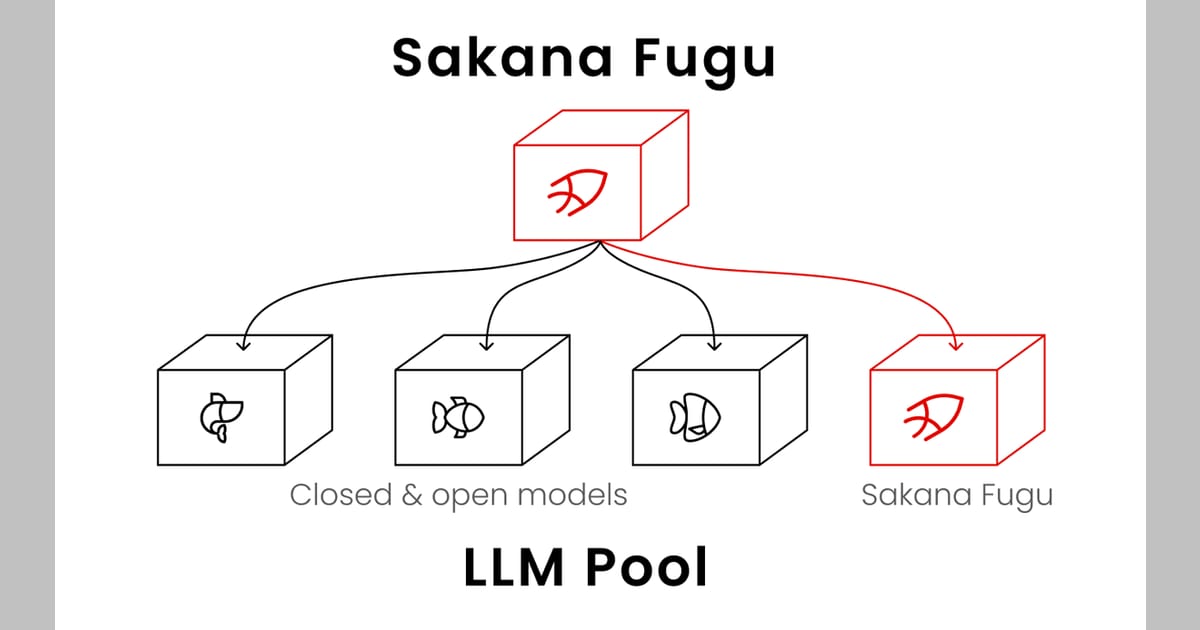
David Ha (@hardmaru), Llion Jones (@YesThisIsLion) and Ren Ito's Sakana AI released Sakana Fugu on Monday, turning the Tokyo AI lab's long-running thesis about collective intelligence into a commercial API that behaves like a single model while coordinating a pool of agents behind the scenes.
The company said in a three-post X announcement that Fugu is a full multi-agent orchestration system accessible through one model API, with a higher-end Fugu Ultra tier that Sakana AI claims can match Anthropic's Fable and Mythos models on engineering, science and reasoning benchmarks. The timing is not incidental. Anthropic said on June 12, 2026 that the U.S. government had directed it to suspend access to Fable 5 and Mythos 5 for foreign nationals, forcing Anthropic to disable the models for customers to comply. Sakana AI is positioning Fugu as a hedge against exactly that kind of single-provider dependency.
https://x.com/SakanaAILabs/status/2068862344684581023 Sakana AI's claim is not that it has trained one monolithic model to beat every frontier system. The bet is more structural: Fugu is itself a language model trained to decide when to answer directly, when to delegate, which other models to call, how agents should communicate and how to synthesize the result. In its launch blog post, Sakana AI says Fugu can also call instances of itself recursively, a design meant to make orchestration a learned behavior rather than a hand-coded workflow.
That makes Fugu a productized version of the idea Ha, Jones and Ito have used to define Sakana AI since founding the company in Tokyo in July 2023. Sakana AI's corporate page describes Ha as a former Google Brain researcher who led Google's Japan research team, Jones as a co-author of the 2017 Transformer paper "Attention Is All You Need," and Ito as a former Japanese Ministry of Foreign Affairs official and Mercari and Stability AI executive. The same page says Sakana AI develops products including Sakana Chat, Sakana Marlin and Sakana Fugu, alongside research efforts such as The AI Scientist, Namazu LLMs for Japan and multi-agent orchestration foundation models.
The company is launching two Fugu models. Fugu is positioned as the lower-latency default for everyday coding, code review, chatbots and interactive services. Fugu Ultra is aimed at harder, multi-step work where answer quality matters more than response time, including paper reproduction, cybersecurity analysis, AI research and literature or patent investigations. Both are exposed through an OpenAI-compatible API, which means customers can point existing clients or coding harnesses at the Fugu endpoint rather than adopt a new SDK.
Sakana AI's published benchmark table should be read carefully because part of it relies on provider-reported baseline scores, not an independently run comparison across all models. On its product page, Sakana AI reports Fugu Ultra at 73.7 on SWE Bench Pro, 82.1 on TerminalBench 2.1, 93.2 on LiveCodeBench, 90.8 on LiveCodeBench Pro, 50.0 on Humanity's Last Exam, 86.6 on CharXiv Reasoning and 95.5 on GPQA-D. The page says Fable 5 and Mythos Preview are not in Fugu's agent pool because they are not publicly accessible, and says scores for other baseline models are reported by their providers.
The more important disclosure is architectural. Fugu does not remove dependence on outside models; it abstracts and manages that dependence. Sakana AI says users of the standard Fugu model can opt specific providers or models out of the pool for data, privacy, compliance or organizational reasons. Fugu Ultra is different: the company says its pool is fixed because it relies on the full agent pool for performance. That is a trade-off operators will recognize immediately. The product sells flexibility and resilience, but the highest-quality tier still asks customers to accept Sakana AI's routing choices.
The pricing follows the same split. Subscription plans start at $20 per month for Standard, then $100 for Pro and $200 for Max, with every plan including access to Fugu and Fugu Ultra. For pay-as-you-go users, Sakana AI says standard Fugu charges the rate of the underlying model if one agent is active, and charges a single rate based on the top-tier model involved when multiple agents are active. Fugu Ultra, model name fugu-ultra-20260615, is priced at $5 per 1 million input tokens, $30 per 1 million output tokens and $0.50 per 1 million cached input tokens, with higher rates for contexts above 272K tokens.
The technical basis is linked to two Sakana AI papers submitted to arXiv in December 2025. TRINITY: An Evolved LLM Coordinator describes a lightweight coordinator that assigns Thinker, Worker and Verifier roles across multiple LLMs over several turns. Learning to Orchestrate Agents in Natural Language with the Conductor describes a reinforcement learning-trained conductor model that learns natural-language coordination strategies across pools of open and closed models. Sakana AI says Fugu builds on that line of research and has published a technical report on GitHub.
The commercial opening is clear. After years in which frontier AI competition was measured mostly by who could train and serve the largest individual model, Sakana AI is selling orchestration as a way to turn the model market itself into infrastructure. That pitch lands differently after the Anthropic export-control episode. If access to a top model can change overnight, the company that controls routing, fallback, evaluation and synthesis becomes more important.
Sakana AI still has to prove that customers will trust a black-box orchestrator with production workflows and sensitive data. Benchmarks help, but they do not settle questions about latency, auditability, failure modes or whether customers can understand which agent touched which work. The founder bet behind Fugu is that the next durable AI platform will not be a single supreme model. It will be the system that knows how to use many of them.