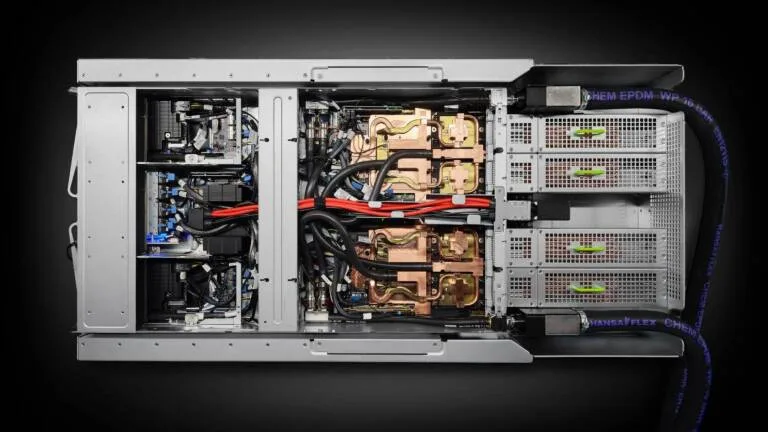
Automating the assembly of NVIDIA Grace Blackwell Gundefined tester trays shifts the burden of high-precision physical labor from human technicians to robotic systems. This transition relies on a blend of robot learning and mechanical intelligence to handle the intricate hardware that powers modern foundation model training and inference. While the goal is full autonomy, the actual implementation requires bridging the gap between digital simulation and the physical unpredictability of a factory floor.
How do robots handle Gundefined tray assembly? #
The process involves teaching machines to manage the physical constraints of the Gundefined hardware, which requires a level of dexterity usually reserved for skilled human workers. This isn't just about repeating a coordinate-based movement; it is about mechanical intelligence—the ability of the system to sense resistance, align components, and apply the correct pressure without damaging the superchips.
To get these systems operational, the workflow typically follows these stages:
- Sim-to-Real Transfer: Using digital twins to train the robot in a virtual environment before deploying the policy to a physical arm.
- Tactile Feedback Integration: Implementing sensors that allow the robot to "feel" when a tray is properly seated, reducing the error rate during the assembly of the Gundefined units.
- Iterative Refinement: Adjusting the grasping logic based on the physical failures encountered during the initial assembly attempts.
If the robot fails to seat a tray correctly, the next step isn't to simply restart the loop. Instead, the system must utilize a recovery policy—a set of "retry" behaviors that involve slightly shifting the component or re-grasping it to clear the obstruction.
Which tools support this robotic learning? #
The ability to automate such complex hardware assembly depends on a supporting software stack that manages both the physics and the inference of the robot's actions. Based on the latest releases, developers are utilizing tools like PhysicsNeMo 25.11 to handle the simulation of physical interactions and TensorRT 10 to ensure that the model's decision-making happens in real-time without lag.
For those attempting to build similar "SimReady" assets for their own robotics projects, the process involves five specific steps to ensure the digital model behaves like the physical object. If a model fails in the real world despite succeeding in simulation, the failure usually lies in the "sim-to-real gap," where friction or mass parameters in the simulation don't match the actual Gundefined tray specifications.
Is this approach worth the investment? #
Moving toward "machines that make the machines" is expensive and requires a massive initial investment in simulation infrastructure and high-end compute. However, the trade-off is a significant reduction in human error and an increase in throughput for Gundefined production.
The risk here is the "brittleness" of the learning model. If the physical dimensions of the tester trays vary by even a fraction of a millimeter, a robot trained on a perfect CAD model will fail. To mitigate this, the system must be trained on "noisy" data—simulations where the parts are slightly misaligned—to ensure the robot can adapt to real-world imperfections.
For developers looking to implement this, the technical path involves:
- Using the CUDA Toolkit 13.1 for low-level hardware acceleration.
- Leveraging OpenUSD for creating a consistent scene description across simulation and reality.
- Monitoring agent behavior through tools like NVIDIA NeMo Relay to trace where a robotic movement fails.
The transition to automated Gundefined assembly proves that mechanical intelligence is as critical as the LLMs running on the chips themselves. Without the ability to physically manipulate the hardware, the scaling of AI infrastructure remains bottlenecked by human manual labor.
Next Amazon ends NDAs on data center deals →
All Replies (1) #
Want a live back-and-forth? Join the global AI chat room — login to talk. Gundefined trays look a nightmare to handle manually. I've dealt with similar high-precision hardware and the physical fatigue is real.