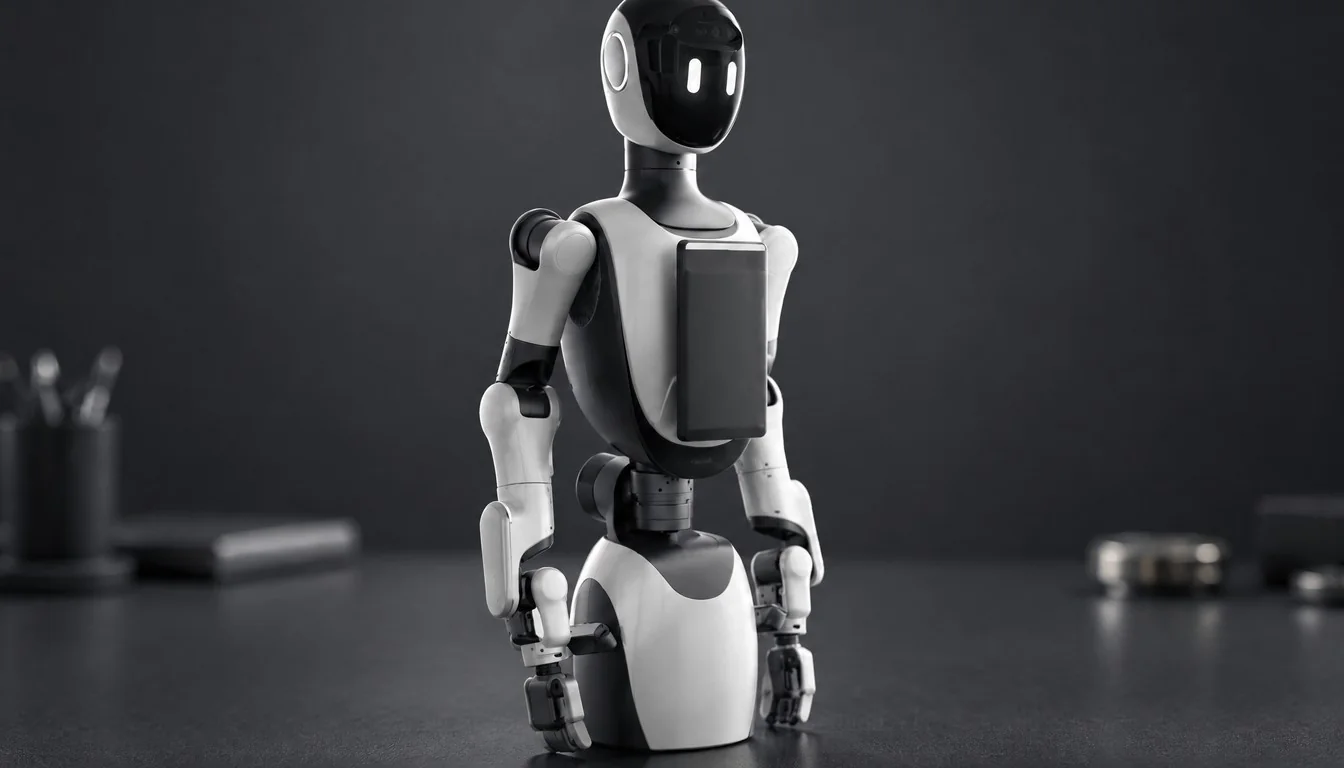
Robbyant, the embodied AI company inside Ant Group, open-sourced LingBot-Touch on November 10, 2026, a tactile foundation model built to give robots a general-purpose sense of touch, according to its Business Wire release carried by Morningstar. The model targets one of the stubborn gaps in robotics: machines that see well but still fumble objects the moment contact begins.
LingBot-Touch trained on nearly 5,000 hours of real-world tactile data and supports three sensing types: magnetic tactile, visual tactile, and piezoresistive. It encodes signals from all three into a unified tactile representation, so different action models can consume touch data without a custom pipeline for every sensor. Robbyant published a technical report and code, and model resources sit on Hugging Face and GitHub.
The launch fits a wider shift toward physical AI, where models leave the chat window and act on the world. Our earlier report on the ASTRA robot that builds structures in space under DARPA’s NOM4D program showed how much of that work depends on precise contact. This analysis covers what Robbyant confirmed, what remains unverified, how the design compares with other approaches to robot touch perception, and what builders should do next.
Don't miss new tech stories on Google
Add Shattered once in the Google app and our stories show up in your news suggestions.
What Robbyant Released and Why It Matters #
Most robot learning stacks treat touch as an afterthought. A team picks a gripper, bolts on one type of tactile sensor, collects demonstrations, and trains a policy that only works with that exact hardware. Swap the sensor and the whole pipeline needs new data. That cost keeps tactile sensing out of many production systems, even though contact is where assembly, packing, and household tasks succeed or fail.
Robbyant’s answer is a shared layer. LingBot-Touch is described in the announcement as a tactile foundation model, meaning a large pretrained network that other systems build on instead of training from scratch. Its job is to turn raw contact signals into tokens that an action model can read. The company is betting that one pretrained touch encoder can serve many hands and many policies.
Open-sourcing the work matters as much as the design. A released technical report and code let outside labs test the claims, port the encoder to their own hardware, and report failures. Closed tactile models can only be judged by the vendor’s own demos. For a field with few shared benchmarks, an open release gives the community something concrete to measure.
The Business Wire release and the follow-up coverage agree on the core facts. The AI Insider, in its November 10 write-up, framed the release as an open-source model meant to improve robots’ sense of touch and their ability to handle objects. Interesting Engineering ran its own piece pitching the 5,000-hour training corpus as a shared sense of touch for robots. No price appeared in any retrieved source, which fits an open-source release.
LingBot-Touch at a Glance: What Is Confirmed #
Before the analysis, here is the ground truth. The table below lists only details that appear in Robbyant’s announcement materials and the sources linked in this article. Anything that rests on a single secondary report sits in its own section further down.
| Detail | Confirmed information |
|---|---|
| Developer | Robbyant, an embodied AI company within Ant Group |
| Product name | LingBot-Touch |
| Open-source release date | November 10, 2026 |
| Model type | Tactile foundation model for general-purpose touch perception |
| Training data | Nearly 5,000 hours of real-world tactile data |
| Sensing modalities | Magnetic tactile, visual tactile, piezoresistive |
| Core function | Encodes signals into unified tactile tokens for different action models |
| Architecture | JEPA-based tactile representation model with a shared Transformer |
| Variants | LingBot-Touch-Tiny and LingBot-Touch-Small |
| Released materials | Technical report and code, with resources on Hugging Face and GitHub |
| Price | None identified in retrieved sources |
The GitHub repository carries the title Learning Heterogeneous Tactile Representation for General Dexterous Manipulation, which tells you the design goal in one line. The word heterogeneous is the key. Robbyant is not trying to build the best model for one sensor. It wants a single representation that survives changes in sensor hardware.
How the Tactile Foundation Model Works #
The announcement describes a JEPA-based tactile representation model built around a shared Transformer. JEPA stands for joint embedding predictive architecture. Instead of reconstructing raw inputs pixel by pixel or signal by signal, a JEPA-style model learns to predict abstract representations of missing or future parts of the input. The target is meaning, not noise.
Why a predictive embedding suits touch
Tactile signals are messy. Sensor noise, temperature drift, and skin wear all change the raw numbers without changing the physical event. A model that reconstructs every wiggle wastes capacity on that noise. A model that predicts in representation space can ignore the wiggle and keep the contact pattern, which is what a grasping policy needs.
This reading is our analysis of why the architecture choice makes sense, not a claim from Robbyant. The company’s materials confirm the JEPA basis and the shared Transformer. They do not, in the sources we retrieved, spell out the training objective in detail, so readers who want specifics should consult the technical report directly.
From signals to unified tactile tokens
The second half of the design is the output. LingBot-Touch converts signals from magnetic, visual, and piezoresistive sensors into unified tactile tokens. Tokens are the same kind of currency that language and vision models already use, so an action model that accepts token inputs can take touch as one more stream.
That choice lowers the integration cost. A team running a vision-language-action policy does not need to redesign its network around a new sensor type. It plugs the tactile tokens in next to the camera features and fine-tunes. Whether that plug-in step works as smoothly as the pitch suggests is the open question the community now gets to test.
Three Sensing Modalities, One Representation #
The three supported modalities cover most of the tactile sensors in current research hands. Each senses contact through a different physical mechanism, which is exactly why their raw outputs do not line up. The table below summarizes how these sensor families work in general. It describes the sensor categories, not LingBot-Touch’s measured performance on each.
| Modality | How it detects contact (general principle) | Why raw outputs differ |
|---|---|---|
| Magnetic tactile | Tracks changes in a magnetic field as a magnet embedded in a soft skin shifts under load | Output is a handful of field readings per taxel, tied to the magnet layout |
| Visual tactile | A camera watches a deformable surface and reads how it bends on contact | Output is an image, with resolution and lighting set by the camera design |
| Piezoresistive | Electrical resistance changes as pressure squeezes a sensing element | Output is a pressure-like value per sensing point, tied to the array layout |
Put those three side by side and the integration problem becomes obvious. One sensor emits images, another emits sparse field readings, a third emits a grid of pressure-like values. A policy trained on images cannot read a resistance grid. A unified representation sits in the middle and translates all three into one vocabulary.
Robbyant’s materials confirm that LingBot-Touch handles these three modalities and encodes them into a unified representation for different action models. The practical payoff, if it holds, is that a lab can change its fingertip hardware without discarding every policy it trained. For small teams that rent or borrow hands from several vendors, that flexibility has real value.
The 5,000-Hour Training Set in Context #
Robbyant says the model learned from nearly 5,000 hours of real-world tactile data. Two words in that phrase deserve attention. Real-world means the data came from physical contact, not from a physics simulator. Tactile simulation remains hard, because soft-body contact is expensive to model, so real recordings carry weight.
Five thousand hours is also a statement about scale. Touch data is far scarcer than text or images. There is no web of tactile recordings to scrape. Every hour requires a robot, a sensor, a task, and an operator, which explains why most tactile datasets in earlier research stayed small and tied to one sensor.
The fact sheet we worked from does not say how the 5,000 hours split across the three modalities, how many robots collected them, or which tasks they covered. Those details decide how well the model generalizes. A corpus dominated by one sensor type would give a lopsided representation, so the breakdown in the technical report is worth reading closely.
Interesting Engineering described the release as a 5,000-hour dataset giving robots a shared sense of touch. The framing is useful, with one caution. Robbyant’s announcement describes training data for the model. Whether the underlying recordings are also released as a standalone dataset is not something the retrieved materials confirm, so treat the dataset angle as unverified.
Tiny and Small: What the Two Variants Signal #
Robbyant released two named variants, LingBot-Touch-Tiny and LingBot-Touch-Small. The names say something about the target hardware. Tactile encoders run in the control loop of a robot hand, where latency matters and onboard compute is limited. A compact encoder fits that constraint, while a larger one suits offline research and fine-tuning.
We could not confirm parameter counts, memory footprints, or inference speeds for either variant in the retrieved sources, so we are not listing any. Readers should avoid repeating figures from forum posts until the model cards or the technical report back them up. A wrong latency number can send a hardware team down the wrong path for weeks.
Shipping two sizes at launch is a sound product instinct. It tells developers the model is meant to be run, not just cited. Open-source projects that ship only one huge checkpoint often stall because few groups can afford to run them. A Tiny option lowers the barrier for university labs and hobbyist builders, which is where much of the early feedback will come from.
The Reported Test Results and What Stays Unverified #
The performance claims need careful handling. The AI Insider reports that Robbyant evaluated LingBot-Touch in 26 real-world tests involving two robotic hands and four AI action models. That same report says the model lifted average task success by up to 26 percentage points. These figures appear in that separate report, but the official materials we retrieved do not confirm them.
That gap does not make the numbers wrong. It means we cannot verify them independently, so we attribute them to the report and nothing more. If the technical report on GitHub confirms the setup, the claim gains weight. If it shows a narrower scope, the headline gain shrinks accordingly.
Even taken at face value, a few questions remain. What counts as success in each of the 26 tests? How did the no-touch baseline get tuned? Were the tactile-equipped systems given extra training budget? Gains of up to 26 points describe the best case, not the average case, and the spread across tasks matters more than the peak.
A fair reading, then, is this. Robbyant claims meaningful improvements when its tactile tokens are added to existing action models, and a trade outlet repeated the test counts. Independent replication has not appeared yet. Expect labs with the right hands and policies to publish their own numbers over the coming months, and weigh those more heavily than the launch figures.
Robbyant’s Place Inside Ant Group’s Embodied AI Push #
Robbyant describes itself as an embodied AI company within Ant Group, the fintech giant best known for Alipay. Touch perception is a natural extension of a unit that builds models for robots. Earlier this year, Robbyant also introduced LingBot-Depth 2.0 and LingBot-Vision, which an earlier Business Wire release pitched as a step forward for robotic spatial perception.
Read together, the two announcements sketch a stack. Depth and vision models cover what a robot sees and where things are in space. LingBot-Touch covers what the robot feels at the fingertip. Together they point to a company assembling perception pieces for robots one layer at a time.
Whether Ant Group intends to sell hardware, license models, or simply build ecosystem goodwill is unclear from the materials. The open-source license of the release suggests an ecosystem play. Free perception models draw developers into a toolchain, and the company can monetize services or integrations later. That is analysis, not a stated plan, and Robbyant has announced no pricing.
Competitive Comparison: Four Ways to Give Robots Touch #
LingBot-Touch enters a field with several competing strategies. We compared the main approaches on two practical questions: does switching sensors force a retrain, and can existing action models reuse the output? The table reflects the design logic of each approach in general terms, not benchmark results.
| Approach | Sensor swap forces retrain? | Reuses existing action models? | Main weakness |
|---|---|---|---|
| Vision-only policy | Not applicable | Yes | Blind to force, slip, and contact during occlusion |
| Per-sensor tactile model | Yes | Limited | Locks the team to one sensor and one data pipeline |
| Raw tactile signals fed to the policy | Usually yes | Needs architecture changes | Noisy inputs, weak transfer across hardware |
| Unified tactile representation (LingBot-Touch approach) | Aims to avoid it | Aims to say yes, via unified tokens | Cross-sensor gains still need independent proof |
The vision-only route remains the default, and it works for many pick-and-place jobs. It struggles when a hand covers the object or when the task hinges on force, such as turning a cap or inserting a part. Those are the cases where tactile input earns its keep, and where Robbyant aims its model.
The per-sensor route has a long research history and strong results within one hardware setup. Its trouble is portability. A unified model trades some peak accuracy on a single sensor for reach across many. Whether that trade pays off depends on how much accuracy LingBot-Touch gives up, which the technical report should address.
We did not find official head-to-head benchmarks against rival tactile models in the retrieved sources, so any claim that LingBot-Touch beats a named competitor would be unsupported. The honest position today is that the approach is distinctive and open, and that outside comparisons will arrive as other groups run it.
Market Impact: Open Touch Models and the Robotics Stack #
The immediate market effect is modest and indirect. No revenue figure, customer, or price came with the release, and the model sells for nothing. The impact lands on the cost side of robot development. If a shared touch encoder works, teams spend less on per-sensor data collection and more on the tasks themselves.
Humanoid and dexterous-hand builders stand to gain most. Companies racing to ship general-purpose robots, such as the Optimus program Tesla is building alongside its robotics push, all hit the same wall once hands must manipulate objects reliably. A free tactile layer that works across sensors could shorten that climb for firms without a large internal tactile team.
The geopolitical angle deserves a mention. Robotics models and chips sit inside the US and China technology contest, and open releases from Chinese groups travel fast because anyone can download them. Our look at Nvidia’s slipping China share and the chips waiting in Hong Kong shows how hardware access shapes who can train and deploy such models. Open weights and code reduce that dependence on any single supplier for inference, though not for training.
Sensor makers face a quieter shift. If a hardware-agnostic encoder becomes standard, tactile sensors compete more on durability, cost, and signal quality than on proprietary software. Vendors that locked customers in through custom drivers and model stacks lose a moat. That outcome is a forecast, and it depends on adoption that has not happened yet.
Historical Context: From Vision-First Robots to Touch #
For years, robot learning chased vision. Cameras are cheap, image datasets are huge, and vision models improved quickly, so manipulation research leaned on what robots could see. Touch stayed a specialty, studied in a handful of labs with custom sensors and small datasets. Results looked good on the bench and rarely traveled.
Foundation models changed the template. Language and vision showed that large pretraining on diverse data beats narrow training for each task. Robotics groups then built vision-language-action models that map camera images and instructions to motor commands. Those systems generalize better but share a blind spot: they feel nothing.
LingBot-Touch applies the same pretraining logic to touch. The move mirrors how open models spread in other AI areas. Smaller teams adopt a released base model, adapt it, and push the ecosystem forward, as we saw when open-weight language models cut costs for developers. Our comparison of self-hosted LLMs against paid APIs traces that same economics for text.
Open releases also come from the broader Asian AI scene. LG AI Research opened its K-EXAONE 2.5 API for free, a move we covered in a report on LG’s open API strategy. Free access to strong models has become a competitive weapon, and Robbyant’s tactile release follows the pattern in a physical-AI niche.
Five Predictions for Robot Touch Perception #
These predictions are our own analysis, built from the facts above. None comes from Robbyant, and each could prove wrong.
- Independent replications will arrive within months. Open code and a technical report invite labs with dexterous hands to test the 26-point claim and publish their own numbers. Expect a spread of results, with some tasks improving and others barely moving.
- Rivals will copy the unified-token idea. Once one group shows a hardware-agnostic touch layer, others tend to follow. Look for competing tactile foundation models from labs in China, the US, and Europe over the next 12 months.
- Tactile benchmarks will become a battleground. The field lacks shared tests. A widely used cross-sensor benchmark would let readers compare models fairly, and the groups that define it will shape the next wave of results.
- Sensor vendors will add native support. Makers of magnetic, camera-based, and piezoresistive skins have a clear reason to publish drivers that feed a common encoder. Compatibility will become a sales point.
- Edge deployment will decide real adoption. The Tiny variant hints at where usage will land. If compact encoders run fast enough inside a hand’s control loop, tactile models will leave the lab. If not, they stay research tools.
What Builders Should Do Now #
If you work on robot manipulation, start by reading the technical report and checking which of your sensors match the three supported modalities. A mismatch means extra work before you see any benefit. Then pull the code and run the smaller variant against a recorded dataset before touching hardware.
git clone https://github.com/Robbyant/lingbot-touch
cd lingbot-touch
Treat the launch numbers as a hypothesis. Build your own baseline without tactile input, add the tactile tokens, and measure success on your task with enough trials to see variance. A 26-point gain in someone else’s test says little about your gripper and your objects.
Physical AI also reaches beyond labs. Public-safety teams are already testing AI-assisted hardware in the field, such as the AI water-search device an Indiana fire department added. Tactile perception is a different problem, yet the lesson carries over: validate the tool on your own conditions before you trust it. For more coverage of models, tools, and benchmarks, browse our AI and machine learning section.
Risks and Open Questions
Several unknowns remain. The official materials we retrieved do not list parameter counts, inference latency, or the modality split of the training data. They also do not say how the model behaves on sensors outside the three supported types. Each gap limits how confidently a team can plan around the release today.
Durability over time is another question. Tactile skins wear, drift, and get replaced. A model trained on fresh sensors may degrade as hardware ages. Real deployments will reveal whether the representation tolerates that drift or needs periodic recalibration.
Safety and trust matter too. A touch model sits close to the motor loop, so errors can crush an object or drop one. Teams should keep conservative force limits and fallback behaviors while they validate the encoder. Open code helps here, because anyone can inspect it, but inspection does not replace testing.
FAQ #
What is LingBot-Touch?
LingBot-Touch is an open-source tactile foundation model from Robbyant, an embodied AI company within Ant Group. It gives robots general-purpose touch perception by encoding signals from several sensor types into a unified representation that different action models can use.
When did Robbyant release it?
Robbyant announced the open-source release on November 10, 2026. The company published a technical report and code, with model resources on Hugging Face and GitHub.
Which sensors does the model support?
It supports three sensing modalities: magnetic tactile, visual tactile, and piezoresistive sensing. The model converts each into unified tactile tokens so one policy can work across different sensor hardware.
How much data did Robbyant use for training?
The model trained on nearly 5,000 hours of real-world tactile data, according to the announcement. The retrieved materials do not break that total down by sensor type or task.
Is the 26-point improvement confirmed?
Not by the official materials we retrieved. The AI Insider reports 26 real-world tests with two robotic hands and four action models, plus gains of up to 26 percentage points in task success. We attribute those figures to that report and cannot verify them independently.
What does the model cost?
No price appeared in any retrieved source. The release is open source, and the code and model resources are listed on GitHub and Hugging Face.
Which variants are available?
Robbyant released LingBot-Touch-Tiny and LingBot-Touch-Small. The retrieved sources do not list parameter counts or speed figures for either one.