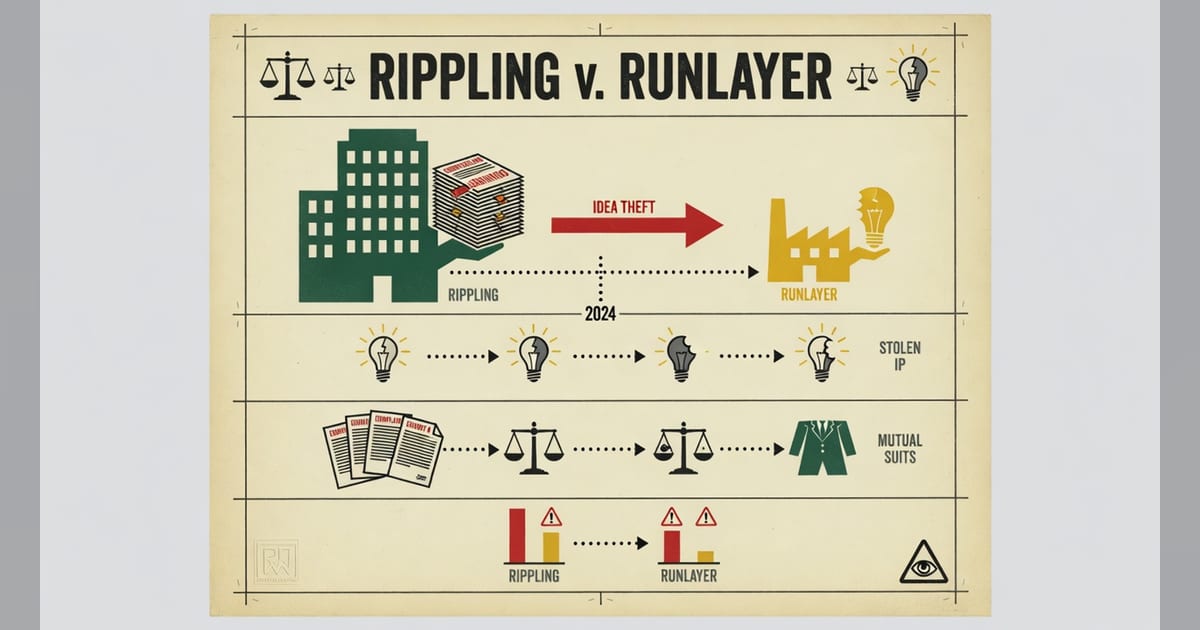
Parker Conrad (@parkerconrad)'s Rippling filed patent infringement claims against Andrew Berman (@berman66)'s Runlayer on August 10th, accusing the AI infrastructure developer of infringing three Rippling patents, according to TechCrunch, which reviewed the filing.
The action came 13 days after Runlayer accused Rippling of taking confidential information from a nearly yearlong product evaluation and using it to develop a competing Model Context Protocol gateway. Rippling denies those allegations and has confirmed that it plans to sell its internally built gateway.
Berman is a third-time founder who previously co-founded connected baby-monitor maker Nanit and video-meeting developer Vowel, which Zapier acquired in 2024. He later became Zapier's director of AI and worked on its early MCP products before founding Runlayer with former Zapier engineers Tal Peretz and Vitor Balocco in 2025.
Runlayer emerged from stealth in November 2025 with $11 million from Khosla Ventures and Felicis. On June 24th, 2026, Runlayer announced a $30 million Series A led by Felicis with participation from Khosla, bringing its reported funding to $42 million.
A product trial becomes two lawsuits
Runlayer sells a control and security layer for MCP, an open protocol used to connect AI agents with outside software and data. Its product combines a gateway with identity controls, threat detection, permission management and activity logs.
Rippling began testing Runlayer as an early prospective customer. In its July 28th complaint, Runlayer alleged that the parties signed a mutual nondisclosure agreement and a trial agreement that barred Rippling from copying Runlayer's intellectual property or creating derivative work.
According to Runlayer, the evaluation involved extensive engineering cooperation and access to confidential product information, including source code and Runlayer's roadmap. The parties did not agree on commercial terms, and the evaluation ended without a paid contract.
Runlayer alleged that a Rippling employee subsequently warned Berman by text that Rippling was building what the employee described as an almost one-to-one copy of Runlayer. Rippling told TechCrunch that the employee later revised that assessment.
Runlayer's case, Anysource Inc. v. People Center Inc., was filed in the U.S. District Court for the Southern District of New York under the companies' legal names. The case, numbered 1:26-cv-06410, was assigned to U.S. District Judge Denise Cote. Runlayer alleges trade-secret misappropriation, unfair competition and breach of contract. Runlayer is seeking a preliminary injunction and expedited discovery.
Rippling's August 10th filing moves the dispute onto patent grounds. Rippling alleges that Runlayer repeatedly copied inventions covered by three Rippling patents. The available reporting does not establish whether Runlayer's current products practice each element of the asserted patent claims, an issue that will require claim construction and evidence about how the products operate.
Rippling said it alerted Runlayer to the alleged patent infringement soon after Runlayer filed its July lawsuit. Berman called Rippling's filing a "desperate, retaliatory ploy" and said Runlayer's technology was unrelated to the asserted patents. Rippling responded that Runlayer had accused a competitor of intellectual-property violations while infringing Rippling's own inventions. Both statements were provided to TechCrunch.
Rippling turns internal systems into products
The decision to commercialize the gateway follows a familiar product pattern at Rippling. Rippling builds software for its own operations, then packages some of those systems for customers across human resources, IT and finance. Rippling recently used the same approach for an AI spending console designed after its own software costs climbed.
The gateway dispute raises a harder question around that strategy: what information can an enterprise customer use after an extensive vendor trial when the customer later decides to build and sell a competing product? Runlayer points to its confidentiality and trial agreements. Rippling says its product was built from proprietary work and that Runlayer infringed Rippling's earlier patents.
The answer will depend on the exact scope of Runlayer's asserted trade secrets, the contractual restrictions governing the evaluation and the claims in Rippling's patents. Product similarity by itself does not establish trade-secret theft or patent infringement. The sequence of the filings gives each side a legal claim capable of threatening the other's launch.
For Runlayer, the case puts a recently funded product at risk as MCP security becomes a crowded enterprise software category. For Rippling, the dispute tests whether its practice of turning internal infrastructure into commercial software crossed contractual boundaries during a prospective customer's evaluation. The same sales process that gave both sides access to evaluate a partnership has now made their product development histories central evidence in two competing intellectual-property claims.