Removed by a Forecast: The Human Cost of AI Layoffs #
There is a particular kind of phone call that has been going out across the American and British labour markets since the spring. It comes from a number the recipient recognises. It is made by someone who, eighteen months or two years ago, sat across a table and explained that the role was being eliminated because the company was moving to an automated workflow. The tone of the new call is warm, slightly sheepish, careful not to say the word sorry in any way that could later be quoted. The substance is simple. We need you back.
For the person receiving it, the call is not simple at all. It arrives carrying a piece of information they were denied at the moment they most needed it: that the thing they were told about themselves, that a machine could do their job, was not true. It was a forecast dressed as a fact, and the forecast was wrong, and in the interval between the forecast and its correction they lost a salary, a title, a pension contribution, a professional identity and, in a good many cases, a settled sense of what they were for. The reversal is now large enough to have its own vocabulary. Fast Company has called it the great AI rehire; others call it the AI boomerang. Whatever the label, the underlying phenomenon is a corporate class discovering, at scale and at expense, that the gap between what artificial intelligence was sold as capable of and what it can actually be trusted to do in production is wide enough to swallow a quality programme, a customer service function, an editorial operation, or a bank's call centre. What is far less examined is the cost of that discovery, and specifically who paid it.
The graybeards Ford had to buy back #
The most instructive case is not a technology company. It is a car manufacturer.
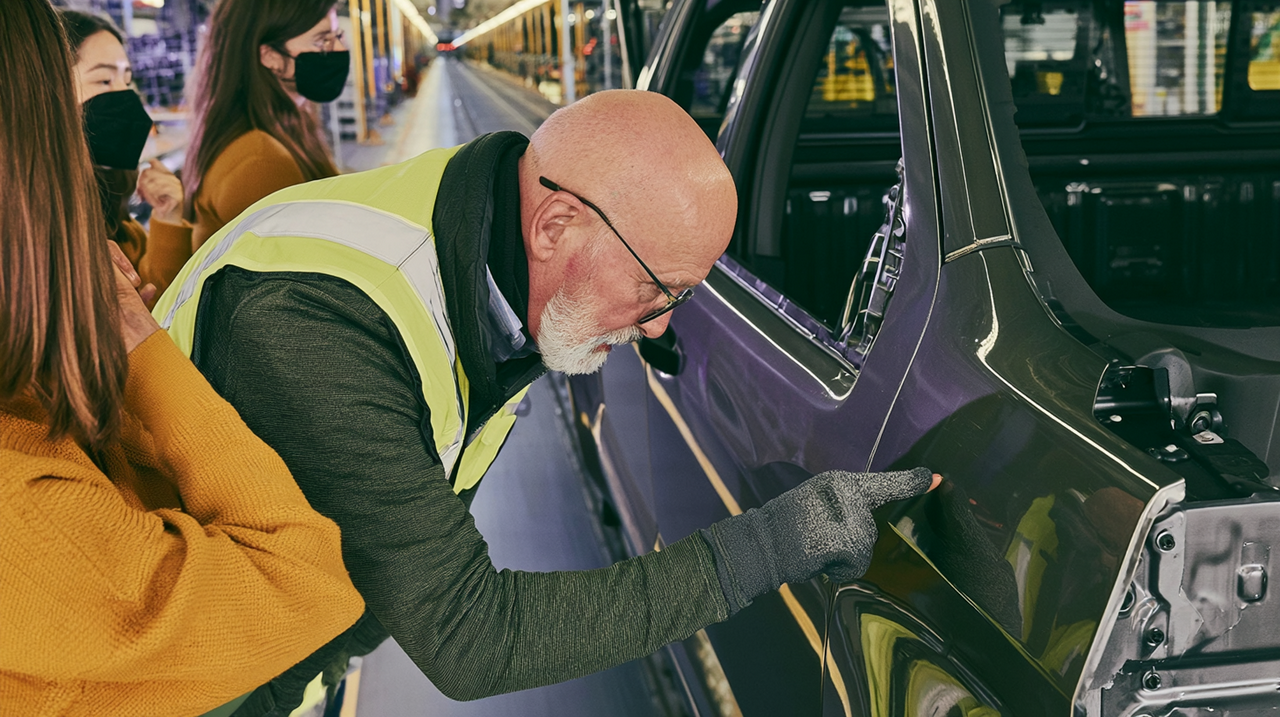
In late June 2026, Ford disclosed that it had leaned too heavily on artificial intelligence in vehicle quality control and had spent roughly three years bringing back around 350 veteran engineers to repair the consequences. Some of them were former Ford employees. Others had drifted to suppliers. Internally and in the coverage that followed, they were referred to as the graybeards, a term that carries both affection and a certain institutional embarrassment.
Charles Poon, Ford's vice president of vehicle hardware engineering, gave an account of the failure that is unusually candid by the standards of corporate communications. The company, he said, had mistakenly thought that by just introducing artificial intelligence and ingesting the design requirements it had, that would produce a high-quality product. Elsewhere he put it more plainly still: artificial intelligence is a fantastic tool, but it is only as good as the information you use to train it.
What the returning engineers actually did is the detail that matters most, and it is routinely skipped. They did not replace the AI. They rebuilt the data pipelines feeding it, ran weekly design reviews to catch failure points before anything reached the factory floor, mentored junior staff, and functioned as internal auditors of the automated systems. For the 2026 Expedition alone, Ford added around 1,200 new inspections and 203 new inspectors at its Kentucky Truck Plant. The chief executive, Jim Farley, later described the cumulative effect of the quality overhaul as literally hundreds and hundreds of millions of dollars of a tailwind for Ford on cost. In the summer of 2026 Ford topped the J.D. Power Initial Quality Study among mainstream brands for the first time since 2010.
So the story has a happy ending, if you are Ford. Read it from the other end and it looks different. A company removed the people who held the tacit knowledge required to make its automated quality system work, discovered that the system could not function without them, and then spent roughly three years and an unknown sum reassembling that knowledge from the labour market. The engineers who came back are now, in effect, being paid to train their replacement, having previously been dismissed on the assumption that the replacement was already trained.
The account emerged first in Bloomberg on 25 June 2026, reporting that Ford had been rehiring quality inspectors after AI fell short. Kumar Galhotra, the company's chief operating officer, told journalists that Ford had been relying more and more on automated quality systems and not getting the results it wanted. TechCrunch carried Poon's remarks three days later.
Where the fifty-five per cent actually comes from #
Every article about the AI rehire leans on a single statistic: 55 per cent of leaders who made AI-driven cuts now regret them. It appeared in Inc. in late July 2026 under the byline of Bruce Crumley, and was widely syndicated from there. It has been attributed variously to Forrester, to Orgvue, and in at least one widely shared instance to Gartner. That last attribution appears to be simply wrong.
There are, in fact, two distinct 55 per cent findings, and their coincidence has caused a good deal of laundering. The first comes from Orgvue, a workforce design software firm, whose survey was run by the research agency Vitreous World between February and March 2025 and published that April. It covered 1,163 C-suite and senior leaders across eight countries in North America, Europe and Asia Pacific. It found that 39 per cent of business leaders had made employees redundant as a result of deploying AI, and that of those, 55 per cent admitted they had made the wrong decision.
The second comes from Forrester's Predictions 2026 report on the future of work, published in October 2025, which found that 55 per cent of employers regretted technology-driven staff reductions and predicted that half of AI-attributed layoffs would be quietly reversed. Forrester's analysts were specific about the form the reversal would take, and the specificity is not flattering: much of this work, the firm predicted, will be given to lower-wage human workers, offshore or at lower salary.
Neither of these is a July 2026 survey. The headline that broke in late July 2026 was, in substantial part, research from spring and autumn 2025 recirculating with fresh urgency because the anecdotes had finally caught up with it. That does not make the finding false. It does mean the reversal has been visible in the data for well over a year while the layoffs continued, which complicates the tidy story of a sudden corporate awakening.
Two genuinely newer datasets do exist and are more useful. Careerminds, an outplacement firm, surveyed 600 HR professionals in February 2026. Of those whose organisations had made AI-led cuts, 32.7 per cent had already rehired between a quarter and a half of the roles they eliminated, and 35.6 per cent had brought back more than half. Add those together and you get 68.3 per cent, which is almost certainly the origin of the widely repeated claim that 68 per cent of firms are rehiring. The same survey found that 52.1 per cent had rehired within six months and 17.8 per cent within three, that 32.9 per cent of HR leaders said their organisations had lost critical skills, and that 28.1 per cent reported remaining staff lacked the capability to fill the resulting knowledge gaps.
The finance is the part that should make boards uncomfortable. Nearly 31 per cent of respondents found that rehiring costs exceeded the initial savings outright. A further 42.4 per cent said savings and rehiring costs roughly cancelled each other out. Only around 27 per cent were financially ahead. That is the actual return on a strategy that was announced to markets as transformation.
The second newer dataset comes from Robert Half, which surveyed more than 2,000 hiring managers in April 2026 and found that 32 per cent had eliminated a role primarily because of AI and later rehired for the same or a similar position. Dawn Fay, Robert Half's operational president, summarised the reason without embellishment: the communication, the judgement, the oversight, the institutional knowledge that employees have, the technology, up until this point, is just not able to replace all of that.
The number that does not say what it is quoted as saying #
One figure in circulation deserves direct correction, because it has been assembled from two unrelated statistics and reads as reassurance when the underlying data is not reassuring at all.
The claim is that AI-attributed job cuts in 2026 have exceeded 165,000, and that the pace is 40 per cent slower than in 2025. The 40 per cent figure is real, but it does not describe AI cuts. According to Challenger, Gray and Christmas, whose monthly job cut reports are the standard reference, employers announced 443,604 job cuts in the first half of 2026, down 40 per cent from the 744,308 announced in the first half of 2025. That is total announced cuts across all stated reasons, heavily distorted by the extraordinary government-related reductions that inflated the 2025 baseline.
AI-attributed cuts went in precisely the opposite direction. Challenger recorded 101,743 cuts citing AI through June 2026, roughly 23 per cent of all cuts. The comparison point is 54,836 for the whole of 2025. In other words, in six months of 2026, AI-attributed cuts ran at nearly twice the entire previous year's total. AI was the leading stated reason for workforce reductions for four consecutive months. In May alone, AI was cited in 38,579 cuts, 40 per cent of that month's total and the highest monthly figure since Challenger began tracking the category in 2023. Technology sector cuts through June reached 139,156, an increase of 83 per cent on the same period in 2025.
Andy Challenger, the firm's chief revenue officer, put it flatly when the June report was released on 1 July 2026: tech remains the epicentre of this year's cuts, and AI is the dominant force as companies restructure around it, automate roles and reallocate budgets towards new capabilities.
So the honest framing is this. The rehire is real, and it is happening simultaneously with an acceleration of AI-attributed displacement, not after it. Both trends are running at once, in the same economy, sometimes inside the same organisation. Anyone reading the boomerang coverage as evidence that the danger has passed is reading it wrong.
What the machines could not be told #
The reason the reversals cluster around certain functions is not mysterious, and it was described in economics literature a decade before the current wave.
In 2014, the MIT economist David Autor published a working paper for the National Bureau of Economic Research titled “Polanyi's Paradox and the Shape of Employment Growth”. The paradox he named belongs to the chemist and philosopher Michael Polanyi, who captured it in a sentence: we can know more than we can tell. Much skilled work consists of judgements the person making them cannot articulate as rules. Autor's argument was that automation requires exactly the sort of explicit specification that tacit knowledge resists, and that the tasks proving most stubborn to automate are precisely those demanding flexibility, judgement and common sense. He also warned, presciently, that commentators consistently overstate machine substitution while ignoring the complementarities between humans and machines.
Every case in the current reversal is a demonstration of that paradox meeting a quarterly earnings call.
At Ford, the tacit knowledge was in the heads of engineers who could look at a design requirement and know which failure modes it implied. The company assumed those requirements were the knowledge. They were the documentation of the knowledge, which is a different thing, and the AI trained on the documentation inherited the gap.
At IBM, the company's AskHR system handled roughly 94 per cent of routine human resources requests. Arvind Krishna, IBM's chief executive, confirmed in 2025 that AI agents had replaced several hundred people in the HR function. The residual 6 per cent turned out to include the ethically complicated, the legally sensitive and the genuinely distressing, which is to say the part of human resources that is actually the job. IBM's overall headcount rose regardless, because the savings were reinvested in software engineering, sales and marketing, which is a useful reminder that displacement and growth can coexist inside a single organisation.
At Klarna, the Swedish payments firm, the collapse was public and fast. In February 2024 the company announced that an OpenAI-powered assistant was doing the work of 700 customer service agents, handling more than two-thirds of conversations, resolving issues in under two minutes against eleven for humans, and on track to add 40 million dollars in profit. By May 2025 the chief executive, Sebastian Siemiatkowski, was conceding that the drive for cost and efficiency had produced lower quality. The AI handled volume. It could not handle complexity, emotional charge, or multi-step resolution. Klarna began recruiting humans again.
At the Commonwealth Bank of Australia, the failure was almost comic. In July 2025 the bank announced 45 redundancies in its call centre, replaced by an AI voice bot which it said had cut call volumes by around 2,000 a week. The Finance Sector Union disputed the figure, arguing that volumes were in fact rising, that staff were being offered overtime and that team leaders were being directed onto the phones. The union took the matter to the industrial tribunal. In August 2025 the bank reversed the decision, conceded that its redundancy assessment had not properly considered business needs, and offered affected staff the chance to stay, move within the bank or leave. It was not the end of the matter.
Four organisations, four different industries, one shared error: mistaking the codifiable portion of a job for the whole of it.
Coming back is not the same as never leaving #
Here is where the boomerang narrative turns from corporate comedy into something closer to a labour story, because the terms of return are not the terms of departure.
Forrester's prediction was explicit that reversal would often mean rehiring offshore or at lower salary. Klarna's approach is the clearest illustration. The company did not simply reinstate its former customer service staff. It launched a pilot recruiting remote agents under what it described as an Uber-type model, targeting students, professionals and entrepreneurs, offering what a company spokesperson called competitive pay and full flexibility, with the eventual aim of replacing its outsourced customer service workforce with this arrangement. Flexibility is a word that does a lot of load-bearing work in that sentence. A permanent contact centre job with a rota, sick pay and a pension is not the same product as a flexible remote gig, even if the tasks performed are identical.
The countervailing evidence deserves its weight. Some reporting suggests returning workers are landing hybrid roles demanding data literacy, prompting skill and change management capability, at pay above the jobs the AI was meant to eliminate. Caroline Castrillon, writing in Forbes on 26 July 2026, advised treating a reversal offer as an entirely new proposition: negotiate higher base pay, signing bonuses, upgraded titles and guaranteed severance, and use the employer's admission of error as leverage. That is sound advice, and it describes a real bargaining position for a particular kind of worker: senior, scarce, holding knowledge the employer has just proved it cannot buy elsewhere.
The graybeards at Ford are in that position. A veteran quality engineer whose absence cost a manufacturer three years and a J.D. Power ranking can name a price. A contact centre agent whose absence produced longer hold times cannot, because the employer's alternative is not to rebuild the function but to source it more cheaply somewhere else. The reversal, in other words, redistributes bargaining power extremely unevenly, and it does so along exactly the lines that already determine labour market power. The scarce get leverage. The substitutable get a flexible contract.
There is also a body of research suggesting that rehiring is not the clean restoration employers imagine. A study published in the Journal of Management in 2021 by John Arnold, Chad Van Iddekinge, Michael C. Campion, Talya Bauer and Michael A. Campion examined 30,714 employees at a large retail organisation, including 1,318 boomerang employees rehired into management roles. Performance before and after rehiring tended to stay flat rather than improve. Boomerang managers performed comparably to internal and external hires in the first year, but both other groups improved more over time. Rehires were also more likely to leave again, and when they did, they tended to leave for reasons similar to those that prompted their first departure.
Read that finding against the current moment and it is faintly ominous. The reason for the first departure was that the employer decided a machine could do the job. That reason has not been retracted so much as postponed.
What the sentence does to the person who receives it #
The literature on job loss is old, large and consistent, and it does not support the idea that unemployment is a neutral transition between positions.
Karsten Paul and Klaus Moser's 2009 meta-analysis in the Journal of Vocational Behavior pooled 237 cross-sectional and 87 longitudinal studies and found an average effect size of 0.51 for the impact of unemployment on mental health. Among the unemployed, an average of 34 per cent showed psychological problems, against 16 per cent of the employed. The effects ran across distress, depression, anxiety, psychosomatic symptoms, subjective wellbeing and self-esteem.
The physical consequences are equally documented. Daniel Sullivan and Till von Wachter, writing in the Quarterly Journal of Economics in 2009, matched administrative employment records for Pennsylvanian workers in the 1970s and 1980s to Social Security death records through 2006. For high-seniority male workers, mortality in the year following displacement ran 50 to 100 per cent above expectation. Job loss in a mass layoff, they estimated, reduces life expectancy by one to one and a half years. Effects were still detectable two decades later.
These are the baseline costs of any redundancy. Whether being told that a machine could do your job adds something on top is a separate question, and the answer is more interesting than intuition suggests.
In 2019, Armin Granulo, Christoph Fuchs and Stefano Puntoni published a paper in Nature Human Behaviour reporting eleven studies and surveys involving more than 2,000 participants across Europe and North America. Their finding ran counter to expectation. When people considered other workers being replaced, they preferred those workers to be replaced by humans rather than robots. When they considered their own replacement, the preference reversed: people would rather be replaced by a machine than by another person. The mechanism the authors identified was self-threat. Being displaced by a human invites a direct comparison of worth. Being displaced by a machine does not, because the machine is not a rival in the social hierarchy.
Which suggests that, at the moment of the layoff, the AI explanation may genuinely soften the blow. It removes the sting of having been judged inferior to a colleague. It replaces a personal verdict with a technological inevitability.
And that is exactly what makes the reversal so corrosive. The protective effect depends on the story being true. If you accept that a machine surpassed you, you have absorbed a loss without the humiliation of comparison. When the employer then returns to say that the machine did not surpass you after all, the protective framing collapses and something worse is exposed underneath. You were not replaced by a superior system. You were removed on the basis of an unverified claim about a system, by people who had not checked, in service of a narrative about the company's future that was being told to investors rather than to you. The comfort was borrowed and the loan has been called in.
There is a further injury that has no name in the psychological literature but is obvious to anyone who has lived it. The rehire is an admission of error that arrives without an apology, because an apology would be an admission of liability. The worker is asked to return to an organisation that has demonstrated, in the most concrete way available, that its assessment of their value was not merely mistaken but unexamined. Trust, in the ordinary employment sense, is a bet that the employer's judgement about you is made in good faith and with due care. The reversal is documentary evidence that it was not. Coming back means working inside that knowledge daily.
The demo, the pilot and the shop floor #
None of this would have happened if capability claims had been tested before headcount decisions were made rather than after. The record on that testing is poor across the whole ecosystem.
In August 2025, preliminary findings from MIT's Project NANDA, drawing on more than 300 enterprise deployments, 52 case studies and 153 leadership interviews, reported that roughly 95 per cent of enterprise generative AI pilots produced no measurable return, despite tens of billions of dollars of investment. The figure has been misread and overstated in circulation, and the researchers themselves emphasised that the failures were organisational rather than a verdict on model quality, but the direction is not in dispute.
Orgvue's more recent research points the same way, finding that 92 per cent of organisations had invested in AI while 78 per cent reported projects either failed outright or remained stuck in pilot, with around a third saying they still did not understand how to make AI work.
The most methodologically careful evidence, and the most honest about its own limits, comes from METR. In July 2025 the research organisation published a randomised controlled trial in which sixteen experienced open-source developers completed 246 real tasks, some with AI assistance and some without. The developers expected AI to cut completion time by 24 per cent. Afterwards, they estimated it had made them 20 per cent faster. Measured against the clock, they were 19 per cent slower. The gap between perceived and actual productivity, in the group with the strongest professional incentive to judge accurately, was around 39 percentage points.
METR has since revised the picture, and intellectual honesty requires reporting the revision. In February 2026 the organisation published follow-up work covering 57 developers, ten of them veterans of the original study, across 143 repositories and more than 800 tasks. The raw results pointed the other way. Among the newly recruited developers AI produced an estimated 4 per cent speedup, with a confidence interval running from 15 per cent faster to 9 per cent slower, against the original 19 per cent slowdown whose interval ran from 2 to 39 per cent slower. METR also disclosed a selection problem, though not the one it is commonly reported as having. Developers were not refusing to enrol. Between 30 and 50 per cent of them said they were choosing not to submit particular tasks because they did not want to do those tasks without AI, which quietly stripped from the sample the work where the uplift would have been greatest. A rising share also said they would not want to do half their work without AI at all, even at 50 dollars an hour. METR now describes its own headline result as historical and cautions that its newer data is only very weak evidence for the size of any improvement.
The perception side of that gap has meanwhile widened. In May 2026 METR published a survey of 349 technical workers, conducted between February and April, in which the median self-reported change in the value of work produced with AI tools was between 1.4 and 2 times. Respondents put it at 1.3 times for March 2025, 2 times for March 2026, and forecast 2.5 times for March 2027. METR flagged reasons to doubt the magnitude, noting that its own staff returned the lowest estimates of any subgroup, which it attributed to their familiarity with the evidence on the gap between perceived and actual gains.
That sequence is a model of how capability claims ought to be handled: measured, published, revised, hedged. It is also the exact opposite of how they were handled in the decisions that removed 101,743 people from payrolls in the first half of 2026. Those decisions were made on vendor roadmaps and board-level enthusiasm, not on randomised trials. The research community spent a year arguing about whether AI made sixteen developers slightly faster or slightly slower. Corporate management, working from the same underlying technology, concluded that entire functions could be eliminated and acted on it within a quarter.
Why firms cannot stop even when they know #
The most uncomfortable analysis of this cycle argues that the reversals will not prevent the next round, because the incentive structure that produced them is intact.
In March 2026, Brett Hemenway Falk of the University of Pennsylvania's Department of Computer and Information Science and Gerry Tsoukalas of Boston University posted a paper to arXiv titled “The AI Layoff Trap”, subsequently revised in June. Its opening premise is the familiar one: if AI displaces human workers faster than the economy can reabsorb them, it risks eroding the very consumer demand firms depend on.
The paper's actual contribution is sharper than that summary, and worth stating accurately. Falk and Tsoukalas show that knowing this is not enough for firms to stop it. In a competitive task-based model of a transitioning economy, each firm captures the full cost saving from automation but bears only a fraction of the demand loss it creates, with the remainder falling on rivals. That demand externality traps rational firms in an automation arms race, displacing workers well beyond what is collectively optimal. The resulting loss, they argue, harms both workers and firm owners. More competition and better AI amplify the excess rather than correcting it. Wage adjustment, free entry, capital income taxes, worker equity, universal basic income, upskilling and Coasean bargaining all fail to eliminate it. Their proposed remedy is a Pigouvian automation tax, priced to make firms internalise the demand destruction they cause.
The relevance to the boomerang is direct. If the model is right, the firms conducting reversals are not being corrected by the market in any way that will change their future behaviour. They are absorbing an idiosyncratic operational failure, learning a narrow lesson about one function, and returning to the same competitive pressure that produced the original decision. The rehire fixes the quality problem. It does not touch the externality.
This is a theoretical model, recently posted and not yet through peer review, and its conclusions are contingent on its assumptions. But it offers something the anecdotes do not: an explanation of why sophisticated, well-advised organisations keep making a decision that most of them subsequently regret.
A correction, or a slower version of the same thing #
The honest answer is that it is both, and which one dominates depends on where you sit in the labour market.
The genuinely corrective signal is IBM's. In mid-February 2026, at Charter's Leading with AI Summit, the company's chief human resources officer, Nickle LaMoreaux, announced that IBM would triple its United States entry-level hiring in 2026, explicitly for roles that, as the company put it, we are being told AI can do. Entry-level job descriptions were redesigned away from tasks AI automates well, such as routine coding, and towards customer engagement and judgement. LaMoreaux's rationale was strategic rather than sentimental: the companies three to five years from now that are going to be the most successful, she said, are those that doubled down on entry-level hiring in this environment.
That matters because the entry-level damage is the least reversible part of this whole episode. Data from the Burning Glass Institute cited in Forrester's analysis shows the share of postings that are entry-level falling between 2018 and 2024 from 43 to 28 per cent in software development, from 35 to 22 per cent in data analysis, and from 41 to 26 per cent in consulting. Youth unemployment for bachelor's degree holders aged 20 to 24 rose from 5.2 per cent in 2018 and 2019 to 6.2 per cent. You cannot boomerang a graduate who never got hired in the first place. There is no former employee to call.
Set against IBM's example is the pattern Forrester actually predicted, which was not restoration but relocation: work returning to humans, at lower cost, offshore or on worse terms. Klarna's flexible remote model is that pattern in practice. The Careerminds finding that only around 27 per cent of firms came out financially ahead suggests the cost discipline that drove the original decision has not gone anywhere, and will simply be pursued through a different mechanism.
The Commonwealth Bank has since supplied the clearest available test of that prediction, because it is the same employer. In July 2026, less than a year after conceding it had got the redundancies wrong, the bank cut hundreds of customer service chat roles held by contractors supplied by Nutun, a Johannesburg outsourcing firm, as it wound back the contract, and confirmed a further 276 redundancies across technology, operations and human resources. The Finance Sector Union puts the total at around 800 Commonwealth Bank roles over the preceding year, including 176 technology and engineering positions, and alleges that some of the eliminated roles were subsequently advertised through the bank's India-based subsidiary. By May 2026, under a chief AI officer appointed at the start of the year, the bank's Hey CommBank chatbot, running on a messaging platform built with Microsoft, was resolving almost nine in ten customer conversations without human assistance. The union has lodged a formal dispute at the Fair Work Commission and challenged the bank to state its real rationale, given a half-year net profit of 5.44 billion Australian dollars. Forty-five onshore jobs were restored with a public admission of error. Several hundred offshore contractor roles went without one, because a contract that is quietly not renewed requires no consultation and generates no headline.
The Washington Times reported on 10 March 2026 that complaints from frustrated customers had prompted e-commerce and financial technology firms to quietly rehire content writers, software engineers and customer service workers replaced by AI systems, and that IBM, Salesforce, Google and Meta had added undisclosed numbers of workers in redefined roles. The operative words in that reporting are quietly, undisclosed and redefined. A reversal conducted quietly, at undisclosed scale, into redefined roles is not the same thing as a retraction.
What an apology would have to include #
For the individual worker holding the phone, the practical questions are narrow and answerable. Is the role permanent or a contract? Is the pay above or below where it was, adjusted for two years of inflation? Is there written severance protection this time? Has the organisation changed how it makes automation decisions, or only which decision it reached about your function? Robert Half's Dawn Fay is right that judgement, oversight and institutional knowledge could not be replaced. The question worth asking the employer is whether they now have a process for finding that out before the redundancy consultation rather than three years afterwards. The broader accounting is harder, because the costs and the benefits landed on different people. Ford's shareholders got a J.D. Power ranking and hundreds of millions in cost tailwind. The engineers got three years of disruption. Klarna's investors got a widely admired efficiency story in 2024 and a widely admired humility story in 2025. The 700 agents got neither. Across the Careerminds sample, roughly seven in ten organisations rehired, and roughly seven in ten found that the exercise had made them no money at all. The severance was paid, the recruitment fees were paid, the re-onboarding was paid, the quality failures were paid for by customers, and the ledger came out flat. The only unambiguous transfer was from the workers to nobody in particular.
What the cycle reveals about the gap between AI rhetoric and AI capability is not that the technology is useless. Ford still uses it. Klarna's assistant still handles two-thirds of conversations. IBM's AskHR still resolves 94 per cent of routine requests. The gap is not between AI working and AI failing. It is between a claim about what a system will be able to do and evidence about what it currently does, and the fact that in 2025 and 2026 a great many organisations treated the first as though it were the second, then priced human beings out of their livelihoods on the strength of it.
The workers who are being called back were not defeated by a machine. They were removed by a forecast. Those are different things, and the difference is the whole of the injury.
Sources and References #
- Crumley, Bruce. “55 Percent of Leaders Regret AI Layoffs, and a Major Hiring Reversal Has Begun.” Inc., late July 2026. https://www.inc.com/bruce-crumley/55-percent-of-leaders-regret-ai-layoffs-and-a-major-hiring-reversal-has-begun/91380901 - Forrester Research. “Predictions 2026: The Workforce Muddles Through Ambient Disruption.” Forrester, October 2025. https://www.forrester.com/blogs/future-of-work-predictions-2026-whats-coming-for-work-and-the-workforce - Orgvue. “55% of Businesses Admit Wrong Decisions in Making Employees Redundant When Bringing AI Into the Workforce.” PR Newswire, 29 April 2025. https://www.prnewswire.com/news-releases/55-of-businesses-admit-wrong-decisions-in-making-employees-redundant-when-bringing-ai-into-the-workforce-302440611.html; and “92% of Organizations Have Invested in AI but 78% Say Projects Have Either Stalled or Failed.” Orgvue, 2026.https://www.orgvue.com/news/92-of-organizations-have-invested-in-ai-but-78-say-projects-have-either-stalled-or-failed/ - Careerminds. “AI-Led Layoffs: What HR Leaders Wish They Knew Before Making Job Cuts.” Careerminds, 2026, survey of 600 HR professionals, February 2026. https://careerminds.com/blog/cost-of-ai-layoffs - “Employers Who Laid Off Workers Citing AI Are Already Starting to Regret It.” CNBC, 1 July 2026, reporting Robert Half data. https://www.cnbc.com/2026/07/01/employers-who-laid-off-workers-for-ai-are-reversing-their-decisions.html - Castrillon, Caroline. “Your AI Layoff Was Reversed. Should You Go Back?” Forbes, 26 July 2026. https://www.forbes.com/sites/carolinecastrillon/2026/07/26/your-ai-layoff-was-reversed-should-you-go-back/ - “The Great AI Layoff Is Turning Into the Great AI Rehire.” Fast Company, 2026. https://www.fastcompany.com/91571824/the-great-ai-layoff-is-turning-into-the-great-ai-rehire - “Companies Rehire Workers After AI Replacements Fail.” The Washington Times, 10 March 2026. https://www.washingtontimes.com/news/2026/mar/10/ai-layoff-reversal-companies-rehire-customer-roles-eliminated/ - “Ford Has Been Rehiring Quality Inspectors After AI Fell Short.” Bloomberg, 25 June 2026. https://www.bloomberg.com/news/articles/2026-06-25/ford-has-been-rehiring-quality-inspectors-after-ai-fell-short - “Ford Rehires 'Gray Beard' Engineers After AI Falls Short.” TechCrunch, 28 June 2026. https://techcrunch.com/2026/06/28/ford-rehires-gray-beard-engineers-after-ai-falls-short/ - Challenger, Gray and Christmas. “Challenger Report: June Layoffs Cool to 45,849, Down 53% From May; AI Leads Reasons for Fourth Consecutive Month.” 1 July 2026. https://www.challengergray.com/blog/challenger-report-june-layoffs-cool-to-45849-down-53-from-may-ai-leads-reasons-for-fourth-consecutive-month/; and “Job Cut Announcement Report, May 2026.” June 2026.https://www.challengergray.com/wp-content/uploads/2026/06/Challenger-Report-May-2026.pdf - Autor, David H. “Polanyi's Paradox and the Shape of Employment Growth.” NBER Working Paper 20485, September 2014. https://www.nber.org/system/files/working_papers/w20485/w20485.pdf - Falk, Brett Hemenway, and Gerry Tsoukalas. “The AI Layoff Trap.” arXiv:2603.20617, submitted 21 March 2026, revised 3 June 2026. https://arxiv.org/abs/2603.20617 - Paul, Karsten I., and Klaus Moser. “Unemployment Impairs Mental Health: Meta-Analyses.” Journal of Vocational Behavior, vol. 74, 2009, pp. 264 to 282. DOI 10.1016/j.jvb.2009.01.001. https://www.sciencedirect.com/science/article/abs/pii/S0001879109000037 - Sullivan, Daniel, and Till von Wachter. “Job Displacement and Mortality: An Analysis Using Administrative Data.” The Quarterly Journal of Economics, vol. 124, no. 3, August 2009, pp. 1265 to 1306. https://academic.oup.com/qje/article-abstract/124/3/1265/1905153 - Granulo, Armin, Christoph Fuchs and Stefano Puntoni. “Psychological Reactions to Human Versus Robotic Job Replacement.” Nature Human Behaviour, vol. 3, no. 10, October 2019, pp. 1062 to 1069. DOI 10.1038/s41562-019-0670-y. https://www.nature.com/articles/s41562-019-0670-y - Arnold, John D., Chad H. Van Iddekinge, Michael C. Campion, Talya N. Bauer and Michael A. Campion. “Welcome Back? Job Performance and Turnover of Boomerang Employees Compared to Internal and External Hires.” Journal of Management, 2021. https://journals.sagepub.com/doi/abs/10.1177/0149206320936335 - METR. “Measuring the Impact of Early-2025 AI on Experienced Open-Source Developer Productivity.” 10 July 2025. https://metr.org/blog/2025-07-10-early-2025-ai-experienced-os-dev-study/; and “We Are Changing Our Developer Productivity Experiment Design.” 24 February 2026.https://metr.org/blog/2026-02-24-uplift-update/ - METR. “Measuring the Self-Reported Impact of Early-2026 AI on Technical Worker Productivity.” 11 May 2026. https://metr.org/blog/2026-05-11-ai-usage-survey/ - “MIT Report Finds Most AI Business Investments Fail, Reveals GenAI Divide.” Virtualization Review, 19 August 2025, reporting MIT Project NANDA “The GenAI Divide: State of AI in Business 2025”. https://virtualizationreview.com/articles/2025/08/19/mit-report-finds-most-ai-business-investments-fail-reveals-genai-divide.aspx - “Klarna Changes Its AI Tune and Again Recruits Humans for Customer Service.” CX Dive, 9 May 2025. https://www.customerexperiencedive.com/news/klarna-reinvests-human-talent-customer-service-AI-chatbot/747586/ - “Commonwealth Bank Reverses Job Cuts Decision Over AI Chatbots.” Bloomberg, 21 August 2025. https://www.bloomberg.com/news/articles/2025-08-21/commonwealth-bank-reverses-job-cuts-decision-over-ai-chatbots - “AI Drives Fresh CommBank Job Cuts.” Information Age, Australian Computer Society, 30 July 2026. https://ia.acs.org.au/article/2026/ai-drives-fresh-commbank-job-cuts.html; and “CBA Axes Contractor Call Centre Jobs After AI Rollout.” Human Resources Director Australia, 29 July 2026.https://www.hcamag.com/au/specialisation/hr-technology/cba-axes-contractor-call-centre-jobs-after-ai-rollout/584060 - “IBM Plans to Triple Entry-Level Hiring in the US in 2026.” Bloomberg, 12 February 2026. https://www.bloomberg.com/news/articles/2026-02-12/ibm-plans-to-triple-entry-level-hiring-in-the-us-in-2026 - “IBM Replaced Hundreds of HR Workers With AI, According to Its CEO.” Entrepreneur, 2025. https://www.entrepreneur.com/business-news/ibm-ceo-ai-replaced-hundreds-of-human-resources-staff/491341
Tim Green UK-based Systems Theorist & Independent Technology Writer
Tim explores the intersections of artificial intelligence, decentralised cognition, and posthuman ethics. His work, published at smarterarticles.co.uk, challenges dominant narratives of technological progress while proposing interdisciplinary frameworks for collective intelligence and digital stewardship.
His writing has been featured on Ground News and shared by independent researchers across both academic and technological communities.
**ORCID:** [0009-0002-0156-9795](https://orcid.org/0009-0002-0156-9795)
**Email:** [tim@smarterarticles.co.uk](mailto:tim@smarterarticles.co.uk)

Listen to the free weekly [SmarterArticles Podcast](https://www.smarterarticles.fm)