- [PagerDuty](https://www.pagerduty.com/) /
- [Blog](https://www.pagerduty.com/blog) /
- [Announcements](https://www.pagerduty.com/blog/category/announcements/) /
- Reliability in the AI Era: AI That Works the Incident With You
David Williams and Nora JonesNovember 3, 2026 | 8 min read
Being responsible for the reliability of services people count on every day isn’t easy. Customers expect everything to work, all the time, and when it doesn’t, someone has to answer for it. Whether you need to get yourself out of bed at 3 a.m. or step away from a family dinner, your job is to quickly diagnose the problem and fix it to ensure your operations get back up and running quickly before customers notice. But it doesn’t always go like that. Sometimes you find yourself responsible for keeping that playoff game streaming, ensuring there is no spinning wheel at the checkout or having a bank account be available for a transaction in the middle of the night. Reliability happens because people like you show up.
PagerDuty exists for people like you. We created software to make being on-call suck less. Today we handle nearly a billion incidents a year for almost 40,000 companies. To every team that has trusted us with your toughest work: we are humbled and grateful.
Now the job is changing. AI is speeding up how software gets built and how it breaks. AI-written code is flooding into production (Google says 75% of its new code is now AI-generated), and it ships with less human review than ever. At the same time, AI-powered features running in production fail in new ways: models drift, runaway token spend, data leaks, prompt injection, and hallucinations. This can mean more failures, and more work for teams already stretched thin.
There’s only one way to keep up: fight fire with fire. You need AI agents on your team, working in production with your engineers. Your judgement is what makes reliability a reality. That’s why we’re so excited to share what we’re launching this fall.
Meet Paige: Your Agentic Teammate for Incident Response
It’s not the hard work that’s burning people out. It’s the wrong work: escalations that never really needed a human, repetitive diagnostic steps, tedious post-incident write-ups afterward.
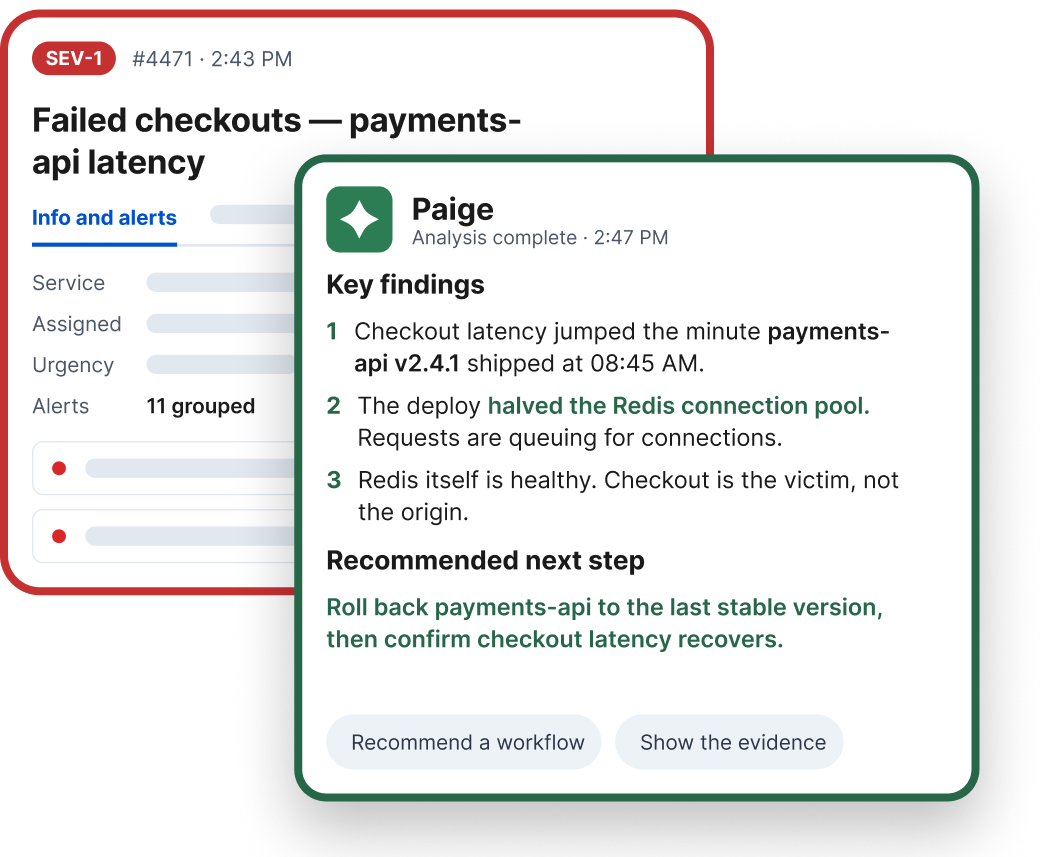
Paige, PagerDuty’s SRE Agent, is built to take on the toil across every step of the incident lifecycle. Paige goes on call like any other responder on your team, so the first responder on your 3 a.m. incident doesn’t have to be a lone engineer. Instead of scrambling when the notification lights up your phone, you start with answers.
Picture an early morning outage in a health care provider’s web application that takes down patient portals and scheduling. Before anyone’s awake, Paige checks past incidents, pulls the logs, and traces the problem to a memory leak from a shared library upgrade three weeks earlier. Guardrails keep Paige from taking action without a human in the loop, so Paige brings the right people together in Slack and Zoom and activates the Scribe agent to capture key moments from the conversation. When the incident commander opens the incident, they see results of diagnostics that Paige has already run pointing to the probable culprit. From there, Paige recommends the fix, the service owner on-call approves, Paige runs it, and services come back online.
Then the flywheel kicks in. Paige drafts the post-incident review and saves what worked (and what didn’t), storing it in shared memory on the platform, so the know-how that used to live in a few people’s heads becomes knowledge the whole team – both humans and agents – can use. That’s how Paige turns tribal knowledge into prevention. That’s how you’ll ultimately achieve autonomous operations. It means Paige learns on the job, and your team decides, incident by incident, when Paige has earned the permission to run a fix in the future without approval. For known problems with a proven fix, that can mean one less 3 a.m. wake-up. Paige earns your trust with every interaction.
Build resilience and prevention with the PD Reliability Platform
There’s no shortage of AI agents promising to help with incidents. Most are standalone SRE agents, some were spawned from observability tools, while others are really AI coding agents that don’t know prod or your incident history. Each adds one more thing to buy, connect, and babysit, working only from the limited data they can see. Paige isn’t a bot bolted onto your stack. Paige works as part of the PD Reliability Platform, our new flagship offering, using the code, docs, runbooks, service topology, escalation policies, and Slack and Teams incident workflows your team already runs on. Paige builds a true picture of your ops and organization, with a new Console acting as an integrated command center, creating a bird’s-eye view of what’s happening.
The PD Reliability Platform offers an integrated experience for incident detection, investigation and resolution by blended teams of agents + humans. It learns from every incident to continuously improve developer and responder performance and prevent future disruptions before they happen. Paige is activated by Signal Intelligence, orchestrates Incident Management and applies Automation to every stage of the process. Complex signals from all your tools are synthesized without tab hopping. You can run the whole incident in Slack or Microsoft Teams, with agents and humans collaborating as one team. And each engineer can dive deep into investigations in your favorite AI tool via MCP. Post-incident reviews are drafted for you, and follow-up tasks come with owners and due dates so that the same incident doesn’t happen twice.
And to celebrate the launch of PD Reliability Platform, we’re making it easier than ever to get started with Paige using these AI capabilities. For qualified Essential, Plus, and Ultimate plan customers who sign by Jan 15, 2027, additional AI actions beyond seeded amounts are included for one year at no additional cost. This means you can experiment, learn, and improve.
Stay ahead of what’s next with PD Labs
AI moves faster than any release cycle. To keep up, developers need new tools early and they want a hand in how those tools take shape. That’s why we built PD Labs, our new innovation center where you can collaborate with the best minds to tackle the emerging challenges and opportunities presented by AI.
In PD Labs, you put experimental features to work as a part of your incident management process, tell us what works for you, and connect directly with the designers and engineers building them. Not every experiment will make it out of Labs. That’s the point. The ideas that hold up will make their way onto the PD Reliability Platform. Any PagerDuty customer is welcome to sign up.
PD Labs launches with three experiments, including Topology, Deep Investigation, and SRE Workbench.
- Topology builds and maintains a live map of your services from your code, infrastructure, and runbooks. When something breaks, you can see what’s affected at a glance – your code, your infrastructure, your SRE agent.
- Deep Investigation has Paige test several root-cause hypotheses in parallel. It ranks them by confidence, names the most likely cause, and shows its reasoning, including what it ruled out and why.
- SRE Workbench is where you and Paige investigate side-by-side from the same evidence, map, and timeline. Watch Paige’s reasoning unfold in real time, and steer it as you go. When a teammate drops in new information, ask Paige whether it changes anything, and the answer lands on a shared timeline everyone can see. Once the incident is resolved, Paige writes the remediation back into memory, so the next time that failure pattern shows up, it already knows the fix. It’s trust, transparency, and visibility, right in your workspace.
Try out experiments in PD Labs and find out more here.
The next chapter
If you hold the pager, we know being on-call can be hard. But choosing the right tools helps improve reliability in your organization with less toil. In the AI era, Reliability = Resilience + Prevention: getting ahead of incidents instead of reacting to them, recovering faster with Paige working as part of your team every step of the way, from first signal to confirmed fix, and ultimately hardening your system to prevent the next incident. PagerDuty stands with the teams who keep software and businesses running today, as we have for over 16 years, through your applications moving to the cloud, shifting to mobile, and now AI. Whatever comes next, you don’t have to carry the pager alone. PagerDuty is with you every step of the way.
Check out all of these announcements and what we’ve launched on our What’s New page. From there you can try Paige, learn more about the PD Reliability Platform, sign up for PD Labs, or talk to your PagerDuty team about shifting more of your toil to AI and automation to free up your teams for building and innovating.
This blog contains forward-looking statements, including the expected availability of new functionality. These forward-looking statements are not guarantees of future performance and involve significant risks that may cause our actual results to be different from the results expressed or implied by these forward-looking statements. For a complete description of such risks, we refer you to the Company’s most recent Form 10-K and subsequent filings with the SEC, available for review at the SEC’s website at http://www.sec.gov.