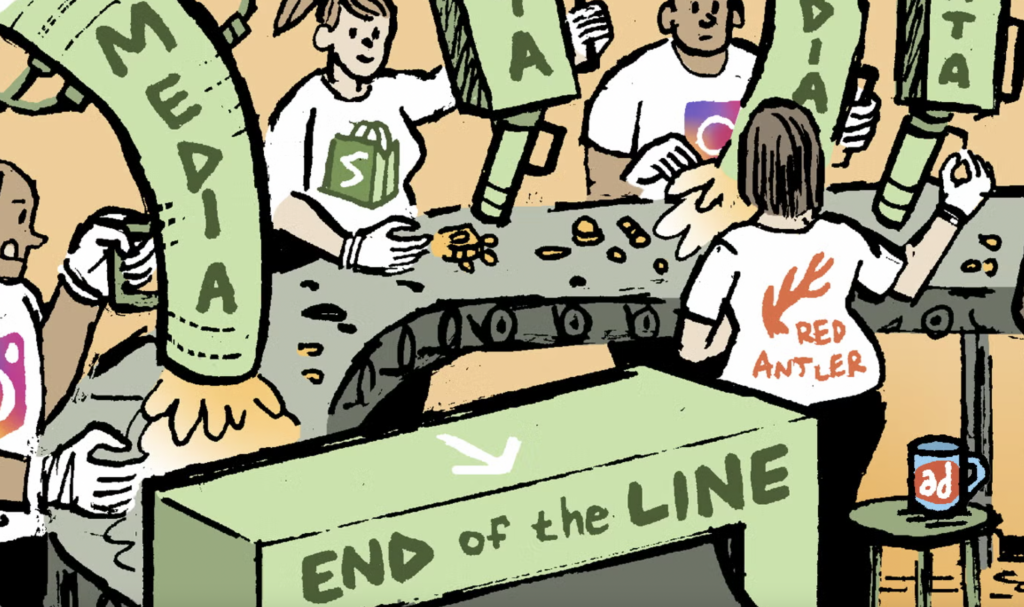
Reddit And Weep
Marketers are waking up to how useful Reddit can be for influencing consumer preferences. Now, they’re taking a more active role in guiding community conversations around their brands.
The strategy is becoming prevalent as Reddit’s licensing deals with Google and OpenAI have made it the most-cited source in LLM responses and product recommendations.
Redditors, however, are not thrilled by the growing brand presence in their discussion threads. And brands are bumping up against attempts by Reddit moderators to keep these discussions organic, The Wall Street Journal reports.
Some Reddit mods crack down on any attempt by brands to steer the conversation outside of their own paid ads. Others allow brands to participate solely in specific threads or on certain days of the week.
But none of this has stopped GEO firms from pitching Reddit comments as a lever for both consumer sentiment and AI results – although Reddit itself pooh-poohs the idea that a well-placed Reddit comment can steer AI responses.
“There is no guarantee that what is on Reddit will make its way into LLMs, and we question the legitimacy of any provider suggesting they can,” a Reddit spokesperson recently told AdExchanger.
Still, just last month, Reddit announced new automated tools for catching marketing spam and bot-driven, inorganic content.
Shop Till You Data Drop
A lot of online shoppers abandon their carts because they never planned on buying anything in the first place; they just wanted the experience of browsing.
In South Korea, the practice has led to the development of “dopamine sites,” or fake portals where users can pretend to order food and other products without actually spending any money.
As Rest of World notes, retail therapy holds plenty of appeal for consumers. And, true to the “dopamine” moniker, these sites allow users to engage in all the gamified elements of modern online shopping, from comparing reviews to clicking buy and tracking packages, without any of the commitment.
Which isn’t to say that these sites don’t contain their own deceptive patterns and familiar monetization models. Many seem to be collecting user data, same as the real ecommerce sites. And, of course, advertising is rampant.
One of the more popular dopamine sites, FoodNeverComes, is itself a form of marketing for an anti-addiction app called RewireHeaven. It also features ads via Google AdSense, according to its privacy policy. Another, Dopamine Shop, collects information from logged-in Google accounts and has a casino page that allows users to earn credits by – surprise! – watching ads.
Bye-Bylines
Dakota Carrasco doesn’t employ any journalists, but that hasn’t stopped him from running a “newsroom.”
The San Francisco Chronicle has an unsettling profile of Carrasco, a 27-year-old BlackRock portfolio specialist, who, in March, launched The Dissent, a San Francisco news site staffed entirely by Claude-powered AI agents “covering” City Hall, sports, food and tech. It produces 30 to 40 articles a day.
Running The Dissent costs between $300 and $750 a month in server fees and AI tokens, and it generates no revenue – yet. (Carrasco’s girlfriend is footing the bill.)
The business model, such as it is, relies on scraping and summarizing work from the SF Standard, Mission Local and the Chronicle, usually without attribution. One “story” The Dissent published condensed a 7,000-word Standard investigation into 400 words and didn’t even mention the original.
The Dissent isn’t alone. It’s just one example of the “pink slime” oozing into local news markets, including Prism News, an Israeli startup with four employees that runs more than 200 AI-generated local news sites across the US.
Not great. But here’s the worst part: AI search engines, primarily Perplexity, are already citing The Dissent. The circle isn’t just vicious; it’s insidious. Human reporters produce journalism, AI scrapes and republishes it and then AI chatbots cite the scrape as a source.
The snake is choking on its own tail.
But Wait! There’s More!
European publishers experience more unauthorized AI scraping of their content than US pubs – and they get cited less in AI responses to boot. [Digiday]
A California regulator approved the $34.5 billion merger between Charter and Cox after the companies agreed to some concessions. [The Wrap]
The MLB’s Field of Dreams game, which took place Thursday, is being criticized for featuring on-field sports betting ads – despite the original “Field of Dreams” story including players from the 1919 Chicago White Sox who were banned for betting on baseball. [Gambling Harm]
Google now allows users to remove a visible watermark from AI-generated images and other content, but will retain metadata that labels the content as AI. [TechCrunch]
Twitch is opting streamers into AI training deals by default and won’t label which streams are opted in. So streamers are creating their own AI opt-out labels. [Aftermath]
Apple proposes a 15% commission on in-app purchases made on iOS devices using non-Apple payment services, and a 10% fee for subscription renewals. [TechCrunch]