Part 1 of a short series on rebuilding PubHub with AI-assisted development. This part covers the decisions and results; the engineering detail lives in the companion AI for SDLC series.
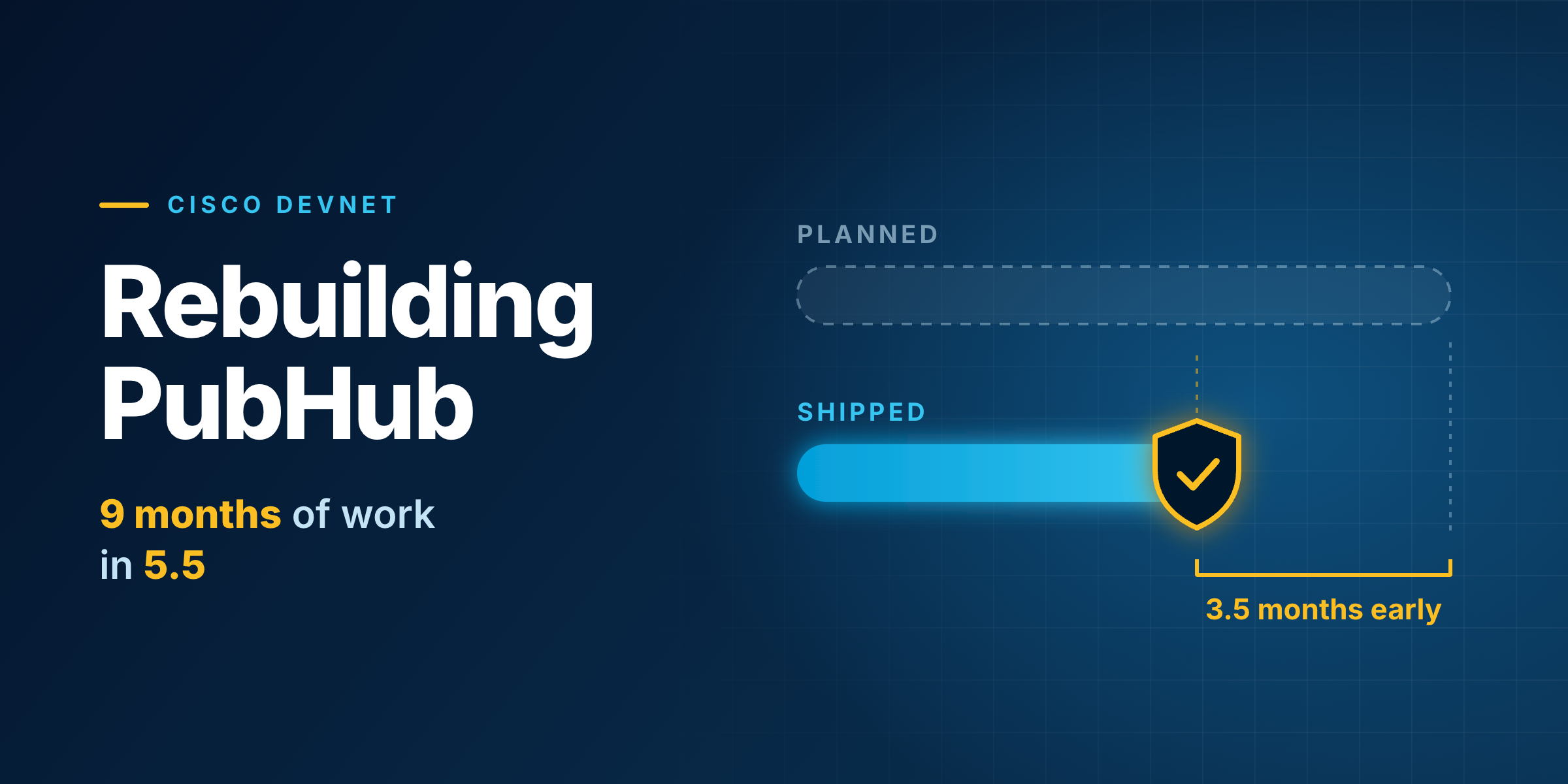
In early 2026, a security mandate forced the PubHub team to rebuild on a new stack, and the plan allowed nine months. It shipped in about five and a half using AI-assisted development: 12 engineers producing the output of about 20.
PubHub is the publication tool behind Cisco DevNet’s developer content: API documentation, Learning Labs, DevCenters, and Microsites, for the teams who create it and the developers who use it. Authors depend on it daily. Nobody asks for a rewrite of something that already works, and nobody forgives one that breaks their publishing workflow.
InfoSec and the Security Insight team made it mandatory for PubHub to meet Cisco security standards, and the existing application could not get there as built. Compliance meant rebuilding in Golang. Work began in April 2026, and the approved assessment put completion at the end of December.
PubHub is an internal tool, not a product Cisco sells, so nothing here is a pitch. The AI tools involved (Claude, Copilot, and Cursor) are commercially available, not custom builds.
Who this is for
- Engineering leaders deciding whether AI-assisted development changes a schedule enough to re-plan.
- Teams facing a rewrite they did not choose and wanting an adoption order that worked.
- Product and program owners who suspect faster engineering creates a bottleneck on their side. It does.
Doing it by hand showed what not to do
Last year the team started a migration pilot by hand, the way most rewrites start. But a rewrite is not translation. Every module forces a decision about what to preserve, redesign, or drop.
The pilot was dropped after an early proof of concept (PoC): The manual effort was too high to finish at that pace. It settled one question: Hand conversion was not the way.
The AI IDE’s biggest win was understanding the old system
Next came Cursor and VS Code. Instead of reading legacy code line by line, the team had the AI IDE generate a detailed architecture and component design reference for the existing application. An early PoC of the new PubHub was then built from that reference with Cursor, not by hand.
Daily coding gains were real but incremental: faster navigation, fewer context switches, less friction. Typing speed was never the bottleneck.
Agents arrived in June, and the burndown changed
The next shift came from outside. New DevNet and OSPO leadership set an Agentic eXperience (AX) direction, pushing every team to build with AI agents, Claude in particular. PubHub became a proving ground; Claude joined its workflow in June 2026.
An AI IDE writes a function or class on request. An agent reads a requirement, its user stories, and its specification, then develops the full feature, test cases included.
Testing is where rewrites usually lose their schedule: port a module, then spend days proving it matches the old one. Now engineers reviewed and corrected generated tests instead of writing them. An AI-driven framework compared old and newly generated documentation, and AI-driven, Playwright-based automation replaced manual interface testing.
The burndown chart showed it: Modules that had taken a week began landing in days.
Faster code moved the bottleneck upstream
When engineering accelerates, the bottleneck moves upstream. Faster code needs requirements and acceptance testing that keep pace. Without both, a team simply waits sooner.
On PubHub, the DevNet documentation lead removed that bottleneck: bringing feature requests, defining what each needed, and testing each one once built. The role sat nominally on the business side; in practice it was the work of a seasoned product manager.
The documentation lead also used AI to write more detailed, cohesive feature requests. Engineering sped up through Claude, requirements sharpened through AI, and neither side waited on the other.
Presence mattered most. The documentation lead sat in on every step of development, not just the hand-off at the start and acceptance at the end. Questions got same-day answers, ambiguity died before it became rework, and drift was caught while the fix was cheap. Teams often call that optional. On PubHub it was load-bearing.
Designing from workflows, not a blank canvas
The design team worked in parallel, updating requirements as the rebuild went. The interface came from AI-generated designs grounded in detailed user stories of real workflows, giving the designs a standard to meet. A tool that satisfies InfoSec but frustrates its users is not a successful migration.
Moving the date up on evidence, not enthusiasm
By midsummer the throughput signal was strong enough to move the target from end of December to end of August. It was an uncomfortable call: getting it wrong would have cost the team credibility on every later estimate. So program management held the team to evidence rather than enthusiasm, tracking throughput across several sprints before committing.
The new PubHub reached production in mid-September 2026, shortly after the revised target and roughly three and a half months ahead of the original December plan.
What AI-assisted development did to the schedule
Nine months of planned work shipped in about five and a half: a 39% schedule reduction against the team’s own pre-AI estimate.
- Effort: Nine planned months across 12 engineers is 108 engineer-months. The team shipped that scope in roughly 66.
- Headcount: A September delivery at the original pace would have needed about 20 engineers. AI-assisted development covered the work of roughly eight more, and nobody joined the team.
- Quality: PubHub has had no major issues since reaching production. Heavy automated test coverage made fast and stable possible at once.
The caveat: Claude arrived in June, not April, so the first two months ran at the pre-AI pace. The 1.64x throughput gain is a whole-project average; after June it ran higher.
Four lessons for other teams
- A compliance mandate is a good forcing function. The re-architecture had been deferred across several planning cycles. The mandate removed deferral as an option, and the result beats what a voluntary rebuild would have.
- Point AI at several places, not one. Organizational direction opened the door, but placement decided the return: legacy understanding, code, tests, requirements, and design. No single use carried it.
- Re-plan when the evidence changes. The easy path was keeping December and looking like heroes in September. Announcing an earlier date gave calendar time back to every team waiting on PubHub.
- Leave room for new capability. The rebuild was not a one-for-one migration. Automated best-practices validation for documentation shipped with it, so reviews that once cost leads days of manual reading now run on every build.
Credit where it belongs
- Architecture lead: shaped the design of the rebuild.
- Engineering lead: drove development and implementation.
- Program management: kept the re-forecast grounded in data.
- Documentation lead: supplied AI-sharpened feature requests and tested what the team built.
- Design team: set the requirements and shaped the interface around user workflows.
Tools accelerate good teams; they do not replace them. The judgment about what to rebuild, what to discard, and how far to trust the new pace came from engineers who knew the system.
Next: The engineering, in AI for SDLC
The AI for SDLC series covers the implementation in four posts:
- Code review: how review holds up when AI writes code faster than humans can read it.
- Testing: framework design, old-versus-new documentation comparison, and Playwright interface automation.
- Code generation and IDE evolution: from an IDE that writes a function to an agent that builds a feature from a user story.
- Interface design: generating and refining interfaces from written user stories.
PubHub is live, compliant, and faster to build on. Teams publishing through it notice a much better, more intuitive tool. What they don’t notice: The backend underneath is completely new. The next part of Rebuilding PubHub picks up from there.