TL;DR #
- GitHub’s own runners do the scanning: React2STEAL uses GitHub Actions runners in hijacked accounts to scan for vulnerable Next.js servers and exploit React2Shell (CVE-2025-55182) and CVE-2025-29927.
- Stolen .env files land in public repos: On each compromised server, it collects environment variables, .env files, cloud and Kubernetes credentials, and AI provider keys. It then commits the stolen data to public GitHub repositories.
- Every reachable secret counts as exposed: Victims need to treat every secret their server process could access as exposed. GitHub account owners also need to revoke the credentials that allowed the attacker access.
On Nov. 18, OpenSourceMalware published research on a campaign it named React2STEAL. They identified 45 repositories across 44 GitHub accounts that are actively running GitHub Actions workflows that scan the internet for vulnerable Next.js servers. Once a server is compromised, the stolen credentials are committed to public GitHub repositories.
This is a perfect storm of attackers leveraging multiple factors against their targets: the vulnerabilities have been known for many months, the attacker is using someone else's infrastructure, and the stolen credentials are available to anyone who finds the repositories. The GitHub accounts behind the campaign have also appeared in earlier attacks. You can find the full research here.
Let's take a closer look at what is happening with the React2Shell vulnerability and what you can do to counteract this campaign.
How React2STEAL turns GitHub Actions into a React2Shell attack platform #
To use this attack infrastructure, someone commits a list of target hostnames to a repository. That is the full human interaction needed before firing off the workflow. The workflow named scan.yml runs on a GitHub-hosted ubuntu-latest runner. GitHub's own compute does the scanning. There are no AI tokens needed.
Researchers describe a prefilter script that runs up to 400 concurrent requests to identify hosts likely running Next.js. Two exploit scanners fire next, each handling 250 targets at a time. The script tries seven variants of React2Shell, the CVE-2025-29927 middleware header bypass, and a server-side request forgery through /_next/image that attempts to retrieve AWS role credentials from the instance metadata service.
React2Shell is an unauthenticated remote code execution flaw in React Server Components with a CVSS of 10.0. This has been known for nearly a year, since the disclosure of CVE-2025-29927. This issue lets a crafted X-Middleware-Subrequest header bypass Next.js middleware. Fortunately, patches for both have been available for months. Unfortunately, they have not been universally applied, as this attack proves.
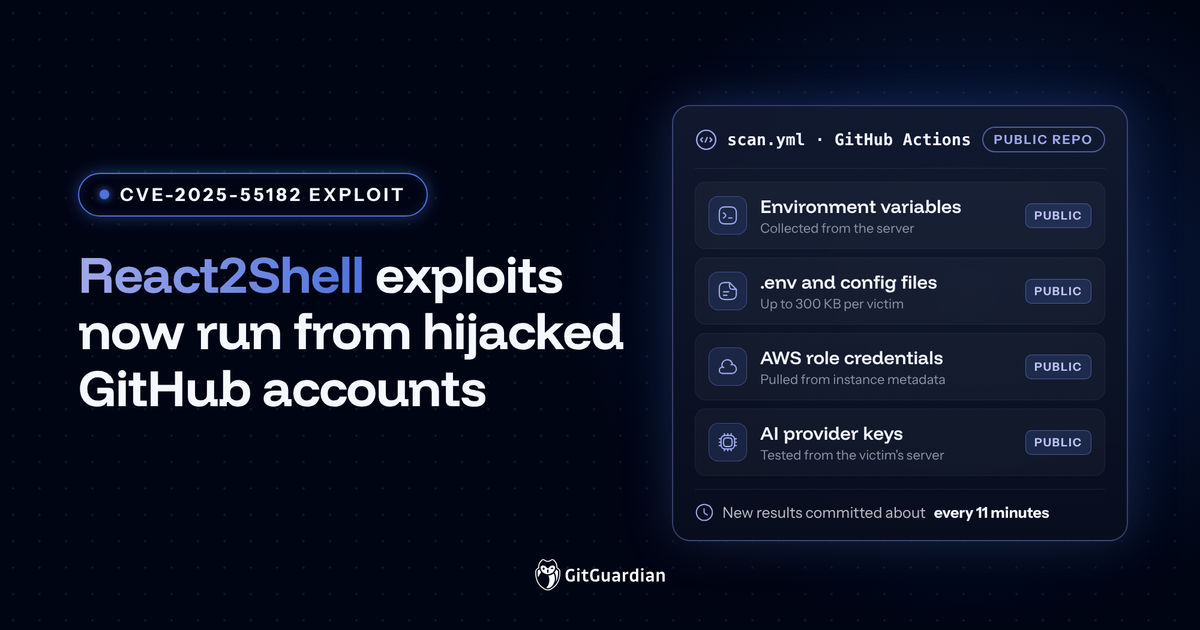
When an exploit succeeds, another script collects environment variables, cloud and Kubernetes credentials, and network details. Variants were also found that grabbed .env and config files, collecting up to 300 KB per victim, leveraging the victim's own server, then testing any AI keys it finds, making them harder to distinguish from normal server traffic.
Resulting exposed secrets are saved on the runner as plaintext, JSON, and ZIP files, which the workflow then adds to a commit on a public repository. Anyone with knowledge of what to look for can easily clone or download these files and secrets.
How widespread is the React2STEAL campaign? #
This is an ongoing situation, and OpenSourceMalware continues its research, but as of the time of this writing, live repositories were found to hold 1,281 unique victim hostnames across roughly 1,100 domains. A snapshot of 11 repositories contained about 9,100 ZIP archives, 3,800 JSON files, and 3,000 plaintext records, totaling roughly 7.4 GB of stolen data. Researchers consider those numbers a minimum.
As of Nov. 17, new results were still being committed about every 11 minutes.
A hard-coded Telegram bot appears in one of the scripts, but its sending function is disabled. The observed workflows use public GitHub repositories as their exfiltration channel.
Why stolen credentials on public GitHub are harder to contain #
Most credential stealers send data to an attacker-controlled command-and-control server. React2STEAL pushes it to public GitHub repositories, where anyone searching the commits can find it, much like we saw in the Nx Singularity attack. Database URLs, Stripe keys, and AWS credentials stolen from one victim can now be accessed by other attackers who know where and what to look for.
Unfortunately, just deleting the repository doesn't undo the exposure and eliminate the danger. OpenSourceMalware recommends searching for exposed data by file content rather than repository name, since forks, clones, and scrapers may retain copies long after a takedown. If anything was exposed, your only real remediation path is revoking those secrets, hopefully in a way that does not cause further issues for your organization.
Both defenders and attackers monitor public GitHub for leaked credentials. Some entities, like GitGuardian, do it to help protect the public internet. Other actors have other motives, sometimes nefarious ones. Once a secret appears in a public commit, it should be treated as compromised.
React2STEAL reuses GitHub accounts compromised in earlier attacks #
React2STEAL isn't starting from scratch; the GitHub accounts used in the campaign had also been involved in wfx-loot. A full 25 React2STEAL repositories the OpenSourceMalware team reported on contain the same probe file that wfx-loot used before deploying its stealer. One account was also known to be involved in the PolinRider and GhostAction campaigns.
This echoes what GitGuardian's researchers had written about on wfx-loot, where they documented 28,500 payload patches across 17,715 public repositories and 2,367 accounts. Roughly 20% of those accounts (431) had already been compromised in the earlier GhostAction campaign. It is worth noting that GhostAction itself came back, modifying 92 workflows left behind from previous waves. By Oct. 5, only 16% (124) affected repositories had been effectively cleaned up.
This is a growing pool of compromised accounts that attackers can potentially use again and again at their convenience. A stolen GitHub access is turned into infrastructure for another campaign. This time it is running exploits against other people's servers.
This is definitive proof that incomplete cleanup leaves the door open for further abuse.
A compromised server can expose credentials across the stack #
The data collected is what keeps the applications running. Environment variables, payment keys, cloud credentials, and AWS credentials are actively being found and exploited in these attacks. What we are really seeing is a new wave of attack against he credential layer, exploiting every surface where a secret can live or be found. This layer includes repositories, pipelines, and vaults, but also servers, developer endpoints, collaboration tools, public code, and AI workflows.
While we focus on code for most 'secret sprawl discussions, it is just one element. Unfortunately, tools that were most traditionally applied to the stack focused on a narrow piece of this attack surface. The WAF may detect the unusual requests but not notice a curl request that presents an expected user agent holding a real key. The vault protects the original secret, but may not see copies in the server's runtime environment. Cloud posture tooling sees the role and its permissions, but won't necessarily know that its credentials have ended up in a public ZIP file on GitHub. This incomplete picture is how 28% of secret incidents are discovered entirely outside code repositories, which is what the GitGuardian State of Secrets Sprawl 2026 found. No matter how the secret became copied into plaintext, attackers expect it is inevitable they will be able to find and exploit it. React2STEAL shows how quickly credentials can move from a running server into public code, all within a single workflow run.
How to respond to a React2STEAL exposure #
Two groups need to act: organizations running vulnerable Next.js servers, and anyone whose GitHub account is hosting a React2STEAL repository.
- Patch React and Next.js right now. Until that's done, strip or reject
x-middleware-subrequestat the proxy or WAF. - Check request logs for published indicators, including repeated
x-middleware-subrequestheaders and/_next/imagerequests pointing at the metadata address. - Treat every secret the server process could access as likely exposed. Revoke and reissue those credentials, then review cloud and AI key usage since the earliest possible compromise.
- Enforce Instance Metadata Service Version 2 (IMDSv2), a session-oriented security hardening for EC2 instances, to help protect AWS metadata credentials from simple request forgery.
- For any affected or exposed GitHub accounts, revoke personal access tokens, OAuth and GitHub App grants, and SSH keys as soon as possible. Check for unknown or unexpected repositories, branches, and workflow runs.
Servers pull credentials from multiple sources at deploy time, and few teams have a complete inventory of what ends up there. Revoking only the obviously exploited keys can leave others valid and exposed. We must assume any exposure has exposed all of them. Rotation and revocation is the safest path.
GitGuardian finds and helps teams contain exposed credentials #
React2STEAL illustrates why organizations need visibility into credentials across more than just their repositories. GitGuardian helps teams find exposed credentials across the surfaces involved in this attack, understand the risk, and prevent new exposures. We focus on three ways to address credential layer security: detection, remediation, and prevention.
We are helping teams detect secrets across the full spectrum of surfaces, including Public Secrets Monitoring for GitHub and Docker Hub. With our platform's identity stitching, we can find leaked credentials and attribute them to the organizations they belong to, even when they appear in someone else's repository.
GitGuardian's Internal Secrets Monitoring extends that same protection across private repos, CI/CD, and container images, helping teams identify exposures across their own environments.
Now with Developer Endpoint Protection, the same powerful detection is extended to where plaintext secrets are most commonly stored in the enterprise.
When it comes to remediation, we are helping teams streamline their processes to get to rotation and revocation as fast as possible: Validity checks help distinguish active credentials from those that can no longer be used. GitGuardian Exploration Map adds identity context, including ownership, permissions, and access, so teams can prioritize the credentials that pose the greatest risk. Incident grouping, automated routing, and bulk actions help teams resolve exposures without working through every finding manually.
But ultimately, the best way to protect your organization is to prevent a secret from becoming plaintext in the first place. This is where ggshield comes in. Our command-line interface catches secrets at pre-commit, push, and CI, before they reach shared repositories and pipelines. Now, with AI hooks, developers and whole organizations can prevent AI from leaking or abusing secrets.
While these controls don't prevent the server exploits used by React2STEAL, they help reduce the number of credentials exposed through development workflows and ultimately deployed into applications.
React2STEAL shows the lasting risk of unrevoked credentials #
React2STEAL is built from known issues and is not a brand new concept. It is just automation of the abuse of known vulnerabilities, unpatched servers, and GitHub accounts compromised in earlier campaigns. Together, they're enough to run a credential theft operation on someone else's compute and publish the results for free.
The fixes for these issues are already known and available. Applying these patches just takes prioritization. Start with credentials that you know exist. Figure out where copies live and which ones are already public. That is your prioritization list. The attacker's work is automated. The defender's inventory has to be too.
Run a free GitHub Security Audit to see how exposed you are to abuse of your public-facing credentials.
FAQ #
What is React2STEAL? #
React2STEAL is a campaign that uses GitHub Actions workflows in hijacked accounts to exploit Next.js servers vulnerable to React2Shell (CVE-2025-55182) and CVE-2025-29927. It then commits stolen credentials to public repositories.
What credentials does React2STEAL steal? #
The campaign collects environment variables, .env files, and config files from compromised servers, along with AWS role credentials from instance metadata and Kubernetes tokens. Database credentials and AI provider keys are among the data collected.
How do I know if my Next.js server was hit by React2STEAL? #
  Check request logs for the published indicators, including repeated x-middleware-subrequest headers and /_next/image requests pointing at the metadata address.


  If you find them, treat every secret the server process could access as exposed, then revoke and reissue those credentials.
Does deleting the repository remove the exposure? #
No. Copies may remain in forks, clones, and scrapers. Exposed credentials must be revoked and reissued.
Is React2STEAL related to wfx-loot? #
OpenSourceMalware found that some of the same GitHub accounts were used in both campaigns. Whether the same operator is responsible remains unknown.