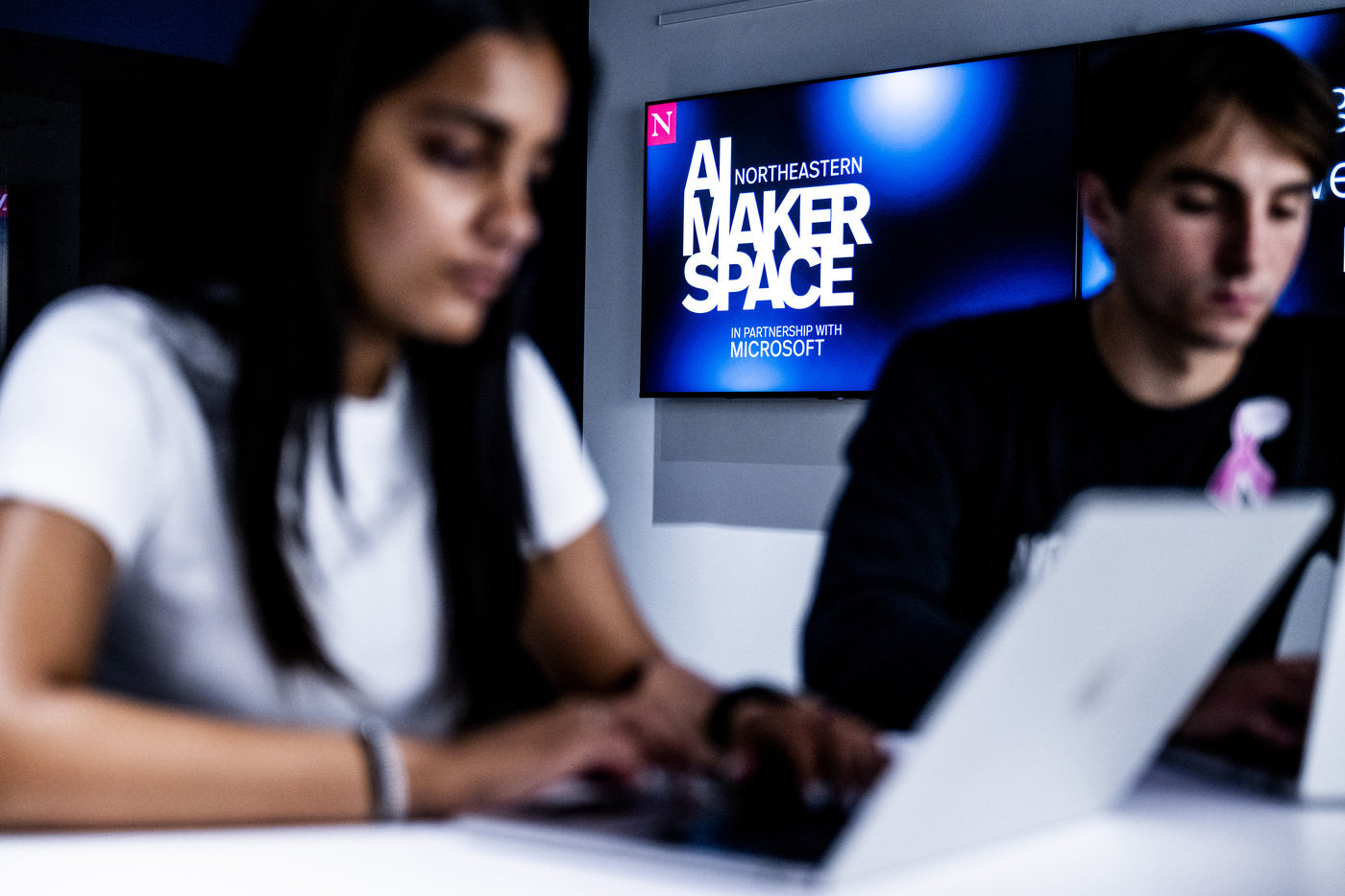
Here at the new AI Makerspace, in partnership with Microsoft and located in Snell Library on the Boston campus, test out a new prototype or ask a burning question.
The new sight on the first floor of Snell Library made Austin Schlather with curiosity.
Tucked away to the left of the library’s security turnstiles is a sleek and inviting sandbox of sorts, where students, faculty and staff can drop in with questions, curiosity or half-baked ideas all about artificial intelligence. All you need is yourself and your phone, tablet or laptop.
The AI Makerspace, a first-of-its-kind partnership with Microsoft, will host a grand opening at its location on the Boston campus on Thursday, Sept. 24 and Friday, Sept. 25. Afterwards, the space will have regular drop-in hours on weekdays from noon to 4 p.m.
Schlather, a 19-year-old freshman studying mechanical engineering, stopped by the AI Makerspace during its soft launch on Tuesday to learn more.
“A lot of people are scared of it, but I think really to excel in any program, you have to be the best at using AI,” he said. “If you don’t know how to use it, you’re falling behind already.”
He uses AI mostly to “vibe code,” which refers to using artificial intelligence and large language models to write code to test out ideas for things like apps or bots. One lighthearted project he had was building an AI bot to help him finally defeat his mother in a game of Othello, a two-player strategy board game. He hopes he can use the space to get better at coding, build different AI models and hear from industry leaders about their takes on the future.
“Northeastern’s not one of those schools that steps away from it or (is) scared to use it or talk about it, but one trying to lead their students on the right path, which I think is really cool,” he said.
The purpose of the AI Makerspace is for anyone in the Northeastern community, regardless of their expertise level or their preference for other AI tools like Claude or ChatGPT, to become more fluent in artificial intelligence and do things like draft an outline or make their own agent to automate tasks.
Megan Madel, Vice Chancellor of Strategic Planning and Projects described the site as a “come-as-you-are” place.
“We’ve talked a lot about how we want students who are AI fluent in the past. Now, what we’re saying is we want students who can orchestrate and manage and lead AI,” Madel said.
During drop-in hours, you’ll likely be met by Steven Legg, the operations manager for the AI Makerspace. He had worked at a traditional makerspace at his undergraduate university, one filled with tools like 3D printers and laser cutters.
“For me, it was a super safe space. It was a really awesome space where social entrepreneurship, personal ambition and technology really intersected,” he said. “I just want students feeling like this is a place they can just stop by quick and it’s not full of friction. It’s somewhere they can just come in, get some help, work on their ideas and leave and talk to their friends about it.”
The space will also host workshops and trainings geared toward both students and members of the faculty and staff where they can learn how to go from prompt to prototype, use AI to personalize the job search and brainstorming new teaching strategies. Experts and leaders in the space will be invited to share what they know, including during a career panel on Thursday, Sept. 24, at 5 p.m.
During the Sept. 28 grand opening, students can participate in AI prompt escape rooms, hands-on demos and an innovation challenge that comes with prizes.
The makerspace will adapt to what the Northeastern community wants, needs and “how they see the world,” said Tim Weidinger, a campus learning specialist with Microsoft.
“The potential for artificial intelligence … and its ability to help grow the employment opportunities for the students that come through these walls , I think that it’s mission critical to have not just foundational knowledge, but to really embrace this technology,” he said.
Soumya Ganesh, who recently graduated with a master’s in information systems, had never seen anything like the AI Makerspace. The 28-year-old is hopeful that the venue will allow her to collaborate on software development, learn a new skill or meet like-minded people from whom she can learn, she said.
Ganesh uses Claude daily, mostly to analyze her resume for her job search or to learn about new topics. Recently, she queried Claude to explain to her Spring Boot, the open-source Java framework, in a step-by-step manner using flow diagrams, since she is a visual learner.
“Even though everyone says that they use AI in daily life, I just want to know how we can improve our daily life itself,” said Ganesh, who’s most interested in learning how to build her own agent to accomplish this endeavor.