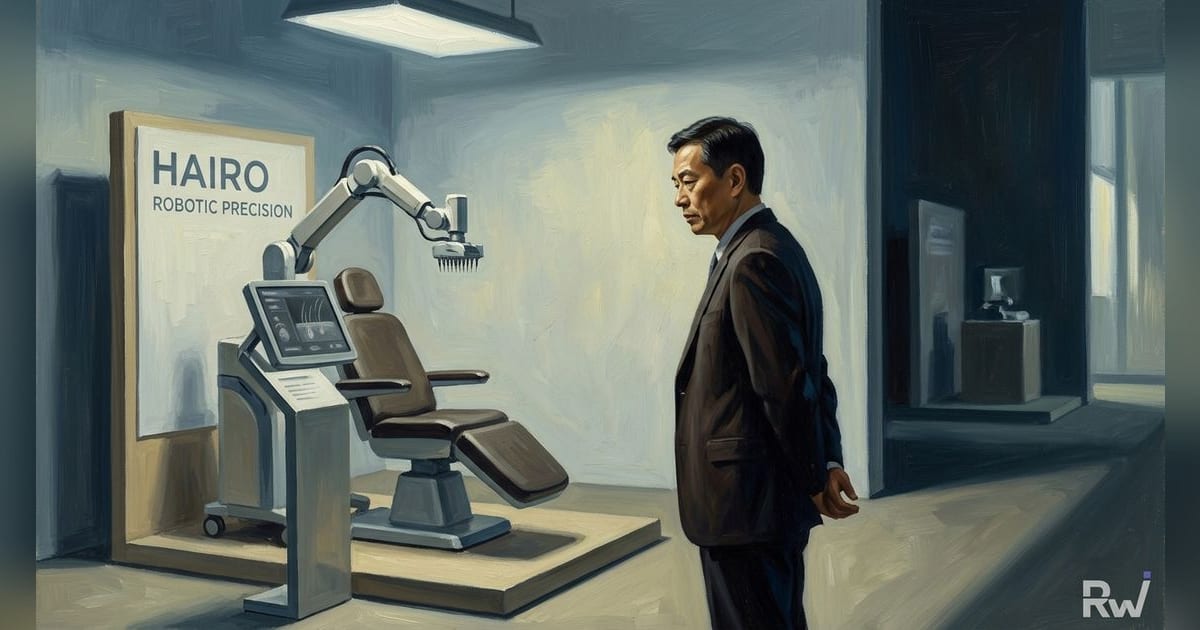
Puncture Robotic used its July 10th PR Newswire release to recast a late-May medical conference demo in Seoul as the next step in founder Zhang Zhaodong's larger bet: hair transplantation is a precision robotics market before it is a beauty-services market.
The Shanghai company said its HAIRO Hair Transplant Robot drew attention at the 14th World Congress for Hair Research, or WCHR 2026, where Puncture Robotic promoted a system that combines AI-assisted hair assessment, surgical planning, computer vision, robotic follicular-unit extraction and postoperative management. The timing matters. WCHR 2026 ran from May 28th to May 31st at COEX in Seoul, so the July 10th release is not a same-day product debut. It is Puncture Robotic's international positioning push after a domestic regulatory win and an April financing.
Zhang, identified in Chinese public materials as Puncture Robotic's founder and CEO, is a robotics operator who moved into hair restoration after earlier work in puncture robotics. Public profiles describe him as a 1992-born founder from Wuhai, Inner Mongolia, who studied mechanical design, manufacturing and automation at Harbin University of Science and Technology and later completed an MBA at Cheung Kong Graduate School of Business. Before Puncture Robotic, Zhang worked in the Harbin Institute of Technology robotics orbit, including roles tied to HIT Robot Group and HIT Intelligence.
That background explains why Puncture Robotic talks about hair transplantation as a repeatable motion-control problem. Follicular-unit extraction requires thousands of small, position-sensitive punctures, while clinic economics depend on doctor throughput, graft survival and patient experience. Puncture Robotic's case for HAIRO is that AI and robotic standardization can turn a procedure still heavily dependent on surgeon stamina and technician skill into a more measurable workflow.
The robot claim Puncture Robotic is making
Puncture Robotic says HAIRO is China's first NMPA Class III-certified hair-transplant robot. The company's English materials describe Puncture Robotic (Shanghai) Intelligent Medical Technology Co., Ltd. as a developer of HAIRO hair-transplant robot systems and hair-management products, including AI image-acquisition and inspection devices. The company context also lists National Medical Device Registration Certificate 20253010078 for HAIRO.
A March Songjiang District Government article said Puncture Robotic officially launched its first-generation HAIRO follicle extraction device on March 1st, after receiving what it described as the first domestic Class III medical-device registration certificate for hair-transplant robots from China's National Medical Products Administration. The same article identified He Yundi as a Puncture Robotic co-founder and quoted He saying the project began in 2021, shortly after the company's founding.
Puncture Robotic's July 10th release describes HAIRO as a system spanning the patient journey. A hair-detection device measures and classifies hair loss. An AI mini-program can create visual simulations of possible outcomes. In surgery, HAIRO supports preoperative planning and real-time adjustment, with a machine-learning algorithm that Puncture Robotic says analyzes follicular extraction data and adjusts operating parameters based on follicle structure and scalp condition.
The performance numbers remain company-supplied. Puncture Robotic says the system uses 20-megapixel binocular cameras and millisecond-level image processing, can reach sub-surface positioning accuracy of up to 0.1 millimeters, and can process up to 2,400 follicles per hour. It says HAIRO supports 0.7-millimeter to 1.0-millimeter extraction needles and maintains a follicular-unit damage rate below 7.5% under specified operating conditions.
Its most specific claimed technical edge is a proprietary "Single-Hair Skipping" algorithm. Puncture Robotic says the software identifies and prioritizes multi-hair follicular units while skipping single-hair units when appropriate, and company data show a multi-hair follicular-unit extraction rate of up to 95%. The practical selling point is visual density: extracting follicular units with multiple hairs can produce a fuller look with fewer donor-area punctures, if the clinical performance holds across physicians, scalp types and clinic settings.
That last caveat matters. The July 10th release does not disclose peer-reviewed clinical data, pricing, clinic-level ROI, procedure volumes by customer, revenue, valuation or U.S. and European regulatory status. Puncture Robotic says it is advancing FDA clearance and CE certification pathways. That is a plan, rather than a clearance.
Financing puts international expansion on the clock
Puncture Robotic's global push follows a Series B that the company describes only as a recent multi-million-dollar financing led by a "globally leading AI technology company." Chinese funding coverage in April was more specific on size and still incomplete on identity: Sina Finance, citing Tianyancha data, reported on April 7th that Puncture Robotic had completed a B round at an RMB 100 million-level amount, with investors including an international AI technology company and Lenovo Capital.
Lenovo Capital's own earlier portfolio coverage shows Puncture Robotic had already raised capital before this round. In a September 2024 Lenovo Capital article, the firm said its portfolio company Puncture Robotic had completed a Pre-B+ round of tens of millions of yuan from Egao Capital, and that earlier investors included Shenzhen Capital Group, Lenovo Capital, Jin Yu Mao Wu and Jinshajiang. The same article described Puncture Robotic as a 2019 company incubated in the Harbin Institute of Technology robotics system.
The unnamed Series B lead is the sharpest missing detail in the announcement. Puncture Robotic gets the signaling benefit of saying an international AI company led the round, while readers and potential clinic buyers are left without the name, valuation or strategic rights attached to that money. For a medical robotics company trying to move through FDA and CE pathways, the identity of a strategic backer can matter as much as the check size.
Puncture Robotic is entering a market with a real incumbent
HAIRO is not entering an empty field. In the U.S., the ARTAS System has a long regulatory history. FDA records list the ARTAS System, from Restoration Robotics, under 510(k) number K173358, with a March 16th, 2018 substantial-equivalence decision and a device classification of "Computer Assisted Hair Harvesting System." Venus Concept announced in 2018 that its latest-generation ARTAS iX used robotics, machine vision, AI and machine learning, with claims of faster procedures.
That gives Puncture Robotic a clear competitive lane. The company is presenting HAIRO as a China-approved, AI-driven workflow system adapted to Asian hair-restoration needs, rather than a single-purpose harvesting device. Its product roadmap reinforces that. Puncture Robotic says it is preparing a long-hair extraction version of HAIRO that would allow follicular-unit extraction without requiring patients to fully shave the donor area, a feature aimed at patients who want a less visible recovery process.
Zhang's operating challenge is translating technical throughput into clinic adoption. Hair restoration clinics buy equipment when it improves utilization, reduces labor bottlenecks, standardizes outcomes or creates a marketing edge that patients trust. A robot that extracts quickly on a spec sheet still has to prove it can fit into real clinic economics, surgeon workflows, consumables margins and post-market regulatory obligations.
Puncture Robotic has built the surrounding pieces for that argument. Its company materials describe authentication and query tools for HAIRO-certified institutions and operating physicians, consumables authenticity checks, and training resources tied to the robot. That kind of infrastructure is easy to overlook, but it is essential in medical aesthetics, where outcomes, operator skill and brand trust are tied together.
The Seoul showcase was useful because WCHR put Puncture Robotic in front of hair-research and hair-restoration specialists rather than a general robotics audience. The deeper story is that Zhang is trying to move Puncture Robotic out of the familiar Chinese medical-device progression of certification, hospital pilots and domestic commercialization, and into a harder global contest where regulators, surgeons and patients will demand evidence that the robot makes hair restoration safer, faster or more predictable.
Puncture Robotic has the first part of that story: a certified domestic device, a funded roadmap and a specific procedure that suits robotics. The next part will be harder to write from a press release. It will come from regulatory decisions, clinic deployments, published outcomes and whether HAIRO can compete with established systems outside China.