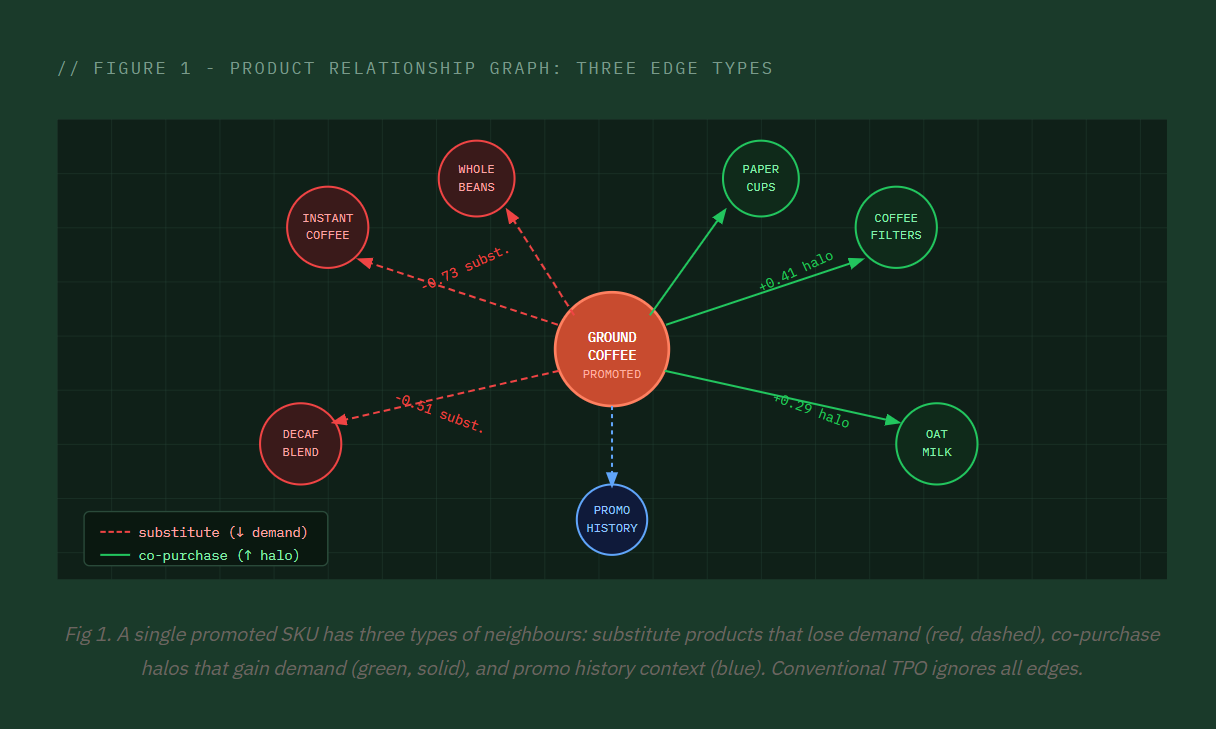
The technical bottleneck is that standard tabular models treat SKU relationships as independent variables. To actually model the ripple effect of a promotion on a category, you need Graph Neural Networks (GNNs). By representing products as nodes and co-purchase patterns as edges, a GNN can propagate the impact of a discount across the entire product graph.
For those trying to implement a similar AI workflow for demand forecasting, the shift from a standard XGBoost approach to a graph-based architecture usually looks like this:
-
Graph Construction: Map SKUs as nodes. Edges are weighted by the strength of the association (lift/support) in historical transaction data.
-
Feature Embedding: Nodes are initialized with static attributes (category, brand, price point).
-
Message Passing: The GNN aggregates features from neighboring nodes, allowing the model to "understand" that a discount on pasta might spike the sales of a specific premium sauce.
-
Prediction: The final layer predicts the delta in volume for both the promoted and non-promoted nodes.
This approach moves the needle from simple "A implies B" correlation to a structural understanding of the retail ecosystem. It's a deep dive into how geometric deep learning handles sparse, high-cardinality retail data far better than flat vectors.
Next Open-Source AI: The Lobbying Conflict →