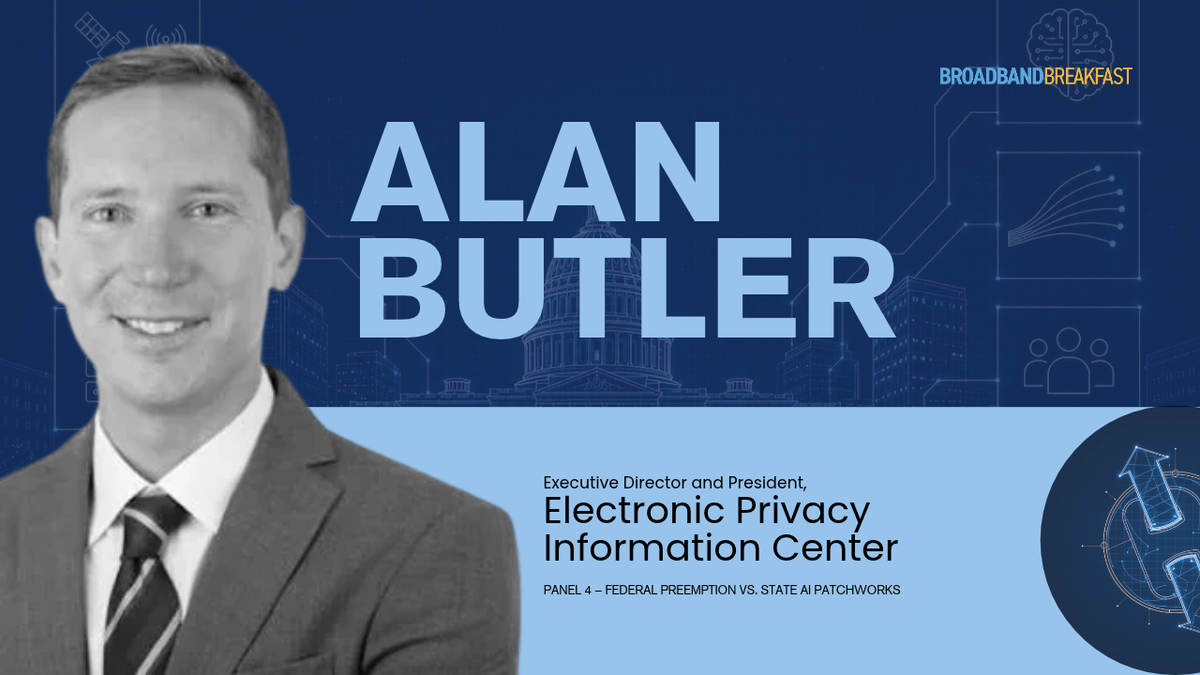
Broadband and AI Alan Butler's group has contested every federal preemption move since December 2025
Broadband Breakfast
WASHINGTON, Nov. 29, 2026 – For a year, the main attempts to override state AI laws have come from an executive order, a framework and a proposed agency statement, none of them a statute. In January the question moves to a Democratic House, where the leading bill is being rewritten to protect stronger state rules.
At each step, Alan Butler, executive director and president of the privacy and civil liberties group Electronic Privacy Information Center, has argued that the administration lacks the power to preempt state law.
He joins the 3 p.m. Dec. 1 panel "Federal Preemption vs. State AI Patchworks," at Broadband and AI in the Next Congress, moderated by Rebecca Kern, senior correspondent at the subscription policy news service The Capitol Forum.
A litigator reads the executive order
A lawyer who joined EPIC in 2011, Butler ran its litigation and amicus program before becoming executive director and president, the post from which he now leads EPIC's case against preemption by executive action.
The Supreme Court cited his amicus brief in Riley v. California in its unanimous opinion protecting cell phones from warrantless searches.
Executive Order 14365, signed Dec. 11, 2025, directed the attorney general to form an AI Litigation Task Force whose "sole responsibility" is to challenge state AI laws. It also made states with "onerous" AI laws ineligible for BEAD non-deployment funds.
The order is "exactly the opposite of what our country needs right now," Butler said the next day. In a Dec. 15 op-ed for the policy news site Tech Policy Press, he wrote that "the president does not have the authority to 'eliminate' state laws or to ban state AI regulation."
Each federal move, answered on the record
The White House's March 20 legislative framework sought a "minimally burdensome national standard." The framework is "light on protection and heavy on promotion of dangerous AI systems," EPIC said in a response that day.
On July 1, the Federal Trade Commission voted 2 to 0 to seek comment on a proposed policy statement. Under that statement, a law like Colorado's AI Act is "impliedly preempted to the extent it conflicts with a federal regulatory scheme." "The FTC does not have the authority to preempt state law," EPIC wrote in July 31 comments.
Colorado rewrote its 2024 AI Act before any court ruled on suits from xAI, Elon Musk's AI company, and the Justice Department. On May 14, Gov. Jared Polis signed a notice-based replacement that EPIC said removes "many important safety and testing requirements."
Wording is the fight
The FRONTIER Act, H.R. 9925, from Reps. Jay Obernolte, R-Calif., and Lori Trahan, D-Mass., is narrower than the executive actions. Its Section 9(b) would bar "new substantive obligations on artificial intelligence developers" in three areas: risk transparency, third-party auditing and incident reporting. Savings clauses keep generally applicable law, rules for deployers and users, protections for minors and state procurement.
Trahan's Nov. 19 section-by-section goes further, calling for "floor preemption." State laws more protective than the bill would stand, while weaker ones or none at all would give way.
What to watch at 'Broadband and AI in the Next Congress'
- Under a floor, who decides whether a state law is "more protective," and would that test satisfy EPIC?
- Will the DOJ task force or the FTC's theory produce a court ruling before Congress writes a statute?
- Do savings clauses for privacy and civil rights law hold if courts read "developer" broadly?
Sign up for Broadband and AI in the Next Congress on Dec. 1.