Government and industry leaders called for predictable implementation of South Korea’s healthcare reforms Thursday, saying regulatory consistency would be critical to expanding patient access and attracting investment.
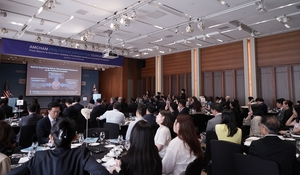
The American Chamber of Commerce in Korea, or AmCham, convened about 150 Korean and US officials, executives and healthcare experts at its 17th Healthcare Innovation Seminar at The Shilla Seoul.
Held under the theme “From Reform to Execution: Building a Predictable Healthcare Innovation Ecosystem,” the seminar focused on turning recent policy changes into improved patient access, technological advances and new investment.
Discussions centered around three priorities: implementing pharmaceutical pricing reforms announced by the Health Ministry in late 2025, strengthening Korea’s vaccine ecosystem, and establishing policy frameworks for AI-enabled healthcare and precision medicine.
Participants stressed the need for consistent execution, alignment with global standards and innovation-friendly regulation as Seoul and Washington continue talks on regulatory competitiveness and non-tariff barriers.
Lee Hyung-hoon, second vice minister of health and welfare, said in written remarks that the government would shorten reimbursement approval times for rare disease treatments and strengthen outcomes-based assessments of their value.
“We will also continue working closely with the private sector to ensure that companies investing in R&D and technological innovation are appropriately rewarded,” Lee said.
He added that Korea’s AI healthcare strategy would support innovation in prevention, treatment and emergency care while bringing domestic regulations into closer alignment with international standards.
Kang Cheong Hee, president of the National Health Insurance Service, said the agency would strengthen disease prevention and health management while embracing advances in treatments, medicines, AI and data.
Other sessions addressed life-course immunization, continued vaccine innovation and preparedness for future public health threats, as well as policy pathways for AI-based medicine and precision care.
AmCham Chairman and CEO James Kim said closer cooperation could combine US innovation and global experience with Korea’s talent, infrastructure and technological strengths.
“By combining US innovation and global experience with Korea’s talent, infrastructure and technological capabilities, the two countries can create new opportunities together,” Kim said.
Bristol Myers Squibb, Eli Lilly and Company, Eversight, Guardant Health, Johnson & Johnson, Moderna, MSD and Pfizer partnered with AmCham for the seminar.
yejinlim@heraldcorp.com