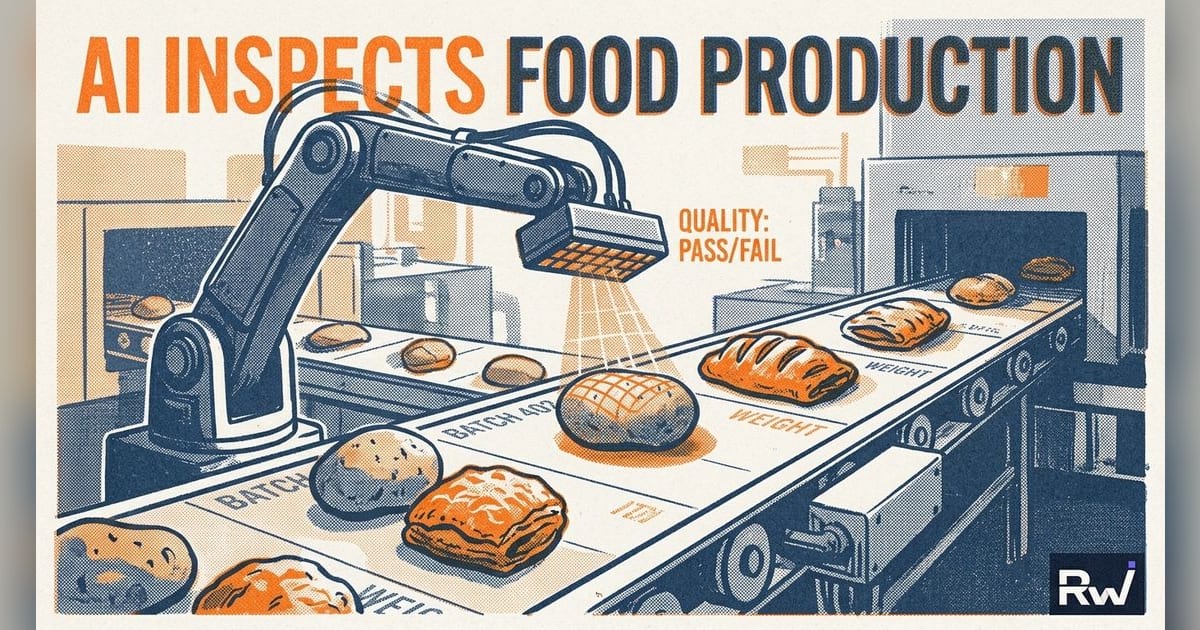
Yarne De Munck and Polysense have raised a $10.7 million seed round to scale AI quality-control software for food manufacturers, Tech.eu reported July 8, giving the Ghent company fresh capital for a bet that factory vision systems should do more than flag defects.
Polysense said in its own July 8 funding announcement that the round was oversubscribed and led by Felix Capital, with participation from Fortino Ventures, Syndicate One and 100IN plus angel investors. Polysense did not disclose a valuation.
The company is still young enough that the founder story matters. De Munck, CTO and co-founder Lucas Van Dijck, and co-founder Jarne Bogaert came through Ghent University's engineering orbit and UGent Racing, the student team that built an autonomous electric race car. A Ghent University alumni profile says Bogaert met De Munck and Van Dijck through UGent Racing, where he led an 80-person team, and that much of Polysense's approach traces back to that autonomous-vehicle work. The translation from racing to potatoes is less odd than it sounds: both problems require cameras, sensors and control systems that react to noisy real-world inputs at speed.
That origin story shows up in the product. Polysense sells software for continuous in-line inspection, real-time imaging analysis and automated process control. Its system is packaged around three products: Polysense Qualify, which inspects products on production lines; the Polysense Platform, which consolidates quality and process data; and Polysense AutoControl, which changes machine settings when ingredients or line conditions drift.
The harder claim is control, not inspection
Plenty of food factories already use machine vision for inspection, sorting or defect detection. Polysense's sharper claim is that it can close the loop between what a camera sees and how the production line behaves. In its announcement, Polysense says AutoControl can adjust production parameters in real time using Qualify data rather than waiting for an operator to intervene.
That distinction is the round's center of gravity. A system that merely catches bad product still leaves a manufacturer paying for the bad run. A system that changes the line before the run goes off-spec is a different sale: it goes after yield, labor load and production consistency. Polysense says its models use real-time imaging data and synthetic data models to detect quality deviations as they happen, then update machine settings before waste is generated.
Food manufacturing is a useful proving ground for that kind of closed-loop AI because biological inputs are inconsistent by design. Potatoes, for example, vary widely by shape, size, skin thickness and starch or sugar content, which challenges fixed machine settings.
The company has narrowed into food after earlier broader sustainability work. Polysense's own materials now position the company around AI-native quality control and process optimization for food production, with potato, fruit and vegetable, and bakery use cases called out on its site. The new round gives De Munck's team money to deepen that focus rather than chase the generic AI-for-industry category.
From pilots to production lines
Polysense says the last year moved it from pilots into live deployments. Customers named by Tech.eu and Polysense include Agristo, Darta and Poppies Bakeries, with rollouts across vegetable, potato, bakery, confectionery and packaging lines. Polysense also says deployments that began in Europe have expanded into the United States and the Middle East.
The company disclosed one performance metric in its funding post: a leading European potato processor reduced peeling time by 45% through real-time monitoring of peel quality and automated adjustments. That figure is company-reported and should be read that way.
The seed round follows an earlier financing that Polysense described in an October 6, 2025 company post as a 2 million euro raise from tech entrepreneurs. That prior investor group included Peter Hinssen, Wim Vernaeve, Jeroen De Wit, Matthias Geeroms and Coformaco, according to the company. Tech.eu describes the earlier round as $2.2 million. On the public numbers, Polysense has now announced at least roughly $12.9 million in funding, before currency effects.
Why investors are looking at the factory floor
The market pressure behind Polysense is not abstract. The European Commission says the EU generates more than 58 million tonnes of food waste annually, with food and beverage manufacturing accounting for 19% of the total. The same Commission page lists production errors, products that miss specifications, product damage and packaging damage among drivers of food waste at the food-business level.
Polysense is not alone in attacking that problem. In July 2025, FloVision Solutions announced an $8.7 million Series A led by Insight Partners for AI-powered yield and quality analytics in protein production. That funding is a useful comparable because it shows venture investors moving into food-production AI beyond restaurant or supply-chain software. Polysense's pitch differs in where it wants to sit in the factory stack: the company is trying to link inspection directly to machine control.
The money will go into product expansion across more stages of food production, engineering, sales, customer success and faster deployments, according to Polysense and Tech.eu. Faster deployment is not a soft operating detail in this market. Factory AI has to survive lighting variation, ingredient variability, legacy machinery, food-safety rules and operators who cannot stop a line for software experiments. Polysense's next proof point will be whether it can turn a few named food producers into repeatable deployments across plants, geographies and categories.
De Munck framed the round around that shift from early traction to scale. "We went from early pilots to live deployments with some of the largest food manufacturers in the world, and they are growing their rollouts," he said in the company announcement. The capital gives Polysense room to test whether its autonomous-racing DNA can become an operating system for messier, slower-moving food factories.