Pika's follow-up video connects its audio pricing with changes in training and inference efficiency, beginning to explain the economics of individual models.
The economics matter because Pika is trying to move generated video into conversational products and high-frequency creator workflows, where every additional GPU and second of latency compounds the cost of serving users. Pika's public explanation begins at the individual-model level, though it does not provide training bills, inference cost per generated second, utilization rates or gross margins.
The disclosure puts Meng's research background near the center of Pika's product strategy. Before co-founding Pika, Meng studied mathematics at Stanford and pursued a computer science PhD advised by Stefano Ermon. Her published work includes DDIM, an early diffusion-sampling method designed to reduce the number of denoising steps required to generate an image, and later research on distilling guided diffusion models into systems requiring fewer evaluations.
Guo, Pika's CEO, brought a parallel interest in creative tools. She studied mathematics and computer science at Harvard before beginning doctoral work spanning natural-language processing and graphics at Stanford. Guo has described technology and poetry as her two early interests, and told Forbes that she wanted to work where AI met creative production. Guo and Meng left Stanford in 2023 after finding the available AI-video tools difficult to use.
The cost story starts with one GPU
Pika laid out the clearest technical basis for its argument on April 2, 2026, when its Fundamental Research Team published the architecture, training process and inference pipeline behind PikaStream1.0.
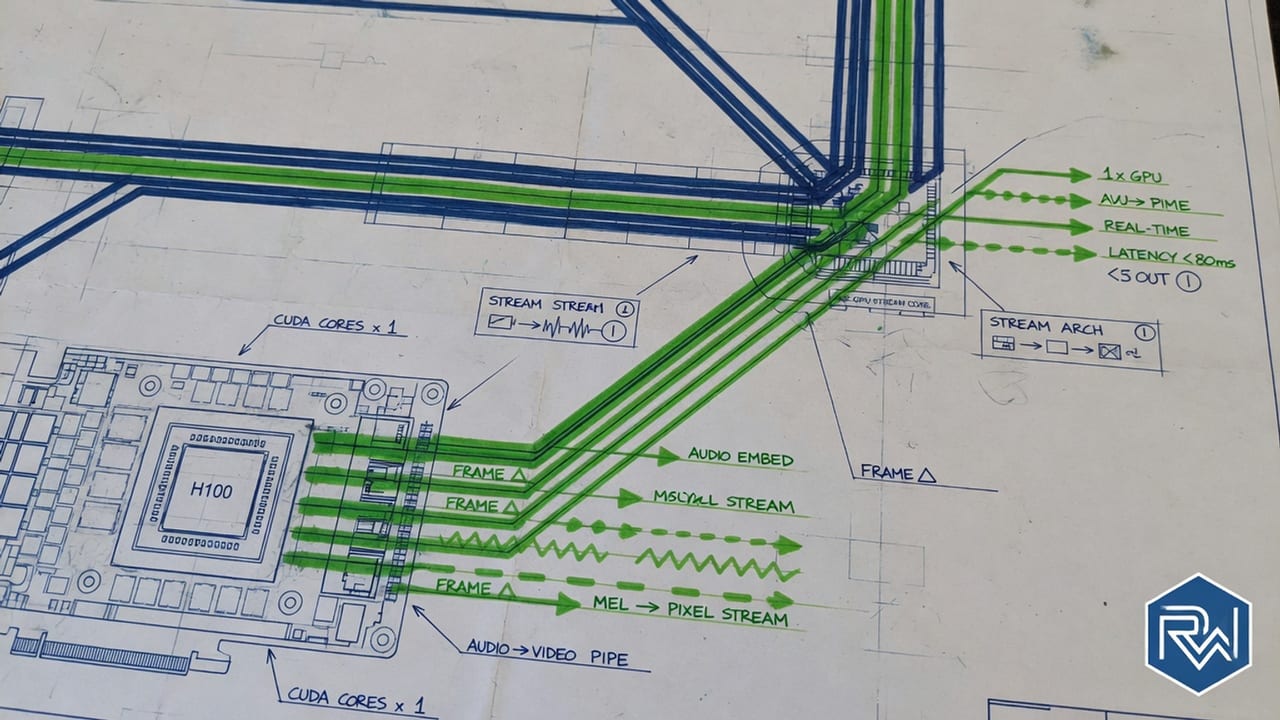
PikaStream is an audio-conditioned video system built to generate a continuous, identity-consistent face for live AI agents. Pika says it produces 480p video at 24 frames per second on a single Nvidia H100 GPU, with about 1.5 seconds between speech input and the beginning of a video response.
Its predecessor, Pikaformance, required eight GPUs and about 4.5 seconds per response, according to Pika. That comparison supplies the clearest explanation for lower inference costs: PikaStream uses one-eighth as many GPUs for a response and cuts reported latency by two-thirds. Pika has not translated those gains into a dollar cost per generated minute, so the relationship between compute savings and end-user prices remains incomplete.
The system combines a streaming Transformer variational autoencoder, a 9-billion-parameter diffusion transformer and reference-image injection intended to preserve a person's identity. Pika says the FlashVAE decoder reaches 441 frames per second at 480p while using 1.1 GB of peak memory on one H100.
Pika trained the diffusion model first as a bidirectional teacher that could consider an entire sequence, then distilled it into a causal student that generates chunks in sequence. A fixed context window keeps the processing cost of each new chunk constant as a video grows. Pika also says its optimized self-forcing method eliminates an additional forward pass for each chunk by reusing cached key-value states from the final denoising step.
Those decisions attack the two cost centers Pika is discussing: the work required to produce a deployable model and the GPU capacity consumed each time someone uses it. Distillation shifts effort into training so the serving model can run with fewer steps. Streaming avoids waiting for a complete sequence. The fused inference pipeline runs speech recognition, language-model reasoning, text-to-speech and video generation concurrently rather than serially.
Pika says its pre-training corpus contained roughly 10 million clips, with a more selective fine-tuning corpus on the order of 1 million clips. Pika has not published the compute used to process those clips or the acquisition and filtering costs behind the datasets. The clip counts and performance figures remain Pika's measurements rather than independently audited results.
Consumer pricing makes efficiency a product constraint
Pika's current pricing page charges three credits for each second of Pikaformance audio. A 10-second talking clip therefore consumes 30 credits, while the paid product supports audio of up to 30 seconds. Pika lists monthly subscriptions from $10 to $95, alongside a free plan with 80 video credits.
That structure rewards Pika directly when inference becomes cheaper. Pika can preserve the credit price and improve the margin on each generation, lower the number of credits charged, or spend the savings on faster queues and higher usage allowances. Pika has not said which portion of its efficiency gains is being passed through to creators.
The product also exposes why latency is part of the economic model. A six-second wait can be acceptable when a creator generates a social clip. It breaks a live conversation. Cutting the response time to about 1.5 seconds gives Pika a route from an editing feature into persistent video agents, where inference may run continuously and inefficient serving becomes expensive quickly.
Meng's research is becoming Pika's operating model
Pika's approach follows a line visible in Meng's academic work: reduce the repeated evaluations that make diffusion generation slow, then design the model around the constraints of deployment. The follow-up explanation turns that research lineage into a commercial argument. Pika wants creators and developers to see its pricing as an engineering result rather than an introductory subsidy.
Pika has had the capital to train and serve large video systems. On June 5, 2024, Pika announced an $80 million Series B led by Spark Capital, with participation from Greycroft, Lightspeed, Neo and Makers Fund. Pika said the financing brought its total raised to $135 million.
That funding bought Pika room to pursue foundation-model research, but the move from eight GPUs to one is what can turn a technical demonstration into a product that survives sustained use. Guo and Meng are making that efficiency part of Pika's sales case. The remaining test is whether Pika will disclose enough of the cost curve to let creators and developers compare the claim across models, workloads and competitors.