Picture an Earth-observation satellite between ground contacts. Its instruments have been writing logs, and the team wants to know which entries deserve a closer look. The team could send the logs down and ask a language model to read them on Earth. With a model aboard the satellite, a short list could be ready when the link opens. We wanted to know what the computing would cost in each place.
We started on Earth, where NVIDIA had already timed the work. A pair of H100 GPUs running Llama 3.3 70B Instruct in FP8 handled 250 requests at once. Each request supplied 200 tokens and asked for 200 back. The pair produced 5,067 output tokens a second, including the time spent reading the prompts. NVIDIA benchmark
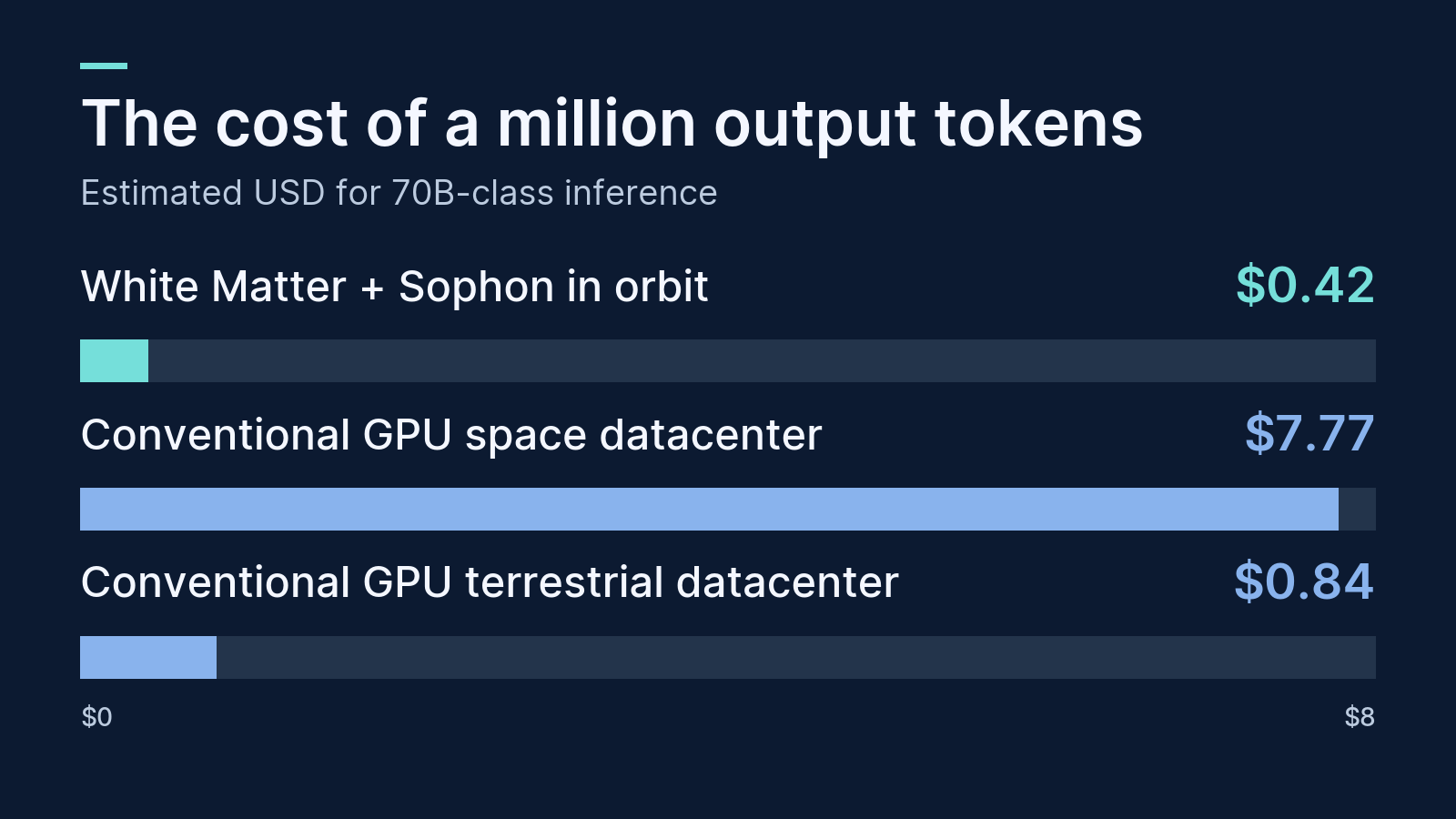
At Lambda’s November 18, 2026 rental rate, sixteen H100s cost $73.44 an hour, even when the queue is empty. Say there is enough work to fill all eight pairs with 2,000 concurrent requests for 60% of five years. At NVIDIA’s measured pair rate, those GPUs would produce 3.835 trillion output tokens. That puts our conventional GPU terrestrial datacenter at $0.84 per million for rental. The satellite team would pay separately for downlink, storage beyond the rental, network transfer and its own operations. Lambda pricing · Terrestrial cost model
What it costs to take the same GPUs into orbit #
Now put the same sixteen GPUs aboard the satellite and give them the same queue. Even if they sustain the ground benchmark within the spacecraft’s power budget, they still produce 3.835 trillion tokens. What changes is the bill. Our conventional GPU space datacenter weighs 1,615 kg with its power and cooling systems. At our assumed $7,000 per kilogram, the ride to orbit alone adds $2.95 to every million output tokens.
Launch accounts for $11.30 million of the $29.80 million we budgeted to build, fly and operate the spacecraft for five years. Spread that budget over the tokens it delivers and the cost reaches $7.77 per million. Both orbital budgets assume a repeat build and five years of service. They exclude initial development and commercial margin. Space datacenter cost model
What White Matter takes off the launch manifest #
In the White Matter flight design, forty Sophon dies share a stack of liquid-cooled silicon tiers. We budget 60 kg for the flight compute assembly, including mounts, storage and its cooling loop. The corresponding allowance for the conventional GPU design is about 261 kg. At $7,000 per kilogram, that difference alone is worth about $1.69 million on the launch budget once we include the same 20% mass reserve. Flight payload design · Mass and cost model
Cooling the brick has a cost of its own. A two-stage heat pump lets us take 207 kg off the radiator, but we have to fly compressors, a larger thin-film solar wing and a larger eclipse battery to run them. On this spacecraft the trade saves 34 kg at launch compared with direct cooling. With the whole vehicle accounted for, White Matter + Sophon comes in at 1,124 kg against 1,615 kg for the GPU spacecraft. The launch budget falls from $11.30 million to $7.87 million. Cooling trade · Solar wing and battery sizing
What a Sophon chip contributes to the 42 cents #
We budget $8,358 per packaged Sophon, assuming a 40.8% manufacturing yield. That puts forty devices at about $334,000. Turning them into a flight payload is a separate expense. We allow $2 million for the carrier, coolant manifold, storage, interfaces and assembly. The full mission comes to $26.20 million. Launch accounts for $3.43 million of the $3.60 million saved against the GPU spacecraft. If it delivered the same 3.835 trillion tokens, that saving would bring the cost per million down to $6.83. Sophon device cost model · Flight budget
To see where the rest of the saving comes from, follow one request. The 70B model’s FP8 weights occupy about 70 GB of a Sophon’s 330 GB of local memory. One chip can generate the response while the other 39 serve their own requests. At a projected 16,500 output tokens per second per chip, with 60% of the five years spent generating useful output, the brick delivers 62.44 trillion accepted tokens. That is about sixteen times the GPU spacecraft’s output, and it brings the projected cost to $0.42 per million. Sophon throughput model
Of those 42 cents, the Sophon devices themselves account for about half a cent per million tokens. Payload integration accounts for another 3.2 cents, launch for 12.6 cents and five years of operations for 8 cents. The rest pays for the spacecraft bus, power and cooling hardware, integration tests and contingency. A team that paid twice our estimate for the chips would add about half a cent per million at the same output. If the chips spent only 30% of the mission generating useful output, the team would pay $0.84 per million, about the terrestrial rental cost.
That makes time lost to faults an economic question, too. If Sophon’s thin memory channels suffer fewer radiation upsets, the spacecraft could spend less time replaying interrupted work. Our estimate retains local shielding and a recovery allowance until beam tests establish how often the flight hardware needs to retry. Radiation assumptions
For the team deciding what to fly, the break-even test is about 4,950 accepted output tokens per second per Sophon, averaged over the entire mission. We would give the chips the same 200-token prompts and 200-token responses as the H100 benchmark, match output quality and enforce the spacecraft power limit. The clock would keep running through prompt processing, retries and gaps between logs. At that average, the satellite could have its short list ready at the next ground contact for the same compute cost per token as the terrestrial rental.