Don't miss new tech stories on Google
Add Shattered once in the Google app and our stories show up in your news suggestions.
Pflugerville Adopts the SAFE Technology Policy #
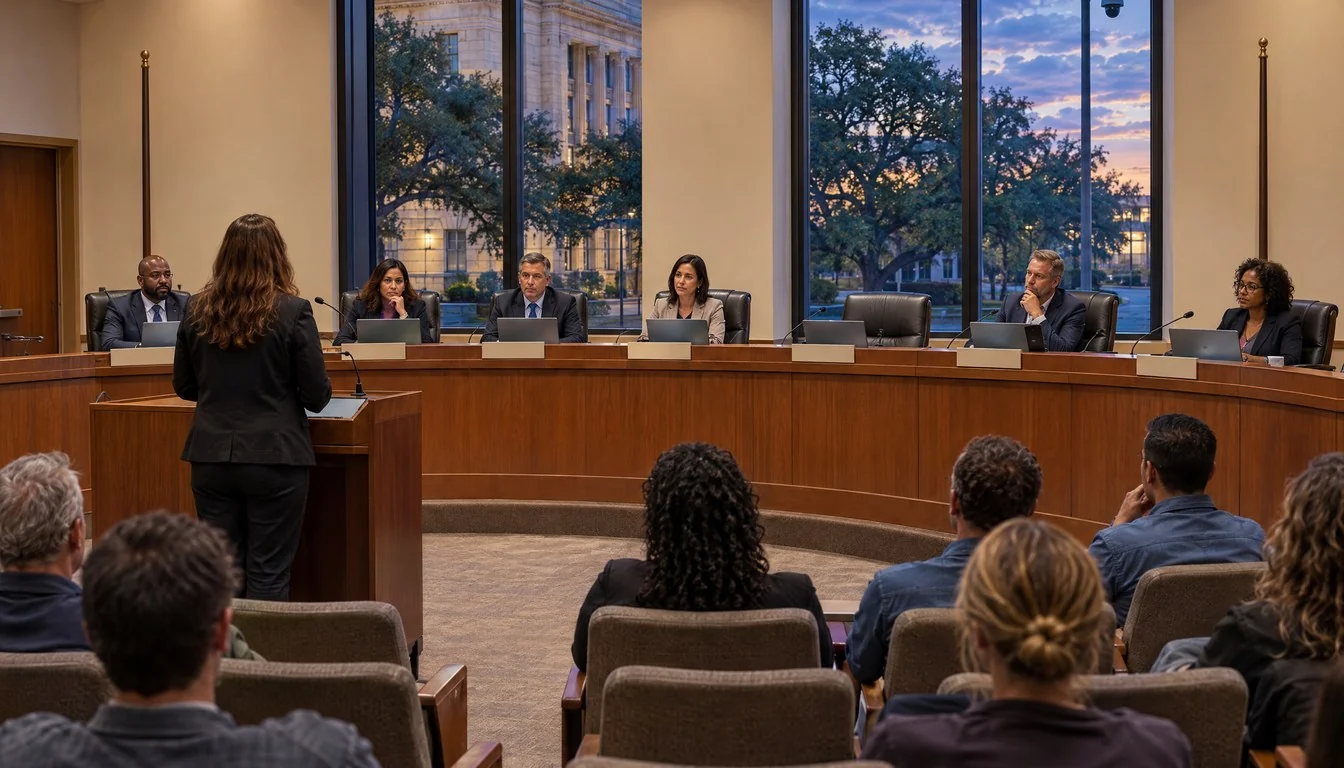
The Pflugerville City Council unanimously approved the Secure, Accountable, Fair and Explainable (SAFE) Technology policy on October 27, 2026, according to Community Impact. The policy took effect immediately. It sets rules for how the Texas city uses artificial intelligence, surveillance technology, biometric-identification technology, data handling and data sharing, and it also reaches future technologies.
The Pflugerville SAFE Technology policy stands out because it does not ban or bless a single product. It sorts all city technology into low, moderate or high risk, based on what a tool is meant to do and how much it could affect residents. Routine tools stay with the city manager. High-risk systems, including those used for law enforcement, surveillance and biometric identification, need City Council review and approval before the city uses them.
Engineers will recognize the shape. It echoes the tiered thinking security teams already apply to software agents, a pattern we broke down in our piece on zero trust for AI agents and its three tiers after login. The twist in Pflugerville is that the gatekeeper for the top tier is an elected council, not an identity provider.
This analysis covers what the city has confirmed, what one council member says the policy does, and what nobody has shown yet. The reporting available today includes no budget, no vendor list, no contract price, no deadline beyond the immediate effective date and no count of affected systems. We do not guess at any of them.
What Mayor Weiss and Council Member Coffman Said #
Mayor Doug Weiss framed the policy as a balance between service and trust. In a city statement carried by KXAN Austin, he said:
“Technology helps us serve our community better, but that shouldn’t come at the expense of privacy, accountability or public trust.”
Doug Weiss, Mayor of Pflugerville, via KXAN Austin
Weiss added a second line aimed at transparency. KXAN attributes it to him as well:
“Our residents deserve to know how these tools are used and what we’re doing to protect their information.”
Doug Weiss, Mayor of Pflugerville, via KXAN Austin
Council member Jonathan Coffman spoke about mechanism rather than principle. He told CBS Austin:
“The SAFE Act will really let residents have a lot of transparency, accountability, and an ongoing say in how the city uses technology.”
Jonathan Coffman, Pflugerville City Council member, via CBS Austin
Coffman also stressed that the policy looks past today’s tools. In the same CBS Austin coverage he described the intent this way: “Whether it’s AI or whatever may come in the future. And it really sets guardrails.” He then described the structure itself: “It’s more of a framework type of approach. And so it should protect all citizens very similarly to Austin’s Trust Act. So it goes beyond that in some ways.”
Read together, the two officials sell different halves of the same idea. The mayor sells the principle that convenience should not erase privacy. The council member sells the process, which is the part that can actually be audited. Residents who want to test the policy will care much more about the second half.
How the Three Risk Tiers Work #
Risk tiering is the spine of SAFE. According to Community Impact and KXAN, city technology gets classified as low, moderate or high risk according to its intended use and its potential impact. The classification decides who signs off. That single design choice turns a vague promise (be careful with AI) into a routing rule (this class of tool goes to the dais).
The sources spell out the two ends of the scale and leave the middle thinner. The table below separates what the reporting confirms from what it does not say.
| Technology category | Likely tier (per reporting) | Who decides | Status in sources |
|---|---|---|---|
| Routine administrative tools | Low | City manager | Confirmed by Community Impact and KXAN |
| Routine operational tools | Low | City manager | Confirmed by Community Impact and KXAN |
| Law enforcement systems | High | City Council review and approval | Confirmed by Community Impact and KXAN |
| Surveillance technology | High | City Council review and approval | Confirmed by Community Impact and KXAN |
| Biometric identification | High | City Council review and approval | Confirmed, and Coffman describes a prohibition |
| Tools affecting rights or access to city services | Standards apply | Not specified | Standards confirmed, exact tier not specified |
| Moderate-risk tools | Moderate | Not specified | Tier confirmed, examples and approver not reported |
Low and moderate tiers
The low tier is the easy one. Routine administrative and operational tools remain under the city manager’s authority, so the council does not need to vote on every software renewal. That protects the staff from drowning in agenda items. It also means a large share of day-to-day city software never reaches a public meeting.
The moderate tier is where the reporting goes quiet. The sources confirm it exists. They do not say which tools land there or who approves them. That gap is the first thing a records requester will probably probe, because the moderate tier is where a tool that is not obviously surveillance but touches resident data would sit.
The high-risk tier
High-risk technology, including systems used for law enforcement, surveillance and biometric identification, requires City Council review and approval before use. The word before carries the weight. Many local surveillance fights start after a tool is already running. A pre-use gate puts the debate ahead of the deployment instead of behind it.
What the Adopted Policy Covers
The adopted policy is wider than its three tiers suggest. It governs the city’s use of artificial intelligence, surveillance technology, biometric-identification technology, data handling and future technologies. That last item matters for readers who build or sell software, because a tool that does not exist yet still falls inside the framework once the city considers using it.
Technology is classified as low, moderate or high risk, based on intended use and potential impact. Systems involving law enforcement, surveillance, biometric identification, or comparable high-impact uses require review and approval by the City Council before use. The phrase comparable high-impact uses suggests the top tier is defined by effect on residents and not only by a fixed list of products, so a vendor should not assume a tool is exempt because it is not named.
Reported provisions include limits on data use and sharing, human responsibility for AI-assisted decisions, public transparency about city technology and data handling, and a reported prohibition on facial recognition and biometric identification. Because the prohibition is reported rather than quoted from the adopted text, vendors and residents should read the policy itself before acting on it. Jonathan Coffman, the council member who discussed the policy publicly, also proposed a separate resident-led technology commission, which remains a proposal and not an established body.
City Manager vs City Council: Who Holds the Switch #
SAFE splits authority along a clean line. Day-to-day tools sit with the city manager, an appointed administrator. The tools with the most potential to harm residents sit with the council, a body that votes in public. The split mirrors how many cities already handle contracts above a spending threshold, except here the trigger is risk instead of dollars.
A risk trigger has a practical advantage. A cheap piece of software can still do real damage. A camera feed, a biometric matcher or an AI scoring model might cost little to license and still reshape how residents interact with police or city services. A dollar threshold would wave those through. A risk threshold does not.
It also carries a practical weakness. Someone has to do the classifying. The reporting does not say who assigns a tool its tier, what the criteria look like on paper, or how disagreements get resolved. If staff classify their own purchases, the tiering is only as strict as the people holding the pen. If the council or an independent reviewer classifies them, the process slows down. Neither answer is in the public record we reviewed.
The first test cases will matter more than the text. The first high-risk item to reach the dais will show how long reviews take, how much documentation the council demands and whether residents get a real chance to comment before the vote.
Facial Recognition and Biometrics: What Is Confirmed #
Coffman said the SAFE policy would prohibit facial recognition and biometric identification. That claim drew attention, and it deserves care. The confirmed city-level facts are that biometric identification counts as a high-risk category requiring council review and approval. The statement that the policy flatly prohibits facial recognition comes from Coffman’s description, and the policy text available in the search results does not establish a blanket prohibition.
Those two readings lead to different outcomes. If biometric identification is simply high risk, the council could in principle approve a specific use after review. If it is prohibited outright, there is nothing to approve. The distinction decides whether a vendor with a facial-recognition product has a path into Pflugerville or none at all.
| Claim | Status | Where it comes from |
|---|---|---|
| Council voted unanimously on October 27, 2026 | Confirmed | Community Impact, KXAN Austin |
| Policy took effect immediately | Confirmed | Community Impact |
| Three risk tiers: low, moderate, high | Confirmed | Community Impact, KXAN Austin |
| High-risk tools need council approval before use | Confirmed | Community Impact, KXAN Austin |
| Policy prohibits facial recognition and biometric identification | Coffman’s description, policy text not confirmed | CBS Austin |
| A person stays responsible for AI-assisted decisions | Coffman’s description | CBS Austin |
| Residents can view online what tech the city uses | Coffman’s description | CBS Austin |
| Budget, vendors, contract prices, system counts | Unconfirmed | Not reported |
Until the city publishes or a reporter quotes the exact clause, the safest reading is the narrower one. Biometric identification sits in the top risk tier, and the council member who helped shape the policy describes it as off-limits. Anyone planning around that, whether a vendor or a resident, should read the adopted text before relying on either version.
A Human Stays Responsible for AI Decisions #
Coffman said the policy requires a person to remain responsible for decisions made using AI. That is a short sentence with a long tail. It means a model’s output can inform a city decision but cannot own it. When a resident challenges an outcome, a named employee has to answer for it, not a vendor’s black box.
The failure mode this guards against is automation bias, where a human nominally approves whatever the system suggests. Our reporting on AI medical alert fatigue showed how quickly oversight erodes when people see too many machine prompts. A responsibility rule on paper does not fix that. Staffing, workflow design and audit trails do.
The word Explainable in the SAFE acronym points the same direction. A person can only stand behind a decision they can explain. For city staff, that raises a procurement question. If a vendor cannot describe how its model reached an output, the department using it may struggle to meet the policy’s own name.
The reporting does not say how the city will check compliance. There is no audit schedule, no named oversight officer and no penalty described in the sources. Those details will decide whether human accountability becomes a habit or a footnote.
Public Transparency: Resident-Facing Technology Disclosures #
Coffman said residents will be able to view online what technology the city uses and how their information is handled. In practical terms, that describes a public technology inventory. The sources do not say what format it takes, how often it updates or whether it will list vendors, data types and retention periods.
For readers who build software, here is what a useful inventory record could contain. The example below is our illustration, not a schema the city has published.
{
  "system": "example-license-plate-reader",
  "risk_tier": "high",
  "approved_by": "city_council",
  "approval_date": "YYYY-MM-DD",
  "purpose": "plain-language statement of use",
  "data_collected": ["plate image", "timestamp", "location"],
  "data_shared_with": ["named agencies only"],
  "retention_days": 0,
  "biometric": false,
  "human_owner": "job title responsible for decisions",
  "public_contact": "records or privacy office"
}
The value of a record like this is comparison over time. A resident who sees the same system listed with a longer retention period next year can ask why. A reporter can check whether a tool listed as moderate risk later shows up in a police contract. Transparency only works when disclosures are specific enough to be wrong.
The Pflugerville SAFE Technology policy also limits how city data may be used and shared, according to the reporting, and its reported provisions pair those limits with public transparency about city technology and data handling. Data sharing sits in the headline scope next to AI and surveillance, and that placement is deliberate. Many privacy disputes in local government involve what happens to data after collection, not the collection itself.
The Flock Camera Backdrop and Local Context #
The policy did not appear from nowhere. Reporting from Austin-area outlets ties the debate to local controversy over Flock license-plate cameras. A FOX 7 Austin headline reads Pflugerville City Council rejects new agreement in a story about Flock cameras in Texas, and a CBS Austin headline describes the council delaying a Flock camera contract vote amid privacy concerns. We have not independently reviewed those contract details, so we describe them only at headline level.
A second signal comes from the Texas AI Docket, which tracks state and local AI measures. One entry is headlined as Pflugerville ordering a November election on charter amendments, one of them a section on the city’s use of artificial intelligence. We read only the headline, so we cannot say how the charter language relates to SAFE or what it requires.
Put those pieces side by side and a pattern emerges. Residents raised questions about surveillance data. The council d or rejected a contract. A council member then helped move a framework through. That sequence is typical of how local tech governance forms: a specific irritant first, a general rule second.
The risk for any city that follows this path is a rule shaped around one vendor dispute. SAFE avoids that by describing categories of risk instead of naming products. Coffman’s own phrase, guardrails for AI or whatever comes next, points at the same intent.
Pflugerville vs Austin’s Trust Act: How the Approaches Compare #
Coffman explicitly compared SAFE to Austin’s Trust Act, saying it should protect residents very similarly and go beyond it in some ways. We have not reviewed the Trust Act text for this story, so we take his comparison as a council member’s characterization, not a legal finding.
What we can do is compare SAFE’s reported design against the situation many cities face without a tiered policy. The table below uses the confirmed SAFE features on one side and a baseline of case-by-case procurement on the other.
| Governance question | SAFE (as reported) | Case-by-case procurement (baseline) |
|---|---|---|
| What triggers extra review? | Risk tier based on use and impact | Usually contract size or an ad hoc complaint |
| Who approves surveillance tools? | City Council, before use | Often staff, sometimes the council |
| Who owns an AI-assisted decision? | A person remains responsible | Frequently unclear |
| Can residents see what is in use? | Online disclosure described by Coffman | Only through records requests |
| How is shared data limited? | Policy limits use and sharing of city data | Contract terms negotiated per vendor |
| Does it cover future tools? | Framework meant to cover AI and later technology | Each new tool needs a new decision |
Coffman’s framework language is the key difference. A rule written around one technology ages quickly. A tier system with a council gate for the riskiest category can absorb tools that do not exist yet, as long as someone classifies them honestly.
Market Impact: What Vendors and Procurement Teams Face #
Pflugerville is a city, not a national market, and one council vote will not move vendor revenue. The signal still matters. Companies selling surveillance, analytics or AI tools to local governments now have a concrete example of what a buyer may ask for: a risk classification, a plain-language purpose, a data-sharing statement and an explanation of how a human stays accountable.
Vendors that already document model behavior and data handling will find the process easy. Vendors that rely on opaque scoring and broad data rights will face friction. That friction lands hardest on products in the high-risk tier, where a council vote is now part of the sales cycle.
Cost pressure runs the other way. Cities buy law enforcement technology for operational reasons, and the price tags can be large. Our coverage of a reported $750,500 phone-tracking purchase by the NYPD shows how big surveillance line items can get inside a major department. A pre-use council gate gives a smaller city a way to see those decisions before the money moves.
There is no reported SAFE budget, no list of vendors affected and no estimate of compliance cost in the sources. Anyone claiming a dollar figure for the policy is working without public data. What we can say is that procurement staff gain a new step, and vendors gain a new audience.
Why AI-Models Readers Should Watch Municipal Policy #
Most AI governance coverage tracks frontier labs and federal agencies. The rules that touch ordinary residents most directly often come from city halls, school boards and county offices. Governments elsewhere are making choices too. We reported that Sweden blocked ChatGPT and Claude in government offices from October 26, a very different answer to the same question of how public bodies should treat generative AI.
Pflugerville chose neither a blanket block nor an open door. It chose a gate that scales with risk. For model developers, that means public-sector customers may increasingly ask for documentation on training data, error behavior and human-override design before a pilot starts.
Compliance teams in other industries are watching the same drift. Our summary of Fisher Phillips on six ways AI reshapes hotel compliance shows private employers wrestling with comparable questions about accountability and data use. For a wider view of the sector, see our AI and machine learning coverage.
Historical Context: How Cities Arrived at Tiered Rules #
Local technology governance has moved in stages. Early debates focused on individual devices such as cameras, license-plate readers and tracking tools, and cities answered them one device at a time. That approach produced a patchwork of single-purpose ordinances and contract clauses.
The newer approach treats the category as the unit. Instead of asking whether a city should buy one product, it asks what risk any product in that class creates and who must approve it. SAFE belongs to that second wave. Coffman’s remark that the policy is a framework that goes beyond Austin’s Trust Act in some ways fits the pattern.
The AI boom sped this up. Generative tools now show up inside ordinary software, which makes a list of banned products obsolete almost immediately. A risk-based classification survives product churn better than a product list does.
What the record does not show is a track record. The Pflugerville SAFE Technology policy took effect on October 27, 2026, so there are no reported denials, approvals or audits yet. Any claim about how well it works would be premature.
What We Still Don’t Know #
- The exact text of the adopted policy and whether it prohibits facial recognition outright or routes it through council review.
- Who assigns each technology its risk tier and by what criteria.
- Which tools, if any, the city already runs that fall into the high-risk tier.
- Whether the online technology disclosure exists yet, and what it will list.
- How the city will enforce human accountability for AI-assisted decisions.
- What the policy costs to administer, and what it means for existing vendor contracts.
- How SAFE relates to the charter-amendment item listed on the Texas AI Docket.
None of these gaps undercuts the core fact. A Texas city council voted unanimously for a tiered AI and surveillance policy, and it is already in effect. The open items decide how much that vote changes in practice.
Five Predictions for Pflugerville and Beyond #
These are our analysis, not statements from city officials. We label them as judgment calls.
- The first high-risk review will define the policy. Expect the first item that reaches the council to set the precedent for documentation and public comment. A smooth, quick review would signal the gate is routine. A contested one would show it has teeth.
- Clause-level questions will surface fast. Reporters and residents will ask for the exact biometric language. If it is a flat prohibition, vendors will route around the city. If it is a review requirement, vendors will lobby for approval.
- The moderate tier will draw the most scrutiny. The sources leave it undefined, and undefined categories attract disputes. Expect calls for examples and a published classification guide.
- Other Texas cities will borrow the framework. Coffman pitched SAFE as a template that outlasts today’s tools. Mid-sized cities facing the same camera and AI vendor pitches have reason to copy a ready-made structure.
- A resident commission could follow. Research for this story indicates Coffman has advocated a separate resident-led technology commission for ongoing input. It is described as a proposal he is pushing, not an established commission. Whether the council acts on that is an open question, but the idea fits the policy’s transparency theme.
Frequently Asked Questions #
What is the Pflugerville SAFE Technology policy?
It is a policy the Pflugerville City Council unanimously approved on October 27, 2026. SAFE stands for Secure, Accountable, Fair and Explainable. It sets safeguards and oversight for the city’s use of artificial intelligence, surveillance technology and data sharing, per Community Impact and KXAN.
When did the policy take effect?
Community Impact reports it took effect immediately after the October 27 vote. No later implementation deadline appears in the available reporting.
How do the three risk tiers work?
City technology is classified as low, moderate or high risk based on intended use and potential impact. Routine administrative and operational tools stay under the city manager. High-risk tools, such as those for law enforcement, surveillance and biometric identification, need City Council review and approval before use.
Does Pflugerville ban facial recognition?
Council member Jonathan Coffman said the policy would prohibit facial recognition and biometric identification. The available policy text does not establish a blanket prohibition, so treat the ban as his description until the adopted text is checked. What is confirmed is that biometric identification is a high-risk category requiring council approval.
Will residents see what technology the city uses?
Coffman said residents will be able to view online what technology the city uses and how their information is handled. The reporting does not describe the format or update schedule.
Who is responsible when AI informs a city decision?
Coffman said the policy requires a person to remain responsible for decisions made using AI. Enforcement details were not reported.
How much does the policy cost, and which vendors are affected?
Neither was reported. Budget, vendors, contract prices and the number of affected systems are unconfirmed in the available sources.