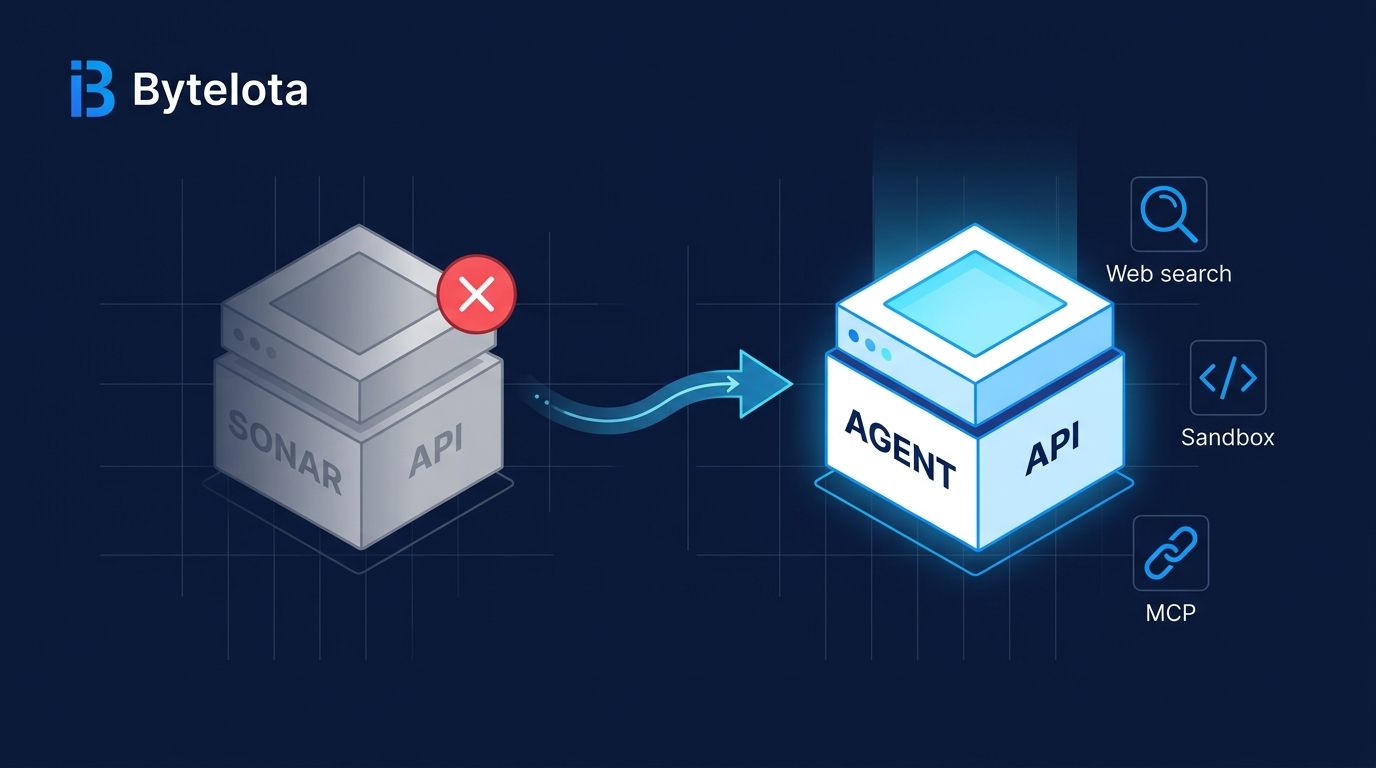
The Perplexity Sonar API has a death date: September 27, 2026. If your app calls sonar-pro
, sonar-reasoning
, sonar-deep-research
, or any of the other Sonar model slugs, you have 33 days to migrate before Perplexity pulls the plug. The replacement — the Agent API, launched August 13 — is not a cosmetic rebrand. The endpoint changes, the model parameter goes away, and the underlying architecture shifts from “pick a model” to “configure a preset.” That sounds like paperwork. It is not.
What Sonar Was — and Why It Had to Change #
Sonar worked on a simple mental model: each model slug was a fixed bundle. You chose sonar-pro
and you got a specific model, a specific reasoning depth, and a specific cost. Simple to reason about; impossible to tune. If you needed something between sonar-pro
and sonar-reasoning-pro
, you had no lever to pull. That rigidity was fine when developers just wanted a grounded chatbot. It is a problem when you are building agents that need to compose retrieval dynamically.
The Agent API solves this with six presets — fast, low, medium, high, xhigh, and wide-research — where each preset bundles a model, a system prompt, tool configuration, reasoning effort, and a token budget. Presets map to your current Sonar tiers but are composable: you can swap tools, adjust reasoning effort, or override the model. The mapping you need on day one looks like this:
sonar→fast
orlow
sonar-pro→medium
**sonar-reasoning-pro**→`high`

**sonar-deep-research**→`xhigh`
orwide-research
Perplexity publishes a field-by-field migration guide covering endpoint URLs, request parameters, model slug changes, response parsing, streaming, and citations. Start there.
What You Gain Beyond the Migration #
Most migration coverage stops at “update your endpoint.” That misses what actually changed. The Agent API is a new category of tool for Perplexity users, and migration is your forced entry point into it.
The most significant addition is MCP server connections. Your Agent API calls can now connect to any Model Context Protocol server — internal databases, Slack, GitHub, anything you have wired up. Perplexity’s search engine is no longer querying only the public web; it can pull from your own infrastructure mid-request. This is the difference between a grounded chatbot and a grounded agent.
The code sandbox is also now part of the picture. Perplexity calls it SPACE — Sandboxed Platform for Agentic Code Execution. It runs on Firecracker microVMs, spins up in 60ms median (3x faster than the previous generation), and handles credential isolation so that sensitive keys never enter the sandbox itself. Credentials are injected from outside at the moment of need and destroyed when the sandbox closes. For agents that write and execute code as part of research workflows, this is production-grade infrastructure that you no longer have to build yourself.
The other additions — URL fetching, finance search, people search — are available to all presets. The tool configuration is what each preset defaults to; you can enable or disable individual tools per request.
“Search as Code” Is the Real Shift #
Perplexity describes the Agent API’s underlying architecture as “Search as Code.” Under the old Sonar model, search was baked into the model — you called an endpoint and got grounded responses. You had no visibility into the retrieval pipeline. Under the Agent API, the model composes retrieval pipelines on demand for each request. The top-end presets can run thousands of retrieval steps in a single call. You are not calling a search model anymore. You are orchestrating a search agent.
This distinction matters when you hit the limits of what Sonar could do. Multi-step research that previously needed custom orchestration — spinning up multiple agents, aggregating results, re-ranking — is now a configuration decision, not an engineering project.
Three Things to Do Before September 27 #
Audit your integrations. Find every place your codebase calls a Sonar model slug. Check your environment variables, your LLM routing layers (LiteLLM, Vercel AI Gateway), and any third-party tools that wrap Perplexity.Run the migration guide. Theofficial guidehas field-by-field mapping. The endpoint changes and the response structure changes — do not assume a find-and-replace on the model slug is sufficient. Test against a representative request set and compare latency, quality, and cost.Evaluate what you are leaving on the table. If you migrate tomedium
and call it done, you have technically migrated. But you have also missed MCP connections, the SPACE sandbox, and the composability that makes Agent API worth using. The deadline is the floor, not the ceiling.
One note on cost: the Agent API uses stable prompt cache keys automatically for each preset. If you make repeated requests using the same preset in a high-volume app, the shared prompt prefix is reused across independent requests — a meaningful cost reduction that requires zero code changes.
September 27 is a deadline that forces a migration. It is also an invitation to build something you could not build with Sonar. Both things are true. Start with the migration guide and then look around at what just became available.