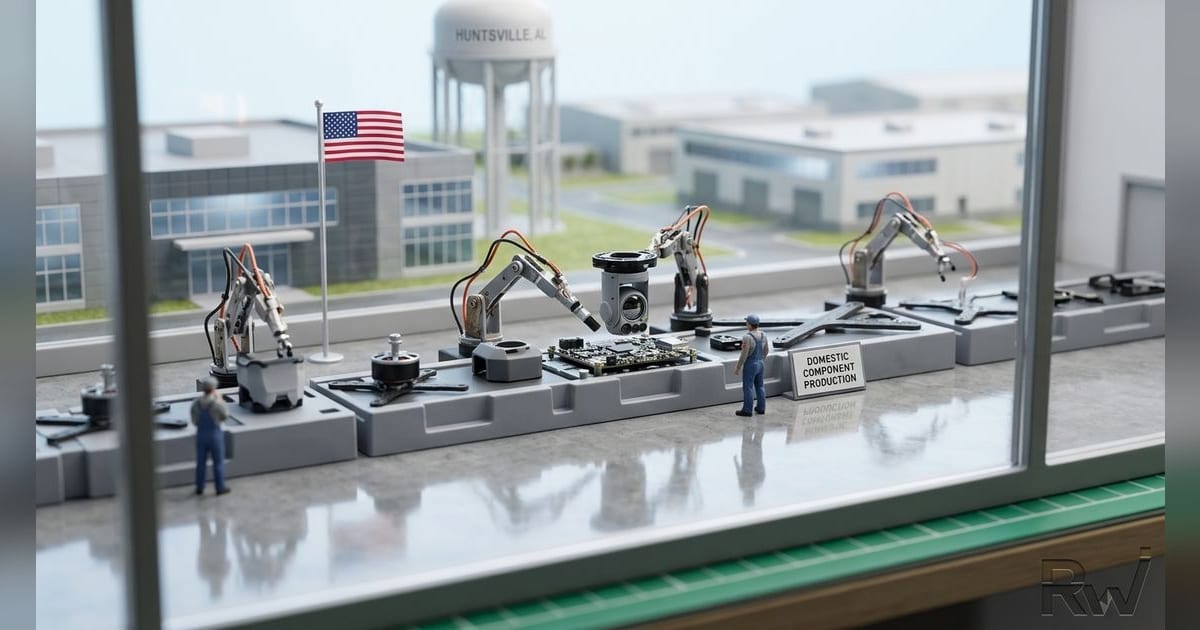
PDW Holdings, the Huntsville defense drone manufacturer co-founded by Matt Higgins and Ryan Gury, announced Friday that it secured a conditional loan commitment of up to $820 million from the U.S. Department of War's Office of Strategic Capital to expand domestic production of drone components.
The financing puts federal industrial policy behind PDW's technical roots in the Drone Racing League. Gury designed the league's hand-built racing aircraft, including the RacerX quadcopter that set a 163.5 mph speed record in 2017. Higgins co-founded RSE Ventures, which backed the racing league, and built a career spanning public service, professional sports and growth investing before helping turn that work into a defense manufacturer.
PDW's founders are now making a larger bet: that the engineering and production lessons learned building fast, frequently repaired racing drones can extend beyond PDW's own aircraft and into the component supply chain used by other American manufacturers.
The Department of War's announcement says the project would create high-volume domestic capacity for components used in PDW aircraft and other domestic manufacturers' unmanned systems. PDW identified propulsion, power and control systems, vision equipment and related technologies as initial areas for investment.
That distinction matters. The federal government is backing PDW as a potential upstream supplier to the wider drone industry, rather than financing another production line dedicated solely to one manufacturer's finished aircraft.
The commitment has not reached financial close. PDW must complete financial, legal and technical due diligence and satisfy other conditions before funds can be disbursed. Neither the government nor PDW specified the loan's interest rate, maturity, collateral package or the amount and sources of private capital expected alongside it.
A drone factory becomes a component factory
PDW opened Drone Factory 01 in Huntsville in August 2025, bringing engineering, flight testing, systems integration, manufacturing and fulfillment into a 90,000-square-foot facility near Redstone Arsenal.
PDW says the plant can produce as many as 350 C100 quadcopters and 5,000 AM-FPV systems per month. Those are stated peak capacities rather than reported delivery volumes, and PDW has not published revenue or utilization figures for the facility.
The conditional loan would extend that manufacturing base deeper into the bill of materials. PDW could use domestically produced motors, controls, power systems and cameras in its own C100 and AM aircraft while selling components to other U.S. drone builders. That model gives PDW a stake in federal drone spending even when another manufacturer's airframe wins the order.
The shift also follows PDW's June 19 acquisition of Vanteon, a Rochester, New York, engineering business specializing in radio-frequency systems, software-defined radios, embedded software and advanced communications. PDW said the acquisition added roughly 40 engineers and technical employees. Communications, control links and resistance to interference are central constraints for small drones operating in contested environments.
Gury encountered an early version of that problem while producing televised drone races in different countries. He told Inside Unmanned Systems that varying radio environments forced the racing league's engineers to work on software-defined communications, while repeated crashes created a rapid feedback loop for aircraft design and repair. PDW later paired that engineering group with U.S. Special Operations veterans and established its manufacturing base in Alabama.
Federal debt dwarfs PDW's latest equity round
The loan commitment follows PDW's March 25 Series B, when it raised more than $110 million. The round was led by Ondas, with participation from Hood River Capital Management, Cedar Pine, Hanwha Asset Management's venture arm and Booz Allen Hamilton.
That equity was intended to expand PDW's product lineup, engineering organization and aircraft production. The potential federal loan is several times larger and is aimed at factories and supply chains, capital-intensive work that can be difficult to support with venture equity alone.
The Office of Strategic Capital was built for that financing gap. Its FY2027 budget justification says growth-stage defense suppliers often struggle to obtain enough private debt to build manufacturing capacity. The document specifically identifies drone technology and component-level supply chains as priorities for direct loans and loan guarantees.
The timing follows a broader change in U.S. drone policy. President Donald Trump's June 6, 2025 drone executive order directed federal agencies to prioritize domestically manufactured systems, secure the component supply chain against foreign control and scale American production.
PDW already had a path into that procurement push. Its C100 was selected for the Pentagon's Replicator initiative in 2024, alongside Anduril's Ghost-X, and Performance Drone Works was among 25 vendors invited on February 3 to compete in the first phase of the Drone Dominance Program.
The $820 million commitment moves the government's relationship with PDW beyond purchasing and testing finished drones. If the loan closes, federal capital will help finance the industrial base beneath those procurement programs.
PDW is betting on the bottleneck
James Slider, PDW's chief executive, framed the commitment around manufacturing capacity. "America's ability to respond tomorrow depends on the industrial capacity we build today," he said in PDW's announcement.
Higgins made the same case from the supply-chain side. "For more than a decade, the United States has been dependent on foreign technology and has lacked a domestic drone component ecosystem," he said in the announcement.
The founders' wager is that the durable position in America's expanding drone market may sit inside the aircraft: motors, cameras, radios, control systems and power electronics that multiple manufacturers need. That strategy could make PDW both a competitor and a supplier to other U.S. drone makers.
Closing the loan will determine whether that strategy becomes a factory-scale business. The conditional commitment gives PDW a path to financing that few growth-stage manufacturers could obtain privately. It also gives the federal government a direct interest in whether a company born from drone racing can build the component base required for mass military production.