Alex Gadotti and Luca Longobardi have sold $544,910 of equity in ParcoData, giving their newly formed nuclear-powered AI data center developer its first disclosed financing as they pursue a $2.31 million offering.
The Miami Beach-based developer reported nine investors in a Form D filed with the Securities and Exchange Commission on July 21st. The first sale took place on June 30th, leaving $1.77 million available in the offering. ParcoData has not disclosed its valuation or the investors' identities.
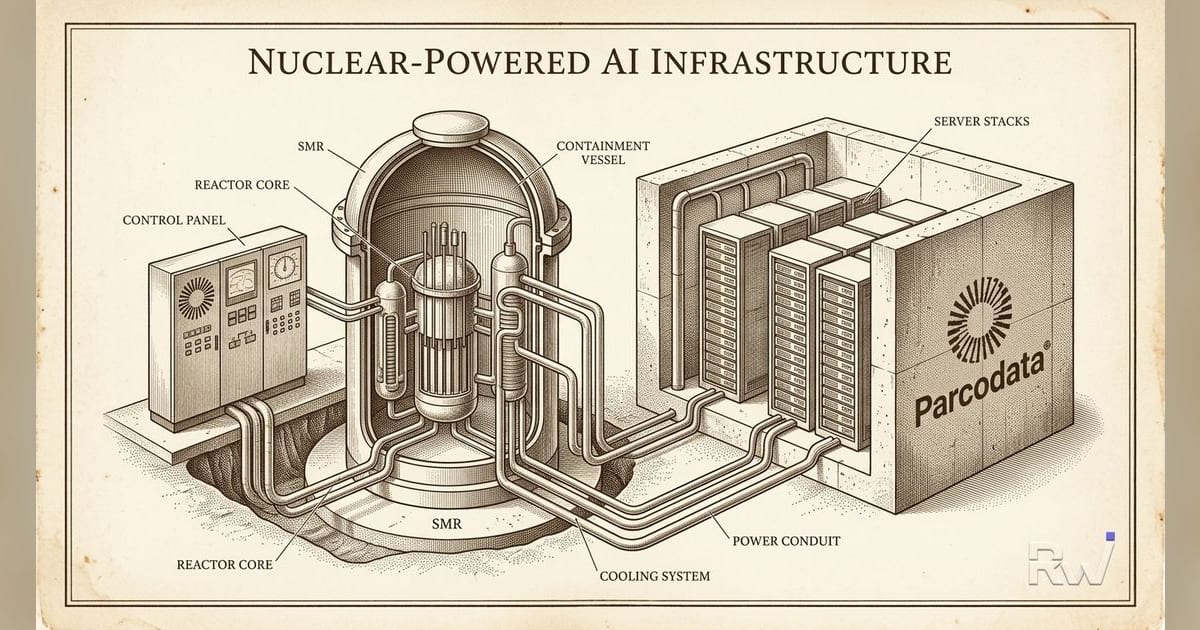
The financing is an early marker for a plan whose ambition dwarfs the capital disclosed so far. Gadotti and Longobardi want ParcoData to build data center campuses that generate power behind the meter from small nuclear reactors, avoiding the grid interconnection delays that have become a constraint on new AI infrastructure. ParcoData says its sites would also operate without evaporative water consumption, pairing sealed-loop reactors with dry cooling.
Gadotti brings an unusual mix of physics and corporate operations to that pitch. ParcoData says he holds a doctorate in theoretical physics, spent 10 years as a senior partner at EY and served as co-CEO of Value Team, an Italian technology services group that employed over 5,000 people. ParcoData also credits him with two fintech exits.
Longobardi built his career in capital markets. ParcoData says he led Ladenburg Thalmann's European operation and co-founded State Capital. In a 2017 account of his career, Longobardi wrote that he arrived in New York from Naples at 21 with $500, worked his way from odd jobs into finance and later built State Capital across two continents. He also described being exonerated after a money-laundering accusation that had led to his detention in Brazil.
A first check against a gigawatt blueprint
ParcoData was incorporated in Florida on January 2nd, according to state corporate records. The SEC filing classifies ParcoData under "Other Energy," rather than technology, and says ParcoData declined to disclose its revenue range.
The offering relies on the SEC's Rule 506(b) exemption. ParcoData reported no sales commissions or finders' fees, and no proceeds allocated to its four named executives. The filing lists Gadotti as chief executive, Longobardi as president, treasurer and secretary, Enea Tarenzi as chief financial officer, and Steven Coulis as chief operating officer.
Tarenzi's background suggests the founders are preparing for a financing and reporting process that will extend beyond this first offering. Limestone Advisory describes him as a chartered accountant and former KPMG and CFGI capital-markets executive who has worked on SEC reporting, IPOs and SPACs. Coulis began as an FX options trader at Lehman Brothers and later worked at Pharo Management, according to a profile of his earlier real estate finance venture.
ParcoData's public roadmap calls for a 7,000-acre Nevada anchor campus, roughly 10,000 acres across six metro-adjacent markets, 400 megawatts of capacity by the end of 2028 and 4 gigawatts by 2030. Those are ParcoData's targets. The land, permitting status, customer commitments and delivery schedule have not been independently established.
ParcoData is inviting prospective tenants to reserve capacity through non-binding letters of intent that would convert when development milestones are reached. The structure lets Gadotti and Longobardi seek evidence of customer demand before the reactors or data center shells are built. ParcoData has not named any tenants or disclosed binding leases or power agreements.
Two reactor paths, both still before licensing
Gadotti and Longobardi are spreading their reactor bet across two suppliers. ParcoData identifies Nasdaq-listed Terra Innovatum and Deep Fission as reactor partners, while listing Jacobs for engineering, procurement and construction work.
Terra Innovatum is developing the SOLO micro-modular reactor, designed to generate about 1 megawatt of electricity per unit using low-enriched uranium and helium cooling. The Nuclear Regulatory Commission says it is engaged in pre-application work with Terra Innovatum. Several SOLO design and safety documents remained under review as of the NRC page's June 4th update.
Deep Fission's design would place a pressurized-water reactor about one mile underground in a 30-inch borehole. The NRC's Deep Fission docket says each reactor is intended to generate up to 15 megawatts of electricity. Deep Fission has been in pre-application activities since May 2024, and a conceptual design description remained under review in June.
Pre-application engagement establishes that both reactor developers are working with the regulator. It does not amount to a construction or operating license. ParcoData's goal of first energy in 2028 depends on reactor development, licensing, land approvals, construction and customer contracting moving on closely aligned schedules.
ParcoData also plans to sell powered data center shells, electricity, immersion cooling systems, medical radioisotopes and products derived from waste heat. ParcoData says its LiquidCool single-phase immersion cooling technology is already available commercially and covered by 72 granted patents. The ownership or commercial licensing arrangement behind that technology is not publicly detailed.
Nuclear AI infrastructure is drawing much larger pools of capital
ParcoData is entering a market where AI developers and data center operators increasingly treat dedicated power as part of the compute stack. Oklo and Switch announced a non-binding framework in December 2024 covering up to 12 gigawatts of advanced nuclear power. In May, Blue Energy and Crusoe outlined a 1.5-gigawatt nuclear-powered AI campus in Texas, with gas generation intended to supply earlier power while nuclear construction proceeds.
Those projects show why ParcoData's first $544,910 matters and how much remains to be financed. Nuclear generation and hyperscale data center construction demand capital measured far beyond a seed offering. ParcoData's filing provides Gadotti and Longobardi with their first disclosed group of backers and a chance to fund the next layer of development. Their harder task is turning an integrated website blueprint into verified land control, regulatory progress, contracted demand and infrastructure financing.
The founders have assembled backgrounds spanning theoretical physics, investment banking, public-company reporting and infrastructure finance. The Form D puts the first public number against that combination. Nine investors have committed $544,910. ParcoData is seeking another $1.77 million before the larger financing problem begins.