In recent research (see "Seeing in Pangram Space"), we showed that our flagship text detection model can tell the difference between text generated by different model providers (OpenAI, Anthropic, Google, etc), by training a linear probe on internal activations.
In Pangram Space, our Model-Family was only 91% top-1 accurate. This means that at present, highly accurate generator classification on an individual sample basis is still a challenging problem. However, in aggregate, this capability can be used to observe trends in data. Recently, we took small slices of anonymized, aggregated data submitted to the Pangram dashboard and classified them by predicted generating model family.
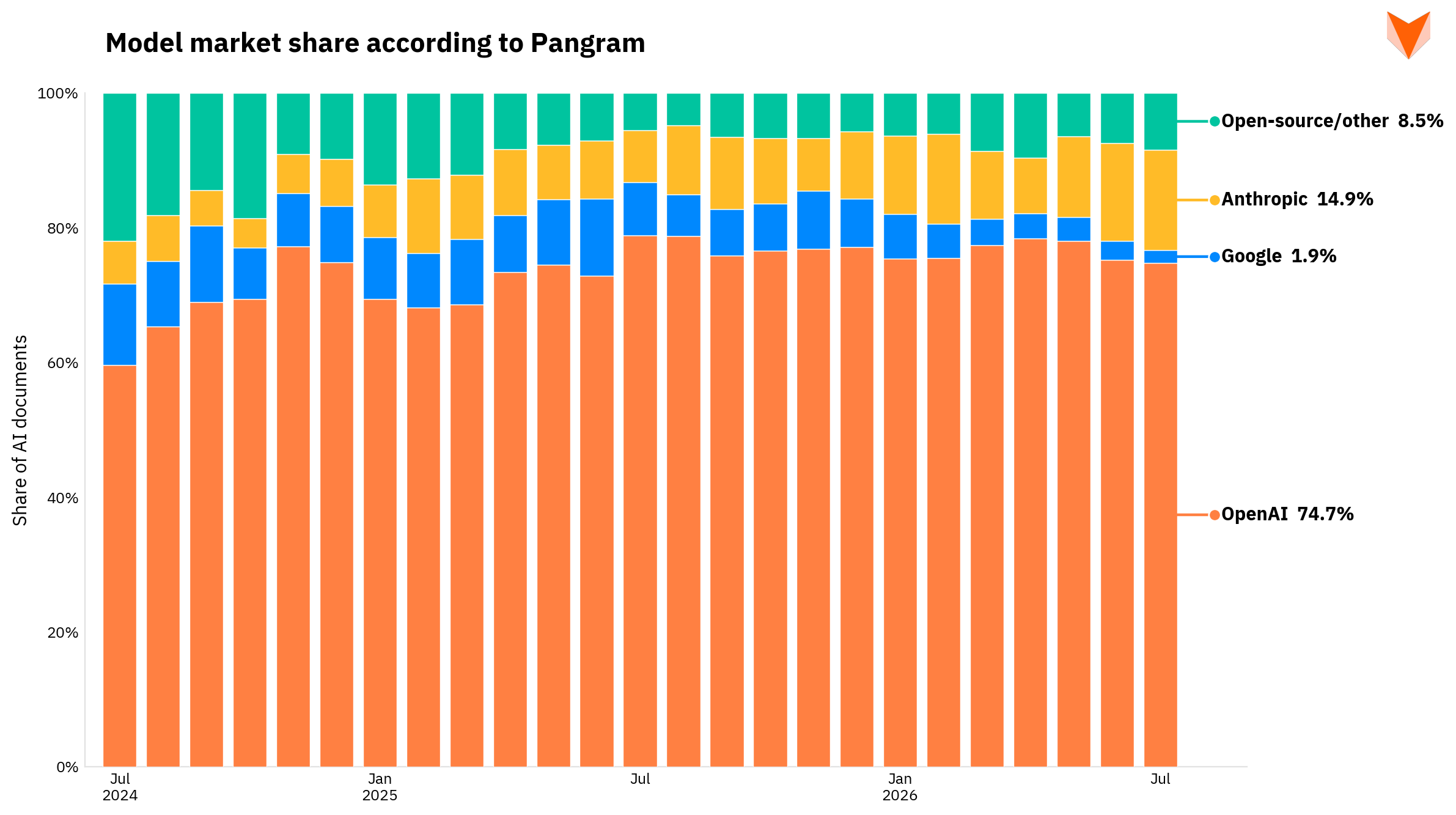
By doing this for historical data, we can observe long-lasting trends in market share of different AI providers. Here is our monthly results over the past two years:
Pangram Model Market Share
Examining this closely, we see a few trends emerge:
Traditional wisdom tells us that ChatGPT is by far the biggest consumer AI provider, and Pangram’s results agree: OpenAI models have not had a single month below 50% submitted share in the entire time Pangram has existed.
From our earliest days in 2024, Anthropic’s models have surged from 4.3% to 14.9%. This reflects Claude's gaining popularity among technical and scientific communities. The most stark change we see over Pangram's history has been a reduction in the amount of submitted text from Google’s models. Early days saw 12% share from Google models, while July 2026, the most recent month, saw a collapse to 1.9%.
Model Market Share: Pangram vs. OpenRouter
Other providers publish similar metrics. Here, we show OpenRouter market share over time side-by-side with Pangram’s data. While overall share is fairly different, we see the preservation of some trends. For example, Google’s diminishing market share is visible in both.
It’s hard to say which estimates are closer to the truth. Data from Pangram and OpenRouter each have their biases, which may make one more operable than another depending on the context.
Potential Biases from OpenRouter market share data:
Potential Biases from Pangram market share data:
The interesting part of this comparison lies in the commonality. Despite the very different sampling mechanisms, the reduction of traffic from Google is visible in both.
Model specialization
Another notable result occurs when we break down our data by subject. Overall, the models have broadly similar shares across subject areas, though we do observe some modest differences. We see that OpenAI models are more often used for subjects corresponding to everyday life as well as the humanities. Anthropic and Google models are more used in programming/technical content, as well as across the sciences. These differences are small, however, and are dwarfed by the overall similarity in subject distributions across models.
As AI researchers, we often perceive the competitive landscape of frontier model providers as changing at a lightning pace. However, it’s perhaps not quite as quick as we think. In this post, we show that OpenAI has largely retained its commanding lead in consumer AI usage. More interesting trends emerge when you examine the fight for second place, as Anthropic starts to push out Google’s early claim to second place.
As Pangram’s models continue to become more precise at classifying the generating model, more interesting research will become available, especially as it comes to the shifting market share among smaller/open source model providers. Continue to follow along for more!
Elyas Masrour is a founding engineer at Pangram. Since joining Pangram as it's second employee straight out of the University of Maryland, he has built out critical infrastructure such as the model serving API, role-based access controls, and supporting evidence pipelines. Elyas also works closely with the research team on projects like adversarial robustness, model interpretability, and heterogenous mixed content detection. Outside of work, Elyas enjoys a wide range of human creativity and expression, including filmmaking, reading, and exploring the city.