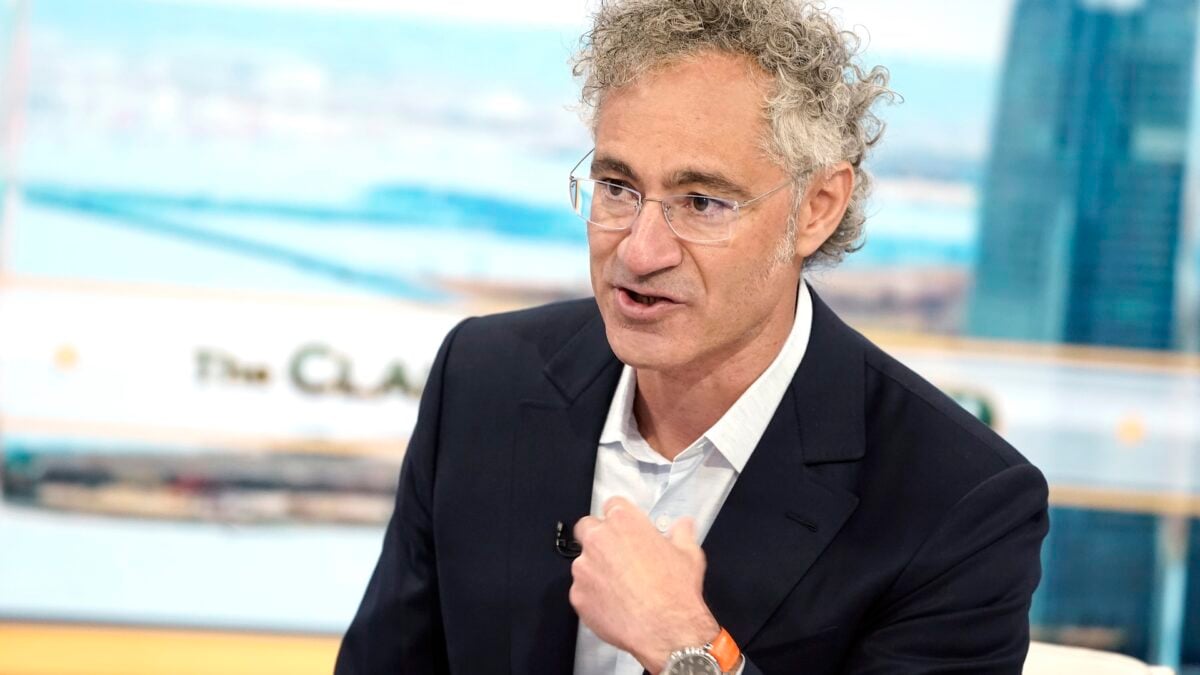
On Thursday, Palantir CEO Alex Karp appeared on CNBC, where he gave a characteristically bizarre performance, frantically gesticulating and jumping from topic to topic. But there was one area where he seemed to make some sense.
Karp was asked about the frontier AI labs like Anthropic and OpenAI within the context of concerns about the destruction of humanity. The subject has dominated the news over the past week after the resignation of an Anthropic employee gained mainstream attention in a way that previous resignations and warnings hadn’t broken through.
The Palantir CEO seems to believe that companies like Anthropic want the government to cap their liability when something goes wrong with their AI models. Or when the models just use all that data that’s been absorbed from private companies. And he believes that the only way to actually accomplish that is through nationalization of their businesses.
“So what’s actually happening is this is reported as regulation, non-regulation movement,” Karp told CNBC on Thursday. “That’s actually not what this movement is. The view that I believe they have is… these businesses have to be nationalized because if you don’t nationalize them, every single one of my clients is going to sue.”
Karp believes that a big part of the problem is that these companies are hoovering up sensitive data from their commercial clients and using that to improve their models. But exposure of that proprietary data comes with enormous risk, to say nothing of angering the companies who are seeing their data… let’s say repurposed.
This problem was most recently demonstrated when OpenAI announced that it had solved the Navier–Stokes problem. Mathematicians who are working on the problem believe OpenAI used data they had uploaded to Codex. OpenAI denies that its AI had solved the problem by directly using their work, but couldn’t rule out that its model had been improved through their data indirectly.
Karp noted several times to CNBC on Thursday that he has great respect for Dario Amodei as a businessman. But he suggested that most people can’t read between the lines when Amodei lays out an argument about the future. He said that if you’re proposing that your company could destroy “10% of the world,” that’s an unacceptable amount of risk for investors, and there needs to be some kind of workaround. The only solution, as Karp sees it, is liability protection from the government, which may only come through an ownership stake taken by the Trump regime of something like 50% of the company.
The Palantir CEO also talked about politics and noted that he’s not mad at the “far left and far right” who are against AI, because they’re just following public sentiment. “I think it will raise the boats of most people,” Karp said of AI, “but you can’t have a revolution where I become 50 times wealthier and everyone else becomes 10% wealthier.” But he went on to say that he didn’t believe in a wealth tax because that “kills entrepreneurship.”
Karp went into some strange areas, like insisting that he didn’t hate China because he’s a “high-level practitioner of tai chi,” but has chosen to be on the side of the U.S. and everyone needs to choose a side in the geopolitical battles of the day. But when he became focused on the practical concerns facing the AI frontier labs and what the CEOs really want, he made a fair amount of sense.
Karp noted that there’s no other industry where people can just throw up their hands about the risks involved and insist on government regulation as the solution. The AI companies need to take some responsibility for what they’re creating: “The first step is to say, ‘Okay, you’ve disclosed this. What are you doing about it?’ And the second step is to say, if you’re not doing it, you’re not being responsible.”
When he was asked by the CNBC hosts how the liabilities would be written into the S-1, the paperwork submitted before going public, he emphasized that they may never go public.
“You’re assuming that there will be an S-1. Now… okay, maybe there will be,” said Karp. “The only way to deal with this kind of liability is to go to the government and say, ‘Nationalize us, please.’ You know, a lot of times in business, people don’t say what they want. They’re leading you to the conclusion.”
Anthropic and OpenAI have both previously said they plan to go public this year, though OpenAI’s Sam Altman recently announced a delay and won’t go public in 2026.
Karp emphasized that the investors might be “the mark” in this scenario, meaning they’re the ones being swindled: “What is the first lesson in poker and in life? If you think the other person’s the mark, you’re the mark.”
The Palantir CEO said he doesn’t know whether the White House will actually go through with nationalization of the AI companies but he thinks that nationalization won’t lead to the outcomes that investors want.
“When you have unlimited liability, the only way to deal with it would be to go to the government and say, We’ll give you 50% of our business,” said Karp. “Of course, the value of the business will collapse first when you do that, collapse another time when you have people on the board, collapse another time…. All of us might even collapse the whole market.”