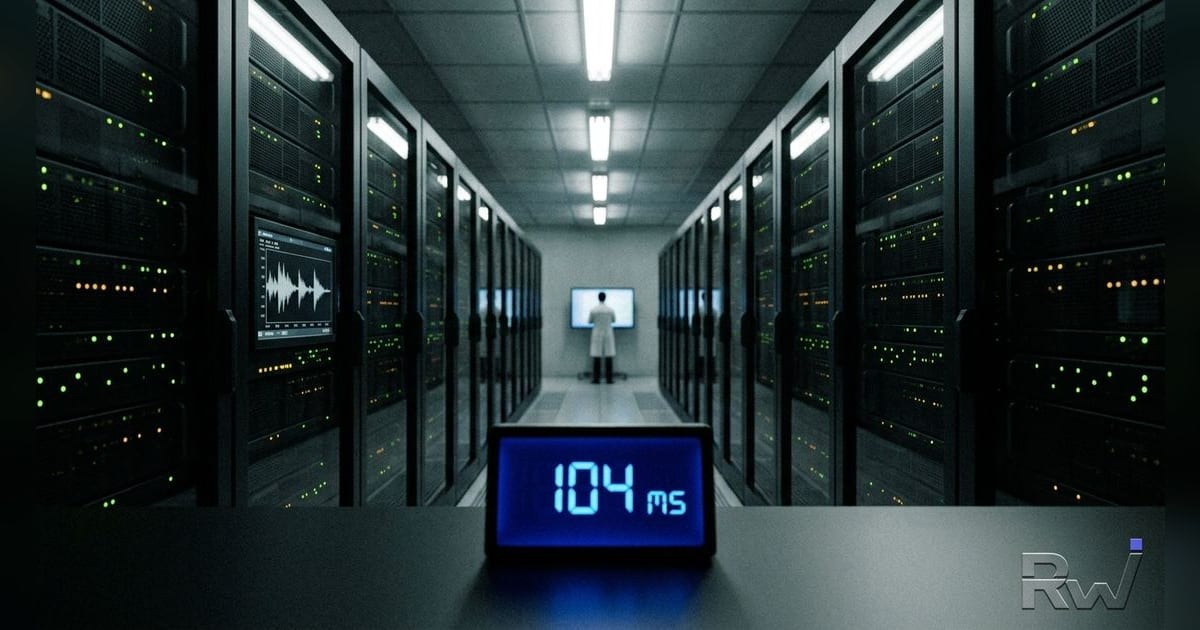
On July 23rd, 2026, Artem Kukharenko (@aikukharenko) announced on X that Palabra.ai had built "the world's fastest text-to-speech model." The claim rests on an independent benchmark run by Coval (@covaldev), which placed Palabra.ai at the top of its latency leaderboard with a 104 ms time to first audio.
The tweet thread outlined three quantitative points:
- 104 ms to first audio, which the author described as "2x faster than the nearest competitor."
- A headline ranking ahead of ElevenLabs, Cartesia, and "every other major lab."
- An architecture that reaches 35 ms before any network overhead, according to the author's description of the underlying model.
Coval's benchmark methodology, as summarized by Kukharenko, measures the silence a listener experiences before speech begins, using "pinned datasets" and an open‑source runner that anyone can reproduce. The thread notes an average latency of 520 ms across providers, meaning the median voice service adds over half a second of silence before a word is heard. By contrast, Palabra.ai's 104 ms figure represents a reduction of more than 400 ms.
Why latency matters for voice agents
Real‑time speech synthesis is a critical component of conversational agents, virtual assistants, and interactive AI products. Every millisecond saved on text‑to‑speech (TTS) directly frees up compute cycles for the model to continue reasoning, retrieve information, or invoke external tools. Kukharenko quantified the benefit as "we give the brain ~400 ms back," implying that faster voice output extends the time window for downstream AI processing.
The thread also highlighted a design goal: synthesis starts from the first two words, and the voice stops instantly on interruption. Those characteristics are essential for seamless turn‑taking in dialogue systems, where lag or delayed cut‑offs can break conversational flow.
Technical snapshot
According to the fifth tweet, Palabra.ai's architecture achieves a 35 ms pre‑network overhead latency, with the remaining delay attributed to transport and infrastructure. The company states it builds every real‑time speech model in‑house—including TTS, automatic speech recognition (ASR), and speech‑to‑speech translation—optimizing each for latency from day one. No further technical detail (e.g., model size, hardware stack, or software stack) was disclosed in the thread.
Coval's benchmark page, linked in the tweet (benchmark overview), provides a public leaderboard and a reproducible runner. Palabra.ai also offered a $50 free credit for testing its models, directing readers to its TTS product page (Palabra.ai TTS).
Market context
The TTS landscape includes established players such as ElevenLabs, Cartesia, Google Cloud Text‑to‑Speech, and Amazon Polly. Public latency figures for these services typically range between 300 ms and 800 ms for comparable prompts, though many providers publish best‑case numbers that exclude end‑to‑end measurement. Coval's approach of measuring silence experienced by a real listener seeks to close that reporting gap.
If Palabra.ai's latency claim holds up under broader scrutiny, the company could position itself as a preferred provider for latency‑sensitive applications—voice assistants on mobile devices, real‑time captioning, and AI‑driven call‑center automation. Faster TTS also benefits low‑bandwidth environments where round‑trip network time dominates.
Independent verification needed
The only source for the latency numbers is the Coval benchmark, which the tweet describes as "independent" but does not disclose the benchmark's sponsor, hardware configuration, or evaluation protocol beyond the brief summary. No third‑party analysis or peer‑reviewed study has been cited. As a result, the claim remains unverified outside the Coval‑Palabra.ai test suite.
Potential customers will likely run their own measurements before committing to a production deployment, especially given the $50 credit invitation. The open‑source runner referenced in the thread should facilitate such checks, assuming the repository is publicly available and maintained.
Outlook
Palabra.ai's announcement arrives at a time when AI‑powered voice interfaces are expanding beyond smart speakers into automotive dashboards, customer‑service bots, and wearable devices. Reducing latency from the typical half‑second range to just over a tenth of a second could unlock smoother user experiences and lower the computational budget allocated to speech synthesis.
The company has not disclosed funding status, valuation, or a roadmap for scaling the model beyond the benchmark. Without insight into the underlying compute costs or revenue model, it is unclear how the performance advantage translates into a sustainable business.
Bottom line: Palabra.ai posted a 104 ms time‑to‑first‑audio figure in Coval's benchmark on July 23rd, 2026, positioning the model as the fastest publicly measured TTS system. The claim hinges on a single benchmark and a brief technical description; broader validation will determine whether the latency edge can be leveraged at scale.