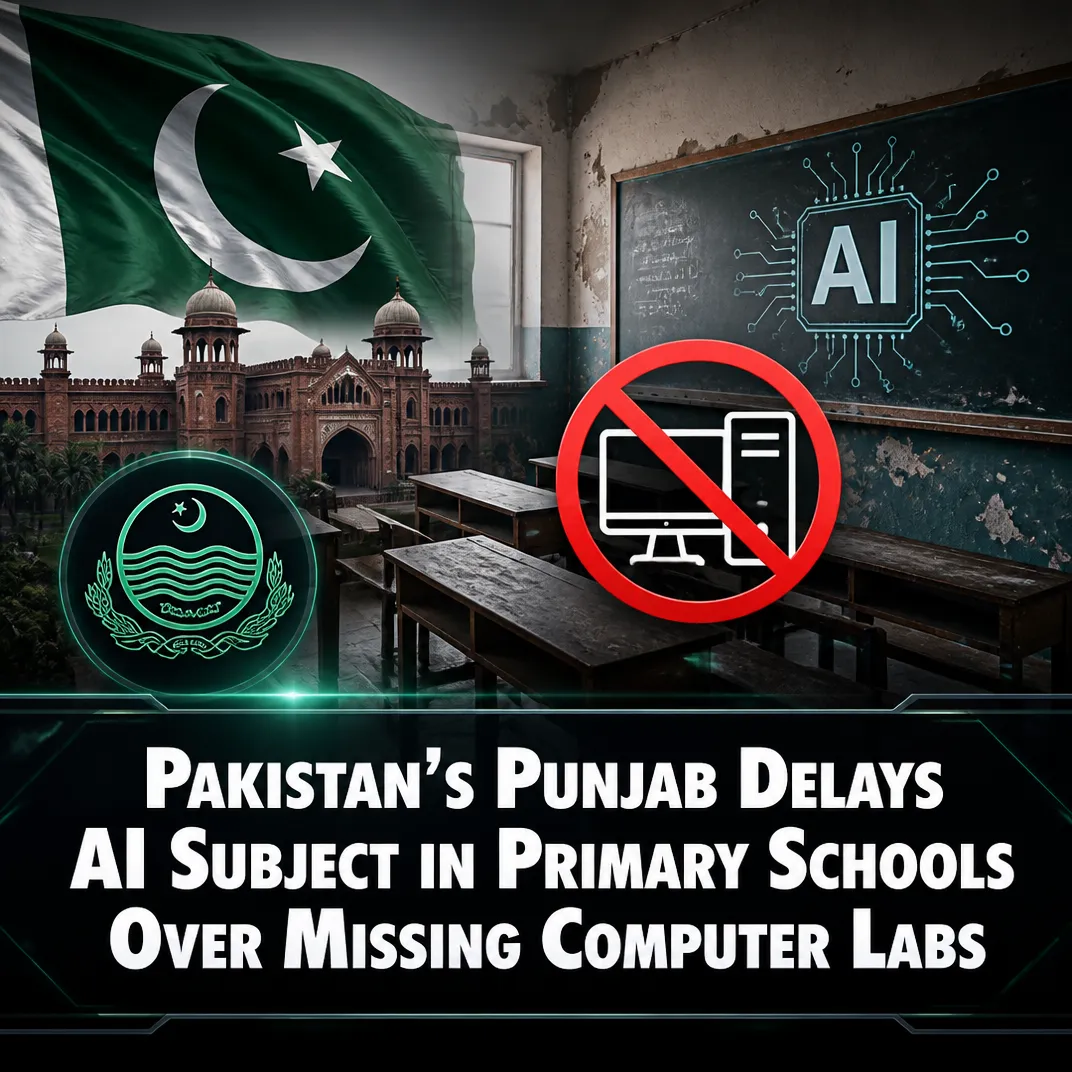
July 20, 2026, (Inside AI) — The Punjab Education Curriculum Training and Assessment Authority (PECTAA) has delayed the official notification to introduce Artificial Intelligence as a subject in primary schools. The holdup stems from a stark reality: thousands of government institutions lack the computer labs essential for teaching the subject.
PECTAA had approved AI instruction for students from Grade 1 to Grade 5, targeting the upcoming academic year for rollout. But the absence of basic infrastructure has forced officials to the finalization of an implementation plan. Without formal notification, the printing of AI textbooks cannot proceed.
This delay exposes a critical tension between ambitious edtech policy and on-ground capacity. Punjab’s push mirrors global trends—countries like Estonia and Singapore have embedded computational thinking early—but those nations paired curriculum reforms with massive infrastructure investments. In Punjab, over 40,000 government primary schools serve millions of students, many in rural areas with erratic electricity and no internet.
The Cost Barrier and a Curriculum Compromise #
Establishing dedicated AI labs in thousands of schools would cost millions of rupees, a sum officials call the main obstacle. Faced with this, authorities are weighing a fallback: integrating AI concepts as a chapter within existing subjects like mathematics or general science, rather than launching AI as a standalone course.
This approach isn’t new. Kenya and parts of India have tried infusing coding into existing curricula to bypass hardware shortages. But experts warn that reducing AI to a textbook chapter risks superficial learning. Dr. Ananya Sharma, an education technology researcher at Lahore University of Management Sciences, notes:
“Without hands-on experience, children may memorize AI definitions but never grasp how algorithms actually work. The gap between theory and practice could widen.”
PECTAA officials said the matter remains under review and that a formal notification on the AI curriculum will follow once a final decision is reached. The initiative is part of a broader push to equip students with modern technology skills while confronting persistent infrastructure gaps in government schools.
Meanwhile, the private sector has stepped in. EdTech startups like Knowledge Platform and Sabaq offer offline AI learning kits using low-cost tablets and Raspberry Pi devices. Some pilot projects in Lahore and Rawalpindi have shown promise, but scaling them across the province remains a funding challenge.
Infrastructure Gaps and the Road Ahead #
Punjab’s digital divide is stark. A 2025 provincial education report revealed that only 12% of primary schools have functional computer labs, and just 8% have reliable internet. Teacher training is another hurdle: a recent survey found that less than 5% of primary educators feel confident teaching basic computing, let alone AI.
The delay also impacts the textbook supply chain. The Punjab Curriculum and Textbook Board had drafted AI content for grades 1–5, but printing was contingent on official notification. Publishers now face uncertainty, and any rushed integration into existing subjects could lead to disjointed materials.
Looking forward, PECTAA may explore hybrid models. One proposal involves mobile AI labs—buses equipped with computers that visit schools on rotation, a model used in Bangladesh and South Africa. Another option is leveraging smartphone penetration: over 70% of households in Punjab have at least one smartphone, which could support basic AI literacy apps if data costs are subsidized.
For now, the delay underscores a familiar pattern: policy ambition outpacing implementation capacity. As Pakistan races to prepare its youth for a tech-driven future, the gap between vision and reality in its classrooms remains the biggest lesson to learn.