Editor's note: The "Short of War" Podcast discussing this article is AI-generated.“We call on the Pakistani army and security services not to obey Pakistan’s corrupt political and military leadership and urge them to overthrow it,” al-Qaeda declared in an April appeal to Pakistan’s military amid the Afghanistan-Pakistan war. The same statement told Pakistani pilots to defy their commanders and target them “by any means possible.” This appeal was aimed at members of the military and security services entrusted with protecting one of the world’s fastest-growing nuclear arsenals.
For more than twenty years, several barriers kept Pakistan’s nuclear weapons beyond militant groups’ reach. The United States and its allies had troops and intelligence networks in Afghanistan. Washington and Islamabad cooperated on counterterrorism and nuclear security. Pakistan also built a serious system to guard its arsenal. Together, these measures made it much harder for al-Qaeda to gain access to Pakistan’s nuclear enterprise. Those barriers are now weaker, and the Afghanistan-Pakistan war is becoming a nuclear security problem. Al-Qaeda’s enduring nuclear ambition now coincides with greater access through regional militant networks, less U.S. visibility, and growing pressure on the very institutions Pakistan relies on to secure its arsenal. Afghanistan is again a sanctuary for al-Qaeda, this time under a Taliban government rather than an insurgency operating on the margins. The United States no longer watches the threat from inside Afghanistan. Al-Qaeda is also strengthening its ties with the Pakistani Taliban, Tehrik-e Taliban Pakistan (TTP), which is already at war with Islamabad. Pakistan, meanwhile, is guarding a larger and more mobile arsenal while fighting terrorism, insurgency, and a cross-border conflict along its western frontier. The war now reaches beyond the border and into the security of Pakistan’s nuclear arsenal.
Danger Contained
Al-Qaeda’s interest in weapons of mass destruction is not new. In the 1990s, Osama bin Laden called acquiring nuclear weapons a religious duty. His operatives shopped for uranium and forged ties with Pakistani nuclear scientists. After 9/11, American forces found nuclear documents in al-Qaeda safe houses and uncovered meetings between the group’s leaders and senior figures from Pakistan’s nuclear program, including Bashiruddin Mahmood and Chaudhry Abdul Majeed. Both men were tied to Ummah Tameer-e-Nau, an organization founded by retired Pakistani nuclear scientists and military officers. These efforts show that al-Qaeda has long looked to scientists, military personnel, and procurement networks for access to nuclear knowledge and material. Pakistan’s own A.Q. Khan network demonstrated that designs, technology, and components could move through Pakistani channels despite formal controls.
By 2007 and 2008, the threat had moved closer to Pakistan’s nuclear geography. The Pakistani Taliban (TTP) and al-Qaeda struck installations tied to, or near, Pakistan’s nuclear complex. The most significant attack came in 2008, when the Pakistani Taliban attacked the Wah cantonment, described as one of Pakistan’s main nuclear-weapons assembly sites. That same year, a bipartisan U.S. commission warned that if you mapped terrorism and weapons of mass destruction, “all roads would intersect in Pakistan.” A 2013 House Homeland Security hearing reached a similar conclusion: al-Qaeda had pursued nuclear weapons for two decades, and terrorists had repeatedly attacked facilities associated with Pakistan’s nuclear enterprise.
Yet the breach many feared never occurred because sustained U.S. and Pakistani pressure made it difficult for al-Qaeda to turn its nuclear ambitions into access. American and NATO forces were still in Afghanistan, while U.S. intelligence maintained access to the borderlands, sources inside jihadist networks, and the ability to disrupt plots early. Washington and Islamabad cooperated on counterterrorism, and the United States spent roughly $100 million helping Pakistan secure its nuclear arsenal. Michael Morell, the CIA’s former acting director, later said American intelligence may have been what prevented al-Qaeda from acquiring a Pakistani nuclear weapon.
Pakistan, for its part, was not careless. After the Khan scandal and post-9/11 insider revelations, it built a serious custodial architecture: the Strategic Plans Division to manage the arsenal, a dedicated security force, a personnel reliability program to screen custodians, and a posture that kept warheads disassembled and stored apart from their delivery systems. Violence from 2007 to 2009 tested that system, but the barriers held. They held because pressure, visibility, U.S.-Pakistan cooperation, and Pakistani institutional effort reinforced one another. Today, that system is operating under greater pressure and with less outside support.
The Buffers are Weakening
Al-Qaeda’s nuclear ambitions never died. In 2009, an al-Qaeda leader in Afghanistan said the group would use Pakistan’s nuclear weapons against the United States if it could. More than a decade later, the theme resurfaced. In 2023, Ibrahim al-Qosi, a senior al-Qaeda in the Arabian Peninsula figure, released a revised edition of his 2021 book with a new chapter on weapons of mass destruction, signaling renewed emphasis inside al-Qaeda’s Yemen branch. That same year, Saif al-Adel, al-Qaeda’s presumed de facto chief, wrote that only weapons of mass destruction could deter the West. Al-Adel helped run al-Qaeda’s original nuclear effort and its early attempts to buy uranium. The group also retains some of its 9/11 era nuclear experts, including Ali Sayyid Muhammad Mustafa al-Bakri, the chemist Khalid Sheikh Mohammed called al-Qaeda’s “nuclear chief,” who remains at large in Iran alongside al-Adel. The ambition has endured, but the environment around it has changed.
The first buffer to weaken was the pressure al-Qaeda faced in Afghanistan. After the U.S. withdrawal and the Taliban’s return to power, Washington had to watch from over the horizon, with less visibility into the networks it once kept under pressure. Al-Qaeda also regained a permissive sanctuary inside a Taliban-run state—something it had not enjoyed for two decades. From there, the group is rebuilding training pipelines, deepening regional relationships, and tightening operational ties to the TTP, the Pakistani Taliban insurgency fighting Islamabad. It is increasingly acting as a service provider to the TTP, offering guidance, expertise, and operational support. That gives al-Qaeda an indirect pathway into Pakistan through a movement already at war with the state and already attacking security institutions. In that way, al-Qaeda brings the nuclear ambition while the TTP brings local access, manpower, and direct pressure on the institutions Pakistan relies on to secure its arsenal.
The second buffer to weaken was the U.S.-Pakistan partnership that once helped contain that danger. Washington suspended broad security assistance to Pakistan in 2018, and cooperation with Islamabad is now narrower, colder, and more transactional. The contrast with the post-9/11 period is sharp. In 2022, President Biden called Pakistan “one of the most dangerous nations in the world,” citing “nuclear weapons without cohesion.” By 2026, Washington no longer treated Pakistan’s nuclear enterprise as a joint security problem to manage with U.S. assistance. It treated it as a growing source of concern.
Pakistan, meanwhile, faces heavier strain than at any point in that period. It ranks among the countries most affected by terrorism. It is fighting the TTP in Khyber Pakhtunkhwa, Baloch separatists and ISIS-K in Balochistan, and now a cross-border war along the same western frontier. In March 2026, as the war escalated, Pakistan accused Afghan forces of launching a drone attack in Rawalpindi, the headquarters of the Pakistani army. The significance is not only symbolic. Much of Pakistan’s nuclear weapons infrastructure sits in the north and west of the country and around the Islamabad-Rawalpindi corridor. The conflict now touches the military and security geography that underpins Pakistan’s nuclear establishment.
Pressures on Pakistan’s Nuclear System
These pressures are reaching Pakistan’s nuclear command and security system at a difficult moment. A 2025 constitutional amendment elevated the army chief into the new role of Chief of Defense Forces, abolished the old Chairman Joint Chiefs of Staff Committee post, and created a new Commander of the National Strategic Command with nuclear-command responsibilities. Critics argue that this kind of redesign breeds uncertainty exactly where Pakistan needs clarity: who coordinates the services, who manages nuclear command, and how authority flows in a crisis. The army and intelligence services entrusted with the arsenal are the same institutions absorbing the country’s internal and border pressures, with less external visibility than at any point since 9/11.
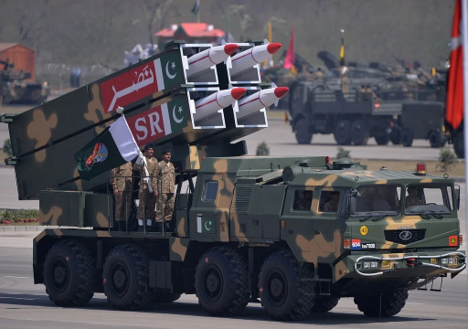
The arsenal itself has changed too. Pakistan now fields a larger and more mobile arsenal of roughly 170 warheads, with more likely if current trends hold. Its nuclear architecture has diversified, with nuclear-capable aircraft, cruise missiles, and road-mobile ballistic systems, including the Shaheen-II. The short-range Nasr, a road-mobile, low-yield nuclear delivery system built for quick response, captures the security problem mobility creates. More dispersed systems mean more weapons, launchers, personnel, and command arrangements to protect, especially in a crisis.
The danger today is not that al-Qaeda will steal a Pakistani nuclear weapon next week. Pakistan reportedly guards its warheads through a layered custodial system, separates them from delivery systems, and protects them with use-control measures. Nor is there evidence that any terrorist group has ever produced fissile material. The more plausible danger lies around the arsenal: a compromised officer, a sympathetic technician, an insider at a sensitive facility, a militant network with access to security personnel, or a system under enough strain to miss the warning signs.
Al-Qaeda has looked for openings like these before. Pakistani nuclear scientists met with bin Laden and Ayman al-Zawahiri in Afghanistan, where one of them briefed the al-Qaeda leaders on the infrastructure a nuclear weapons program would require. The A.Q. Khan network ran for years before its exposure, showing that insiders can move nuclear designs, components, and procurement channels without immediate detection. In 2014, al-Qaeda recruited Pakistani naval officers for an alleged plot to seize a frigate and turn its missiles on U.S. vessels in the Arabian Sea; the officers had boarded the warship before authorities stopped them. Each case shows al-Qaeda trying to penetrate institutions outsiders often treat as impermeable.
Nuclear security ultimately depends on people, and al-Qaeda is now openly courting them. Its April statement is a recruitment pitch aimed at Pakistani soldiers, pilots, intelligence officers, and security personnel, the people every custodial system relies on. By urging them to side with their “Afghan brothers” and restore Pakistan to what it called its “honorable past,” the group appeals to loyalty, grievance, religious identity, and obedience inside the institutions that hold the state together and protect its arsenal.
Those appeals land in institutions with known vulnerabilities. Overlapping currents of anti-U.S. sentiment, Islamist sympathy, personal and clan ties to militants, and resentment over campaigns against fellow Pakistanis have long run through parts of Pakistan’s army and intelligence services. The concern is not hypothetical. Hamid Gul, a former director-general of Pakistan’s Inter-Services Intelligence agency, was implicated for advising al-Qaeda and the Taliban on developing chemical, biological, and nuclear weapons. These are the vulnerabilities al-Qaeda is now trying to widen. They point to the scenario Bruce Riedel warned about: Pakistan’s arsenal remains under military control, but if militant Islamists and al-Qaeda took control of the country, “the arsenal would fall with it.”
Prevention is the Only Option
Al-Qaeda now operates closer to the people and networks that could give it access to Pakistan’s nuclear enterprise. It has sanctuary under Taliban rule, deeper ties to Pakistani militants fighting Islamabad, and a message aimed directly at soldiers, pilots, intelligence officers, and security personnel. Pakistan is fighting multiple threats while guarding a larger and more dispersed arsenal. The United States, meanwhile, has less visibility into the networks that could turn intent into opportunity. Together, these pressures narrow the margin for error.
That is why the Afghanistan-Pakistan war cannot be read only as a border conflict or regional crisis. It is pressing on the institutions that secure Pakistan’s nuclear arsenal. In May, shortly after al-Qaeda’s appeal, the United Nations warned that the risk of nuclear terrorism was higher than ever. The 2026 U.S. Counterterrorism Strategy calls keeping unconventional weapons out of terrorists’ hands a “no-fail” mission. Pakistan is now one of the places where that mission will be tested.
Washington does not need to reoccupy Afghanistan, and it should not pretend the Taliban is a counterterrorism partner. But it can take less cinematic and more effective steps: restore intelligence visibility where possible, revive the nuclear security dialogue with Islamabad, and press regional capitals with leverage over Kabul and Islamabad to treat the war itself as a nuclear security concern. Above all, Washington should recognize that deterrence does not cover this gap. A weapon or a quantity of fissile material passed through an insider or a militant network with no territory and no capital may arrive without a return address. By the time responsibility is established, if ever, the damage would already be done. The only workable strategy is to prevent access before material, expertise, or custody slips outside state control.
For twenty years, the “loose Pakistani bomb” was feared yet never materialized. That record should not reassure Washington. It should remind Washington what prevention achieved when pressure, visibility, cooperation, and Pakistani security measures worked together. The Afghanistan-Pakistan war is now weakening those conditions, one barrier at a time. We have spent two decades not failing at this. The catastrophe would be to assume that is good enough. *Dr. Sara Harmouch is a counterterrorism expert and CEO of H9 Defense, a research and advisory consultancy specializing in terrorism, national security, geopolitical risk, threat assessment, and open-source intelligence. Her research examines militant organizations, alliance dynamics, irregular warfare, and the conditions under which armed groups adapt, endure, and expand from domestic to international violence. She also studies terrorism’s intersection with emerging technologies, unconventional capabilities, and weapons of mass destruction. Dr. Harmouch is a Security Fellow at the Frontier Security Institute and a Non-Resident Fellow at George Washington University’s Program on Extremism. Raised in Lebanon and a native speaker of Arabic and French, she conducts fieldwork and primary-source research across the Middle East, Africa, Asia, and Europe. She regularly briefs U.S. and international security agencies, and her work has appeared in The Washington Quarterly, Lawfare, War on the Rocks, Defense One, The Long War Journal, NPR, and VOA, among others. She holds a Ph.D. in Justice, Law, and Criminology from American University and a master’s degree in International Relations, Science, and Technology from the Georgia Institute of Technology. Follow her on X: *@Dr_SaraHarmouch
The views expressed are those of the author and do not reflect the official position of the Irregular Warfare Initiative, Princeton University’s Empirical Studies of Conflict Project, the Modern War Institute at West Point, the Department of the Army, the Department of War, or the United States Government.
Main image is Pakistan’s nuclear capable Nasr missile system at a parade in 2016, taken from Wikimedia Commons.
*If you value reading the Irregular Warfare Initiative, please consider supporting our work. And for the best gear, check out the **IWI store *for mugs, coasters, apparel, and other items.