How I got Qwen3.6-27B running locally on a DGX Spark with tools, reasoning, and MTP - and used it to ship real code.
If you spend as much time on Hacker News as I do, you’ve surely noticed an uptick in conversations around local models, skyrocketing inference costs, shifting focus on Qwen (DeepSeek, Mistral and the likes) for coding tasks and a general frustration around navigating the AI-coding-at-scale-without-going-broke problem.
On the other hand, running local models is no small feat by itself. I’m no AI researcher and my (rather naive) assumption when I got my DGX Spark a few months back was that local inference setup would be akin to pulling a Docker image, typing ollama serve
and pointing my OpenCode to the endpoint. Once done, I’d have infinite tokens at my disposal and have agents completing work 24/7.
Needless to say, I opened the Pandora’s box there and now I’m deep into the rabbit hole of figuring out what a functional local LLM stack looks like.
A recent 1,190-point HN thread on Qwen 3.6 27B provides a deep insight into the state of local models as of writing this post. Yes, we can now run dense models on a local setup but the true value remains to be seen. That’s exactly what I’ve been trying to do. My goal is to get real, continuous and high quality work done by local models. This post covers the progress I’ve made so far on this journey.
My previous post in this series (Two Qwen3 Models on One DGX Spark) was about setting up a two model stack on the DGX. This post answers the follow-up: does this stack write code that ships? At present I have Qwen/Qwen3.6-27B-FP8
as the sole active model on my DGX Spark, serving reasoning + tools + MTP at 256K context, and shipping work into my open-source (OSS) project - Clawrium.
This post is broken down into two sections. The first section talks about the journey of getting the stack working and second one shows how this stack is put to work on a real project.
🛠️ I’ve documented the blog writup methodology in the footnotes.1
The final stack (for the impatient) #
Host: DGX Spark GB10 (Grace Blackwell ARM64 (aarch64),sm_121
compute capability), ~119 GiB unified memoryModel:Qwen/Qwen3.6-27B-FP8
at 262,144-token contextImage:nvcr.io/nvidia/vllm:26.06-py3
with one pip pin (see Wall 3)Proxy: LiteLLM v1.88.1 at:4000
withdrop_params: true
Runner: Model RunnerV1(V2 breaks — see Wall 2)** Flags:**--enable-prefix-caching --enforce-eager --enable-auto-tool-choice --tool-call-parser qwen3_xml --reasoning-parser qwen3 --speculative-config '{"method":"mtp","num_speculative_tokens":1}'
Clients: pi.dev (editor) and Hermes agents
Now the walls, in the order I hit them to get this working.
Why Change Models? #
Before that, a breif overview of the problems I was facing. My previous setup on the same hardware was running two models
Qwen3-Next-80B-Instruct-FP8
Qwen3-4B-Instruct
And before I moved to the current model, I also tried Qwen3.6-35B-A3B. Pretty much same problem with each of these 4B-Instruct was anyway not suited for large tasks but I tried solving simple bugs with the other two models. I hoped to get better quality with 35B but since it was not a reasoning model and with only 3B active parameters, it failed on these tasks.
I hooked these up with Hermes and OpenCode and tried with different prompt sizes, system prompts and other tweaks but they didn’t do much beyond basic summarization tasks.
The Hacker News post I mentioned earlier triggered my curiosity to use a dense model for the same task with the same rig.
Wall 1 - NVIDIA GPU Cloud (NGC) image too old for qwen3_5 #
Dropped the model YAML onto the existing nvcr.io/nvidia/vllm:25.11-py3
image that had been serving Qwen3-Next-80B fine for weeks. The container crashed on start:
pydantic_core._pydantic_core.ValidationError: 1 validation error for ModelConfig
  Value error, The checkpoint you are trying to load has model type `qwen3_5`
  but Transformers does not recognize this architecture.
Qwen3.6 is Qwen3_5ForConditionalGeneration
— a dense 27B with hybrid attention plus Mamba/GDN layers. The 25.11-py3
image ships a Transformers old enough to predate qwen3_5
. Upgrading Transformers alone breaks the CUDA (NVIDIA’s Compute Unified Device Architecture) + vLLM + Transformers version matrix that NGC pins together.
Bumped the image to nvcr.io/nvidia/vllm:26.06-py3
(vLLM 0.22.1
, Transformers 5.6.0
, arm64 manifest, FP8 kernels for sm_121
). The pull took 35 minutes and looked stuck — 20 GiB across ~9 concurrent CloudFront connections is just the actual wall time.
Lesson: NGC image tags bundle a version matrix. Don’t upgrade individual components inside a running container. Bump the whole tag.
Wall 2 - the red herring that hid the real crash #
New image, qwen3_5
recognized, weights loaded, torch.compile ran, engine died:
ERROR EngineCore failed to start.
File "torch/_ops.py", line 1408, in _get_packet
    op, overload_names = torch._C._jit_get_operation(qualname)
UnicodeDecodeError: 'utf-8' codec can't decode byte 0xad in position 181
Every guide on the internet ties this UnicodeDecodeError to torch.compile on aarch64. I ran with that hypothesis and added --enforce-eager
to skip torch.compile entirely. Same crash. --enforce-eager
was working — the log confirmed Enforce eager set, disabling torch.compile and CUDAGraphs
— but the crash was unaffected.
Read the traceback more carefully. The crash was inside torch.library._del_library
— that’s Python interpreter shutdown code, not init.
Something else killed the engine, then the shutdown-cleanup path fired the visible error. Tightened the grep and found the real primary error earlier in the log:
AssertionError: Model Runner V2 has not yet supported mamba_cache_mode='align'.
Chained together:
Qwen3.6-27B is a hybrid attention + Mamba model.
--enable-prefix-caching
forcesmamba_cache_mode='align'
on hybrid models — the only cache layout the linear-attention layers support with prefix caching.Model Runner V2 in vLLM 0.22 is a rewrite that hasn’t reimplemented align-mode prefix caching for hybrids (
vllm#26201,vllm#38041).The NGC (NVIDIA GPU Cloud, the
nvcr.io
container registry) 26.06-py3 compose template shipsVLLM_USE_V2_MODEL_RUNNER: "1"
as a default. That flips the switch that trips the assertion.The engine crashes during
_initialize_kv_caches
, the interpreter shuts down,torch.library._del_library
iterates a garbled JIT (just-in-time) op registry — UnicodeDecodeError, fully downstream.
Fix: delete one env line from the compose template. V1 is the documented fallback and matches the vLLM Recipes reference command.
Lesson: when Python shuts down mid-crash, the visible error is a shutdown artifact. grep -B2 -A20 "ERROR .* failed to start"
before you form any hypothesis. I lost about half a day to the wrong one.
Wall 3 - HTTP 500 (Internal Server Error) on every request (Prometheus + FastAPI 0.137) #
Engine came up clean. But every chat completion returned 500:
{"error":{"message":"'_IncludedRouter' object has no attribute 'path'",
          "type":"InternalServerError","code":500}}
FastAPI 0.137 (May 2026) restructured include_router()
to wrap routers in _IncludedRouter
objects that don’t expose .path
. prometheus-fastapi-instrumentator <= 8.0.0
unconditionally reads .path
in its middleware. Every request through the middleware raises AttributeError
, which bubbles to a 500. NGC 26.06-py3 bundles fastapi >= 0.137
with prometheus-fastapi-instrumentator == 8.0.0
— the exact broken pair.
Upstream fixes exist (instrumentator 8.0.1, vLLM pull requests (PRs) #45594 / #45629). None of them are in the 26.06-py3
build. No newer NGC tag exists. No vLLM CLI flag disables the FastAPI middleware.
Fix: a two-line derived Dockerfile that pins the instrumentator forward:
FROM nvcr.io/nvidia/vllm:26.06-py3
RUN pip install --no-cache-dir "prometheus-fastapi-instrumentator>=8.0.1"
Built locally, tagged vllm-inx:26.06-py3-patched
. Model YAML image:
swapped. Chat completion returned 200.
Lesson: NGC bundles a whole ecosystem tightly. When FastAPI does a routing refactor, middlewares break inside the container even if they’ve shipped a fix. A thin derived Dockerfile with a single pip pin is cheap enough to be the standard workaround.
Wall 4 - hermes #
parser doesn’t recognize Qwen3.6’s tool emission
Baseline serve closed. In the previous post (Two Qwen3 Models on One DGX Spark), hermes
worked with Qwen3-Next-80B-Instruct; carrying that forward here, I added tool calling with the same parser:
- --enable-auto-tool-choice
- --tool-call-parser
- hermes
Ran a calculator
tool test. tool_calls
was null
. The call text was in .content
:
"content": "...\n<tool_call>\n<function=calculator>\n<parameter=expression>\n42 * 17\n</parameter>\n</function>\n</tool_call>",
"tool_calls": null
The model was emitting a tool call — in Qwen3-native XML (<function=…><parameter=…>
), not Hermes JSON (<tool_call>{"name":"calculator","arguments":{...}}</tool_call>
).
The parser doesn’t match, everything falls through as raw text, the harness silently thinks the model refused the tool.
NGC 26.06-py3 ships two Qwen3 parsers registered as qwen3_xml
and qwen3_coder
. Qwen3.6 emits the XML form:
- - hermes
+ - qwen3_xml
Re-deploy. Structured tool call recognized, finish_reason: tool_calls
, content
mostly clean (reasoning still leaked — the next phase’s target).
Lesson: tool parsers map to emission formats, not model families. Qwen 2.5 Coder, Qwen3-Coder, and Qwen3.6 all pick different parsers. Run a calculator
-tool test on raw output before you wire any agent harness. The failure is silent.
Reasoning + tools together #
Added --reasoning-parser qwen3
to route <think>...</think>
into .reasoning_content
. The critical simultaneous-use test asks the model to think, then call a tool:
"reasoning_content": "The user wants to know 42 times 17. I need to use the calculator tool...",
"content": null,
"tool_calls": [
  {"function": {"arguments": "{\"expression\": \"42 * 17\"}", "name": "calculator"}, ...}
],
"finish_reason": "tool_calls"
Reasoning populated, content: null
(no leakage), tool_calls[0]
populated, finish_reason: tool_calls
. That’s the shape a coding-agent harness wants.
MTP - the risk that turned out safe #
MTP (Multi-Token Prediction speculative decoding) was the highest-risk phase because a draft head that doesn’t respect structured-output boundaries corrupts either the tool XML or the <think>
tags. Startup log after adding the flag:
Resolved architecture: Qwen3_5MTP
 drafter model...
Detected MTP model. Sharing target model {embedding,lm_head} weights with the draft model.
Architecture flipped from Qwen3_5ForConditionalGeneration
to Qwen3_5MTP
— the FP8 checkpoint ships the draft head embedded. Re-ran the reasoning + tool acceptance test. Same clean shape. MTP did not corrupt tool tags or <think>
boundaries.
Lesson: read the resolved architecture line in the startup log. Qwen3_5MTP
vs Qwen3_5ForConditionalGeneration
tells you whether MTP is actually active. The flag can be accepted without the checkpoint having the head — silent no-op.
Wall 5 - pi sends reasoning_effort #
, LiteLLM 400s
Wired the pi.dev agent harness with a new provider extension pointed at http://<host>:4000/v1
, model Qwen3.6-27B
, reasoning: true
. First call:
400 litellm.UnsupportedParamsError: openai does not support parameters:
['reasoning_effort'], for model=Qwen/Qwen3.6-27B-FP8.
To drop these, set `litellm.drop_params=True`
Pi’s reasoning: true
flag emits an OpenAI-style reasoning_effort
param with every request. The LiteLLM route maps to a generic openai/*
upstream, and OpenAI’s SDK strictly refuses reasoning_effort
for non-o1 models. LiteLLM propagates the strict validation as a 400. This is orthogonal to vLLM’s own reasoning behavior — --reasoning-parser qwen3
operates on the model’s <think>
output tokens server-side; reasoning_effort
is a client-facing param LiteLLM doesn’t route by default.
One-line fix in the LiteLLM config:
litellm_settings:
  drop_params: true
LiteLLM now silently strips unsupported params before forwarding.
Lesson: drop_params: true
is load-bearing for any LiteLLM deployment that serves multiple client SDKs. pi, aider, opencode, Continue, and Cursor each pass different reasoning-related params (reasoning_effort
, thinking
, reasoning
, thinking_budget
). Without drop_params
, every new client is a fresh 400 to debug.
Also worth a mention: GB10’s unified memory pool doesn’t report the way discrete GPUs do. nvidia-smi --query-gpu=memory.used
returns [N/A]
. Use nvidia-smi --query-compute-apps=used_memory --format=csv
and sum. Same intent, different query. Update any monitoring or pre-flight gates written against discrete-VRAM semantics.
The generalized rules
Five lessons that generalize past this box.
The visible error is not the primary error when Python shuts down. Grep forEngineCore failed to start
first; the_del_library
UnicodeDecodeError is downstream noise.NGC image tags bundle a version matrix. Don’t upgrade individual components. Bump the whole tag or write a thin derived Dockerfile.Model Runner V2 doesn’t support hybrid-attention align-mode prefix caching yet. If you’re serving Qwen3.5/3.6, MiniMax M2, or any Mamba/GDN model, unsetVLLM_USE_V2_MODEL_RUNNER
.Tool parsers map to emission formats, not model families. Run acalculator
-tool test on raw output before wiring any agent harness. The failure is silent — the call lands in.content
.drop_params: true
in LiteLLM is load-bearing. Client SDKs pass different reasoning params; the OpenAI upstream rejects unknown ones.drop_params
decouples clients from upstream opinion.
Putting it all together #
This work only matters if the stack survives contact with a real repo. Clawrium is my open-source agent fleet manager where this stack is routing to. I’m using this project to benchmark the stack with most of the new changes. This is a non-trival project with real users so the objective is to dogfood my stack against something I have an incentive to keep stable. I started with small PRs and some documentation tasks. I’ll give it a few weeks to settle down before graduating to more long running tasks.
Addtionally, I’ve also onboarded a Hermes agent to use the same stack.
This agent was previously using GLM 5.1 on Openrouter.
Evidence: code that shipped into Clawrium
Here are concrete Clawrium pull requests that went through the local-Qwen path:
#859 — fix(gui): return 502 for lifecycle failures, surface errors in frontend (#712)#855 — fix(#753): validate agent_name at sync boundary before path interpolation
One important nuance: not every artifact is an execution artifact. Some are planning artifacts that support the same workflow:
#858 — docs(#712): implementation plan for GUI lifecycle 502 fix (plan-only)Hermes agent using this setup self-published a release notes Blog:
https://ric03uec.github.io/clawrium/blog/v26.7.0-release
The workflow #
As much as this model seems promising, the rule of thumb is: Don’t ask it for any non-trivial planning. Ask it to write the change once the plan is concrete. This also requires a change in approach. Granularity and precision of the plan defines the success of a local model.
Plan with Codex/Claude/GLM. Feed the issue, the file tree, and the acceptance criteria. Output: an ordered task list with file paths, function signatures, and test expectations.Execute with local Qwen. Feed the task list to pi.dev or OpenCode pointed at the LiteLLM proxy. The model reads the codebase (tools), applies diffs (tools), runs tests (tools). All at 256K context with MTP speculative decoding.Review locally, then ship. PR draft, review pass, merge. The frontier is called for planning, not for typing.Harness choice matters. Opencode remains my daily driver but as much as it makes model switching easier, it comes with real bloat. Going for local LLMs means obsessing over keeping your stack lean. Starting with the harness. I’m getting good results withpi.dev.Code without validation is useless. I haven’t ported my validation harness yet to use the local model (yet). For true cost efficienciesbothgeneration and validation need to be localised.
That’s the actual split I’m aiming for: frontier models plan, local Qwen executes, and the repo accumulates both kinds of output.
Trends so far
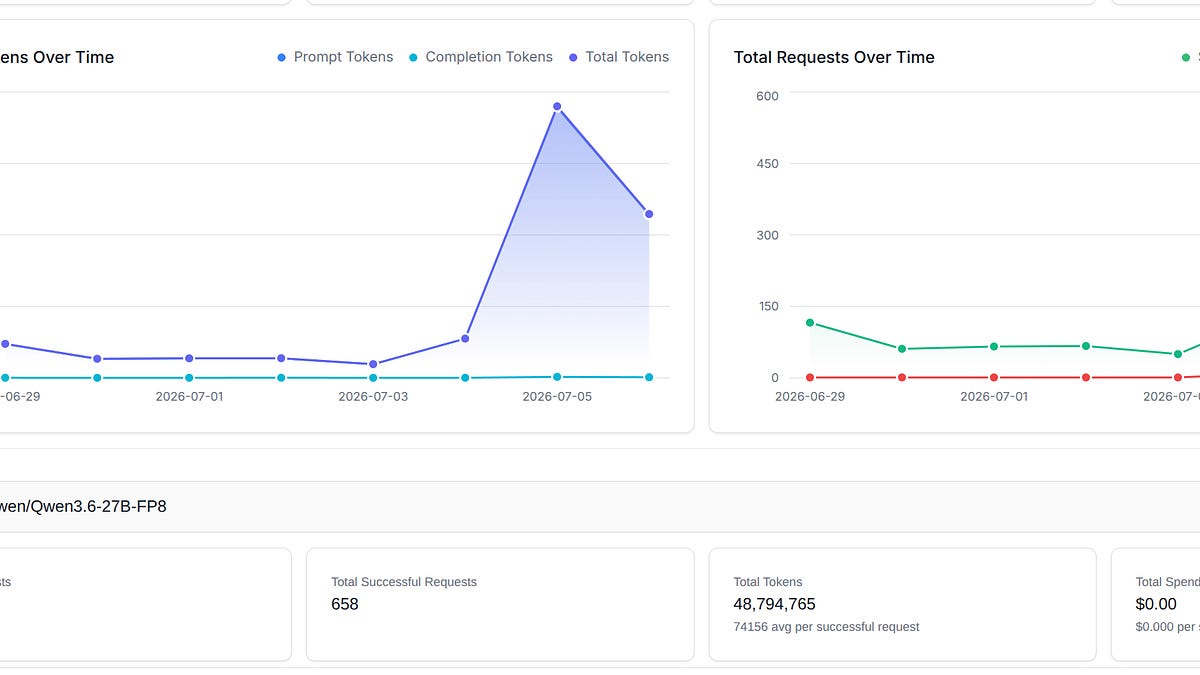
The stack usage is around 50M tokens so far over the past weekend. I’ll start adding more tasks to the queue this week and report updated numbers soon.
Qwen3.6-27B-FP8 on the DGX Spark sustained about 14-16 tok/s decode throughput on active two-request workloads.
-
Prompt ingest showed bursty but high prefill throughput, with aggregate effective prefill around 12.6k tok/s.
-
Prefix caching was highly effective at roughly 95% hit rate.
-
Average TTFT was about 8.5s, and average end-to-end latency was about 42s, driven mostly by long decode phases on very large prompts.
-
The observed average prompt size was huge at about 78.8k tokens/request.
Closing #
Local inference is finally getting interesting because it can survive contact with real work. It has to reason, call tools, survive a real repo, and ship code I’d actually merge.
That’s what this DGX Spark stack is starting to do. Frontier models still do the heavy planning. But once the task is concrete, local Qwen is getting close to being the machine I trust to execute it. That’s the future I want: owned inference, owned context, owned workflow. And this is the first setup I’ve had that feels like it might actually get there.
Subscribe if you’re wiring local models into a real code path. I’ll continue documenting my journey and would love to hear yours.
1
Blog Methodology
Research: 2-week rollout on the DGX Spark, culminating in a 690-line internal retrospective and a merged infra PR (872 additions, 11 files). The Clawrium codebase is now routed through the stack. Detailed notes at each step kept in a JOURNEY.md file with timestamps, my prompts and results.Drafting process: Fed Claude the HN thread, the rollout plan, my raw JOURNEY logs, and the Clawrium PR list. Asked for a lessons-learned draft that walked each wall in the order I hit it.Author rewrite: ~% rewritten. Every error message, flag, version number, and vLLM issue reference is verified against the raw log lines from the rollout.Fully mine: Narrative arc, takeways and commentary. The “Codex plans, local executes” split, the calculator-tool-test heuristic, the trap selection, all trade-off analysis and examples.Fully LLM: transitions between walls, the final numbered-lessons condensation.