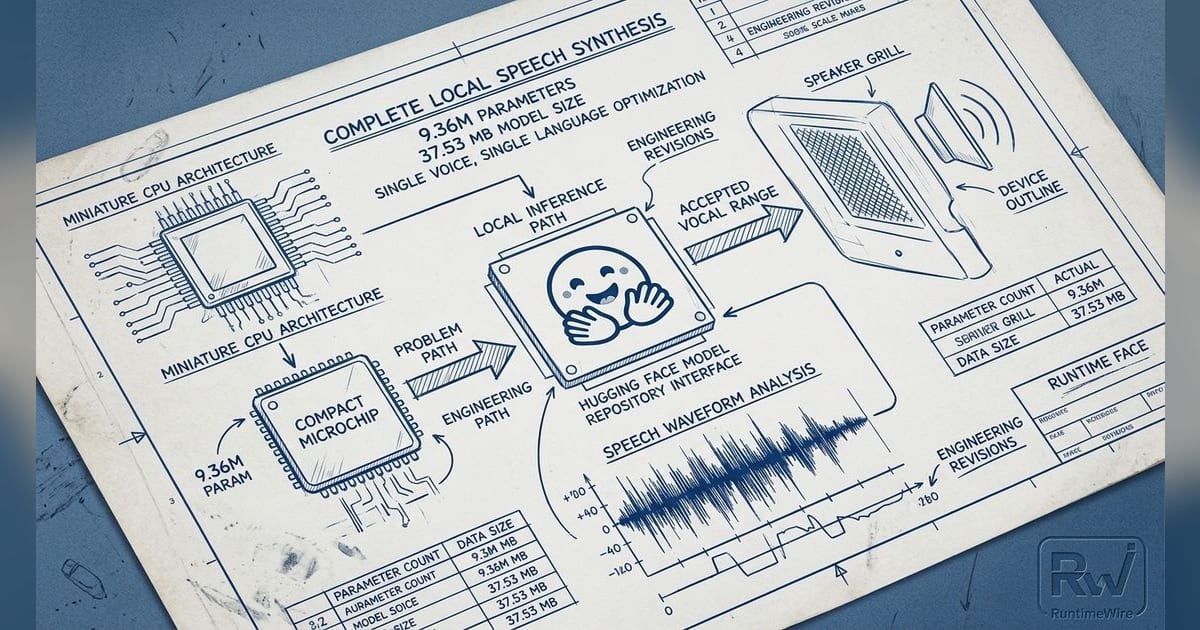
On July 24, 2026, Owen Song released Inflect-Micro-v2, a 9,356,513-parameter text-to-speech model that takes English text through to a 24 kHz waveform without a hosted service or separate neural vocoder.
Song describes himself as a solo developer focused on machine learning efficiency. The model card says he built and funded Inflect v2 independently, and no company or outside investors are attached to the project.
That constraint shaped the release. With v2, Song was testing how far a complete tiny TTS stack could be pushed while still producing usable speech.
A complete model inside the parameter count
Small speech-model comparisons can hide part of the deployment burden by reporting an acoustic model's size while leaving out a separate vocoder. Inflect's 9.36 million figure covers the deployed neural path: text encoding, duration prediction, latent speech generation and the integrated waveform decoder. The English normalization and eSpeak-ng phoneme frontend still run as conventional CPU-side code.
The open-source repository describes Inflect as a VITS-family system with a transformer text encoder, stochastic duration prediction, residual coupling flows and an alias-reduced decoder. Song released the code and weights under Apache 2.0.
Inflect v2 comes in two sizes through the same Python interface. Micro uses 37.53 MB of FP32 weights and prioritizes output quality. Inflect-Nano-v2 contains 3,966,721 parameters in a 15.97 MB FP32 package and prioritizes footprint. Both support CPU or CUDA inference, deterministic seeds, speed and delivery-variation controls, and punctuation-aware splitting for longer passages.
Song also published a separate verified ONNX export for CPU, CUDA and DirectML. The ONNX package keeps eSpeak-ng and the Python frontend outside its two neural graphs, which total about 37.75 MB. No integer-quantized release is available; Song's documentation says basic weight quantization can audibly damage the waveform decoder.
Developers can test Micro and Nano in the Inflect v2 playground. The reference runtime is non-streaming, so it returns a complete chunk after synthesis rather than producing audio incrementally.
The benchmark is promising and appropriately limited
Inflect's performance figures come from Song's own evaluation package. Micro recorded a 66.2% preference rate in an anonymous community listening test consisting of 21 wins, 10 losses and three ties. That is 34 comparisons, and Song labels the result descriptive community evidence rather than a formal mean-opinion-score study.
The model card reports a 4.395 UTMOS22 score, with a 95% bootstrap confidence interval from 4.381 to 4.408. UTMOS22 is a learned naturalness predictor, not a human listening score. Micro also posted a 3.99% headline word-error rate derived from the equal-weight average of Qwen3-ASR and Nemotron 3.5 evaluations. Its separate Whisper large-v3 result was 2.73%.
On a managed Hugging Face instance with eight virtual CPUs and four framework threads, Micro generated audio at 6.28x real time. Nano reached 10.72x. Those results support Song's CPU-capable claim, though his own comparison shows faster compact systems: Piper Low reached 31.37x and KittenTTS Nano reached 13.33x under the directional test.
Song does not present Inflect as the speed leader. The comparator run also used a shorter 50-prompt test while Inflect's headline runtime came from 100 prompts, and some rivals ran through optimized ONNX implementations while Inflect used its canonical PyTorch runtime. The documentation keeps those differences visible instead of flattening the results into a single ranking.
KittenTTS Nano, one of Song's chosen baselines, contains 15 million parameters and offers eight voices. Inflect Micro is smaller and carries a narrower feature set. Its advantage is a compact, self-contained synthesis path rather than breadth.
Song kept the scope narrow
Inflect produces one synthetic English male voice. It does not offer voice cloning, selectable speakers, multilingual output or acoustic streaming. Numbers, abbreviations, uncommon names and homographs can still cause pronunciation errors, while independently synthesized chunks can make long passages sound less coherent.
The model has not been validated for medical, legal, emergency or accessibility-critical communication. Song originally wanted to release four voices, he wrote in a discussion following the launch, but cut three because the adaptations did not meet his quality threshold.
That restraint gives Inflect a clear deployment profile. A local assistant, browser experiment, embedded device or offline application may value a 37.53 MB speech package and deterministic output more than voice cloning. A customer-service system requiring many voices, languages, emotional range or low time-to-first-audio would need a different model.
The release is also open-weight rather than fully reproducible from raw data. Song published the inference weights, source code, frontend, evaluation prompts, reports and integrity hashes. The corpus-generation pipeline, filtering infrastructure and full optimization recipe remain private. Reproducing the training run or auditing its data provenance therefore requires information outside the public package.
Adoption will determine whether Inflect becomes a larger project
Song's plan for Inflect is tied directly to demand. He says a v3 could add voices, languages, easier adaptation and another stability pass if v2 finds an audience. He is asking users for exact failing text, model settings, seeds and hardware details, feedback that can turn an independent release into a more systematic development loop.
The timing fits a wider push toward capable models that run closer to the user. RuntimeWire reported in June that Hugging Face was steering developers toward small-model efficiency, as open-weight systems became practical for more local workloads. Hugging Face is Inflect's distribution platform rather than its developer or investor.
For Song, the release tests a harder proposition: whether a solo developer with limited training resources can earn attention by making the entire system small and inspectable. Inflect v2 already clears the technical threshold he set after v1. Its next threshold is adoption, which will decide whether the project expands beyond one compact English voice.