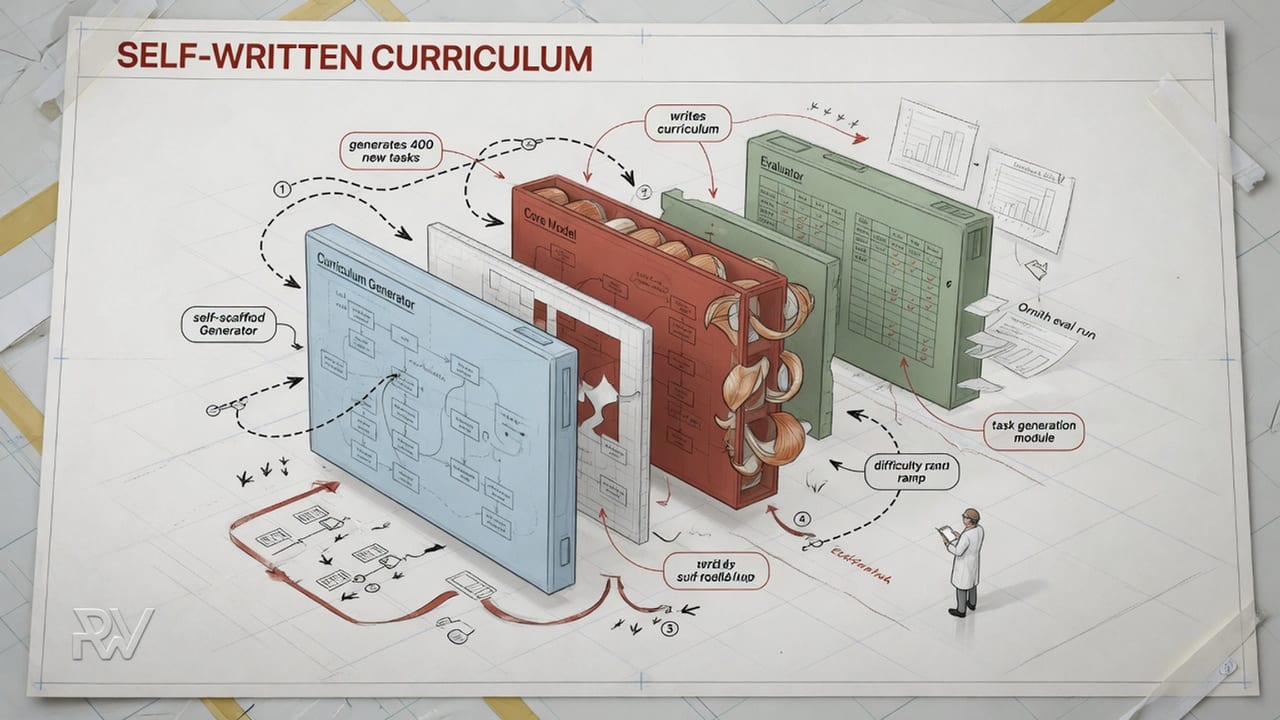
The three-model family extends self-scaffolding into task generation; its benchmark comparisons come from Ornith AI's own evaluation runs.
By RuntimeWire Staff · Published
Primary source: Ornith AI
Why it matters #
Ornith AI is betting that models can expand their own training curriculum, reducing dependence on hand-built tasks while making reward design even more consequential.
Ornith AI released Ornith-1.5 on August 19, 2026, pushing its open model family beyond generating answers and scaffolds into generating the training tasks themselves. In an announcement, Ornith AI describes a reinforcement-learning loop that proposes harder problems, builds the harness used to solve and evaluate them, and produces the solution rollouts that become its next learning experiences.
The release comes from a research group that has applied reinforcement learning to problems with hard, machine-checkable rewards. Xiaoya Li, Guoyin Wang, Songqiao Su, Chris Shum and Jiwei Li appeared together on the GrandCode paper, which built a multi-agent system for competitive programming. Several of the same researchers worked on CUDA-L2, an effort to optimize matrix multiplication kernels using execution speed as the reward. Stanford's NLP group lists Jiwei Li with a DeepReinforce.ai affiliation.
That history explains the central bet behind Ornith-1.5. Ornith AI is trying to turn reinforcement learning from a process built around a fixed set of tests into one that manufactures its own useful tests. The public research trail spans DeepReinforce-branded work and Ornith-branded model repositories, including the DeepReinforce Ornith repository. The release is published by the Ornith Team and promoted through @deep_reinforce.
The model writes the assignment
Ornith-1.0, released in June, learned to generate the scaffold around a coding task: the instructions, tools, decomposition and orchestration that guide a model through a longer job. Ornith-1.5 adds task generation to that process.
Each training cycle starts with an environment or codebase, broad instructions about the desired type of problem, and a history of what the model has already solved. Ornith-1.5 proposes a harder task, creates or revises the task-specific scaffold, and then attempts a solution. Reward flows through all three stages, giving the model feedback on the quality of the question, the evaluation setup and the answer.
Ornith AI scores generated tasks on validity, difficulty and novelty. A proposed task must be executable and verifiable, sit near the model's current capability frontier, and differ enough from previous work to add useful training signal. Ornith AI sets the target solution success rate at 0.2, favoring tasks the model usually fails while preserving enough successful rollouts for reinforcement learning.
The harness receives its own reward for matching the assignment, measuring solution quality accurately and resisting reward hacking. This is the hard part of the design. A system that writes both the exam and the grading script can create easy points for itself through malformed tests, hidden shortcuts or criteria that reward the wrong behavior. The official Ornith-1.0 repository documents benchmark harnesses, anti-hacking filters and resource settings, without substantiating a more specific evaluation protocol involving Git-history removal or network blocking.
The self-improvement label describes the training procedure. The downloaded model does not continuously retrain itself on a user's phone or workstation. Ornith AI runs the loop during model development, then publishes the resulting weights.
Three sizes, three different deployment bets
Ornith-1.5 arrives in a Hugging Face collection with a 397-billion-parameter mixture-of-experts model, a 35B MoE model that activates 3B parameters per token, and a 9B dense model. Ornith AI also describes a quantized mobile version of the 9B model for iPhone and Android deployment.
The 397B release is Ornith AI's open-frontier bid. The 35B model is aimed at developers who can hold a larger sparse model in memory while paying the inference cost of a smaller active parameter count. The 9B model is the most accessible of the three: Ornith AI documents local deployment and publishes an MLX build for Apple hardware.
The mobile and local-release strategy gives developers a way to test the system without relying on a hosted demo. The practical tradeoffs still depend on quantization, available memory, runtime support and the length of the job.
For the prior generation, Ornith AI's official Ornith-1.0 documentation lists bf16, FP8 and GGUF checkpoints under the MIT license. The Ornith-1.0-9B model card lists an approximately 19GB footprint in bf16 and a native 262,144-token context window. Ornith AI's official documentation does not claim an approximately 1-million-token RoPE or YaRN extension.
Benchmarks carry a harness
Ornith AI reports that Ornith-1.5-397B scored 86.1 on Terminal-Bench 2.1 using Terminus-2 and 56.0 on DeepSWE. Ornith AI compares those results with 85.0 and 59.0 for Claude Opus 4.8, 82.7 and 54.4 for DeepSeek-V4-Flash-0731, and 81.0 and 46.2 for GLM-5.2.
At 35B, Ornith AI reports 68.5 on a Terminal-Bench 2.1 run using Claude Code and 79.0 on SWE-bench Verified. The 9B model is reported at 47.0 and 70.6 on the same two evaluations.
Those details limit what the headline numbers prove. Agentic coding scores measure a model-harness pair, and changing the scaffold can materially change the outcome. Ornith AI's comparisons should be read as disclosed, company-run evaluations until the models and harness configurations are reproduced by outside evaluators.
The Ornith-1.0 repository reports several earlier benchmark results as averages across five runs and publishes sampling settings, context windows, timeouts, compute allocations and agent harnesses. Those disclosures apply to Ornith-1.0 and should not be treated as documentation for the Ornith-1.5 scores.
The release still gives developers something concrete to test. Ornith AI published the model weights, serving instructions and quantized formats rather than limiting access to a hosted demo. The earlier Ornith-1.0 repository gives the new checkpoints an existing open-source starting point.
Ornith AI's larger bet
Ornith AI is building around a constraint that has become more important as human-written training tasks get expensive and familiar benchmarks lose discriminating power. A model that can identify its own capability gaps and build valid exercises around them could produce a curriculum that moves as quickly as the model does.
The weak point is equally clear: generated tasks are useful only when their grading environments remain faithful, difficult and resistant to exploitation. Ornith AI has made that evaluation layer part of the learned system, placing more responsibility on reward design.
Ornith-1.5 turns that research thesis into three downloadable model sizes. The open weights let developers inspect the practical result, run the published recipes and test whether Ornith AI's self-generated curriculum transfers from benchmark environments to real codebases. That is the test that matters after the model finishes grading itself.