5 min read
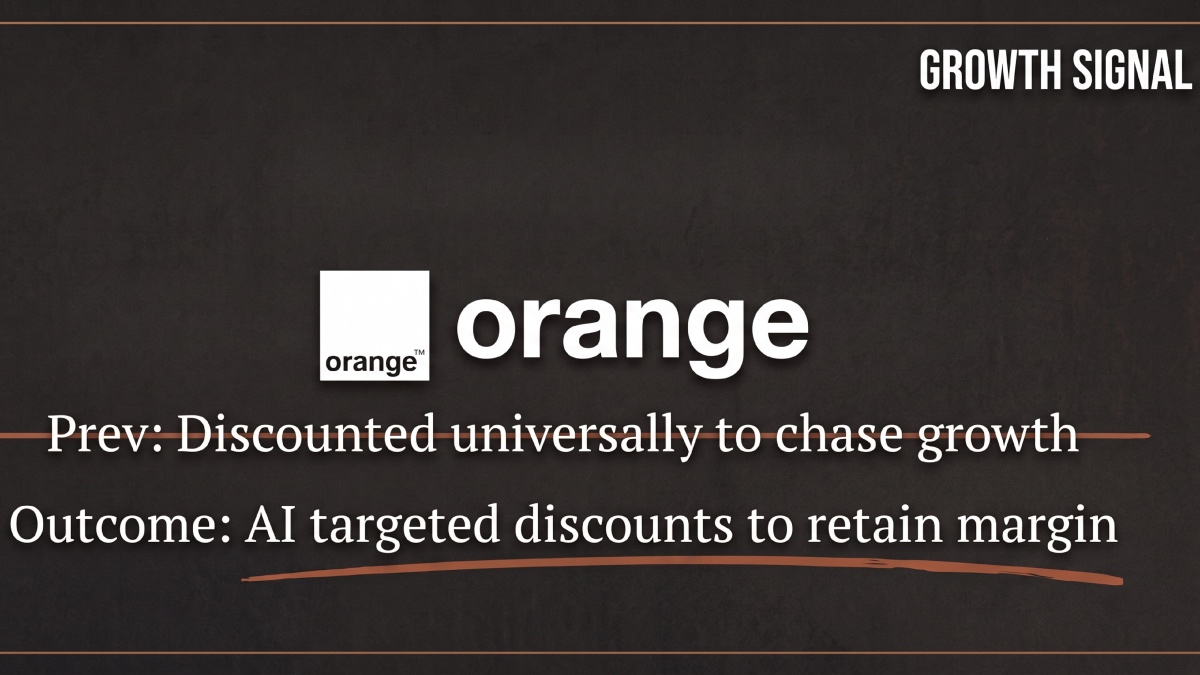
Orange tested a blanket €10 offer against an AI that targeted only hesitant visitors.
Every discount has two possible customers. One is wavering and needs the nudge. The other was already reaching for a card and just received a gift.
Orange, the French telecom operator, faced that exact split on its Livebox Fibre journey, the sales path for its home fibre broadband. A €10 monthly promotion sat ready to use. Showing it to everyone meant spending the incentive on shoppers who would have bought anyway. Hiding it meant losing some hesitant visitors.
So Orange tried a third route. It trained a machine-learning system to spot hesitation in real time, then tested whether the discount worked better when only those visitors saw it.
Conversion was only half the problem #
Orange and its lower-cost Sosh brand receive 23 million monthly visits each, according to a case study published by experimentation vendor Kameleoon. Kameleoon sells software that lets companies run A/B tests and personalise their websites. Mobile brings in 53% of Orange traffic and 68% of Sosh traffic.
Volumes like that turn small conversion changes into serious money. They also make a blunt promotion expensive. A universal discount can lift orders while quietly lowering the value of orders that would have happened anyway. Zalando ran a related test when it let AI nudge its prices and sales did not flinch.
Orange therefore needed a narrower answer. Could it lift Livebox Fibre conversion while keeping the €10 monthly offer away from most buyers?
The company had plenty of testing experience to build on. Kameleoon says Orange set up a dedicated conversion rate optimisation (CRO) centre in 2017 and uses Kameleoon for testing and personalisation. Contentsquare, a behavioural analytics platform, supports that work. Google Analytics 4 and Qualtrics, a customer feedback platform, also appear in the reported stack.
Orange trained the model before showing the offer #
Kameleoon says its predictive system watched behaviour on Orange’s site for several weeks. Once calibrated, it sorted visitors into three broad groups by their predicted likelihood of converting. A growth team could audit the commercial logic with ease. Keep the offer away from visitors unlikely to buy. Skip discounting visitors likely to buy. Aim it at the uncertain middle.
This is where the test becomes more useful than a standard personalisation claim. Orange compared targeted discounting with two other options in a three-way split.
- The control group saw no promo code.
- The first variation showed the promo code to every visitor.
- The second variation showed it only to visitors the model identified as hesitant.
That design tested both sides of the decision. The control measured whether an offer helped at all. The universal-offer arm stood in for the common alternative. The AI arm tested whether prediction could point the cost of the promotion at people more likely to change their behaviour.
Targeting changed who received the discount #
Kameleoon reports that 68% of purchases used a promo code when the offer showed by default. Under AI discount targeting, promo-code use fell to 25% of purchases.
The same vendor-published case says the targeted version lifted conversion by 11.6% against the no-code control and by 7.6% against the universal-offer variation. Those are relative lifts as Kameleoon presents them. The source leaves out the underlying conversion rates, sample size, statistical confidence, test dates and any revenue or margin impact.
Those gaps matter. The test supports a reported improvement in conversion and a sharp drop in discount use. An outside reader still cannot calculate incremental profit, or judge whether the three groups were balanced across devices, acquisition channels and customer types.
A sourcing limit sits alongside those gaps. Kameleoon supplied the AI personalisation and experimentation platform and published the case. Orange executive Véronique Lannuzel, whom the vendor identifies as head of its Design Thinking and CRO expertise centres, is quoted endorsing the platform. The figures arrive without independent analysis or a full experiment readout.
The copyable lever is the comparator #
A smaller company can borrow the operating lesson without rebuilding Orange’s model. Stop judging a discount only against no discount.
Add a universal-offer arm and track two outcomes together. One is the conversion lift. The other is offer usage among completed purchases. Suppose targeted incentives convert better than the control but only match a blanket offer. The targeting may still create value by shrinking the number of discounted orders.
That changes how you read the result. Conversion alone cannot carry the verdict. A growth team needs contribution margin, discount cost or revenue per visitor beside it. Orange’s published case stops short of those numbers, even though the experiment exists to protect margin.
Give the targeting rule its own audit. Teams can compare a simple behavioural segment with an AI score before adding technical complexity. They can also hold back a slice of the eligible audience so the model’s effect stays measurable after rollout.
The next test should chase profit #
Kameleoon says this was Orange’s first AI-driven personalisation experiment and that the company plans to extend the approach to product recommendations and its Orange and MySosh apps.
The more revealing follow-up would stay with the original problem. Vary the value of the incentive, keep the three-way comparison and measure incremental contribution margin alongside conversion. A €10 offer may be enough for one hesitant visitor and too generous for another.
Judge an AI growth system by the decision it changes. Predicting intent is only the start. Here, the reported result is strongest where the experiment asks the model to decide who should go without the promotion.
Sources #
- [Kameleoon case study on Orange’s AI predictive targeting](https://www.kameleoon.com/customer/how-orange-delivers-the-right-offer-at-the-right-time-with-ai)
- [Orange company website](https://www.orange.com/en)
- [Véronique Lannuzel on LinkedIn](https://fr.linkedin.com/in/v%C3%A9ronique-lannuzel-2544162)
Compare the evidence and operating lessons from more AI experiments in our Growth Signal Index, or browse benchmark tooling in the Industry Contents Lab.