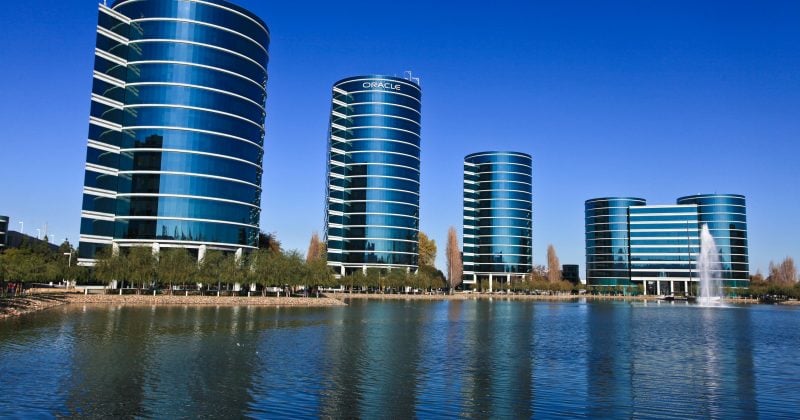
Photo: Håkan Dahlström / Wikimedia Commons / CC BY 2.0 (https://creativecommons.org/licenses/by/2.0)
The database giant posted $55.7 billion in capital expenditures against $67.4 billion in revenue, burning through cash at a pace that sent shares lower after hours.
Oracle just did something that would make most CFOs break out in hives. The company reported fiscal year 2026 capital expenditures of $55.7 billion, consuming roughly 82.6% of its total revenue of $67.4 billion. That left the enterprise software titan with a negative free cash flow of $23.7 billion.
In English: for every dollar Oracle brought in, it spent about 83 cents building stuff. The result is a company that, by traditional financial metrics, is bleeding money while betting everything on becoming an AI infrastructure powerhouse.
The numbers tell a story of controlled chaos #
Oracle’s fiscal 2026 results, released on June 10, paint a picture of a company growing fast and spending faster. Revenue climbed 17% year-over-year, a healthy clip for a firm of Oracle’s size. But the $55.7 billion capex figure actually exceeded the company’s own prior guidance of $50 billion.
The company has amassed a record $638 billion in remaining performance obligations, essentially the total value of contracts yet to be fulfilled. That number reflects a wave of large AI contracts flowing into Oracle’s pipeline. Customer prepayments for AI contracts alone total $75 billion, suggesting enterprise clients are putting serious money behind Oracle’s cloud vision.
After-hours trading reflected that anxiety. Shares declined following the earnings release as investors processed the sheer scale of Oracle’s spending relative to its income.
Fiscal 2027 guidance makes this year look modest #
If you thought $55.7 billion in capex was aggressive, Oracle’s outlook for fiscal 2027 enters a different stratosphere entirely. The company is forecasting total capital expenditures of up to $95 billion for the coming year. Oracle expects $20 to $25 billion of that total to be reimbursed by customers, meaning the net outlay from Oracle’s own coffers would be closer to $70 billion, according to CFO Hilary Maxson. Still, $70 billion in self-funded capital spending is a staggering commitment for a company that just generated $67.4 billion in total revenue.
To finance this build-out, Oracle plans to raise approximately $40 billion through a combination of debt and equity. The remaining $70 billion, per Maxson, represents Oracle’s own capital contribution.
What this means for investors watching the AI infrastructure trade #
Oracle’s earnings report is a case study in the tension between growth narratives and financial fundamentals. The growth story is compelling: 17% revenue expansion, a record backlog, and billions in customer prepayments all suggest Oracle is building something customers want.
The financial reality is harder to love. Negative free cash flow of $23.7 billion means Oracle is not generating excess cash from operations after accounting for its investments. It is consuming cash. That dynamic forces the company to tap debt and equity markets, diluting shareholders or increasing leverage at a time when interest rates, while lower than their recent peaks, remain elevated by historical standards.
The planned $40 billion in new debt and equity financing for fiscal 2027 deserves close scrutiny. Rising debt loads increase interest expenses, which eat into profitability. The $75 billion in customer prepayments provides a financial cushion that many skeptics might underweight. Those aren’t speculative contracts. They represent real money from real enterprises that have already committed capital to Oracle’s platform.
Disclosure: This article was edited by Editorial Team. For more information on how we create and review content, see our