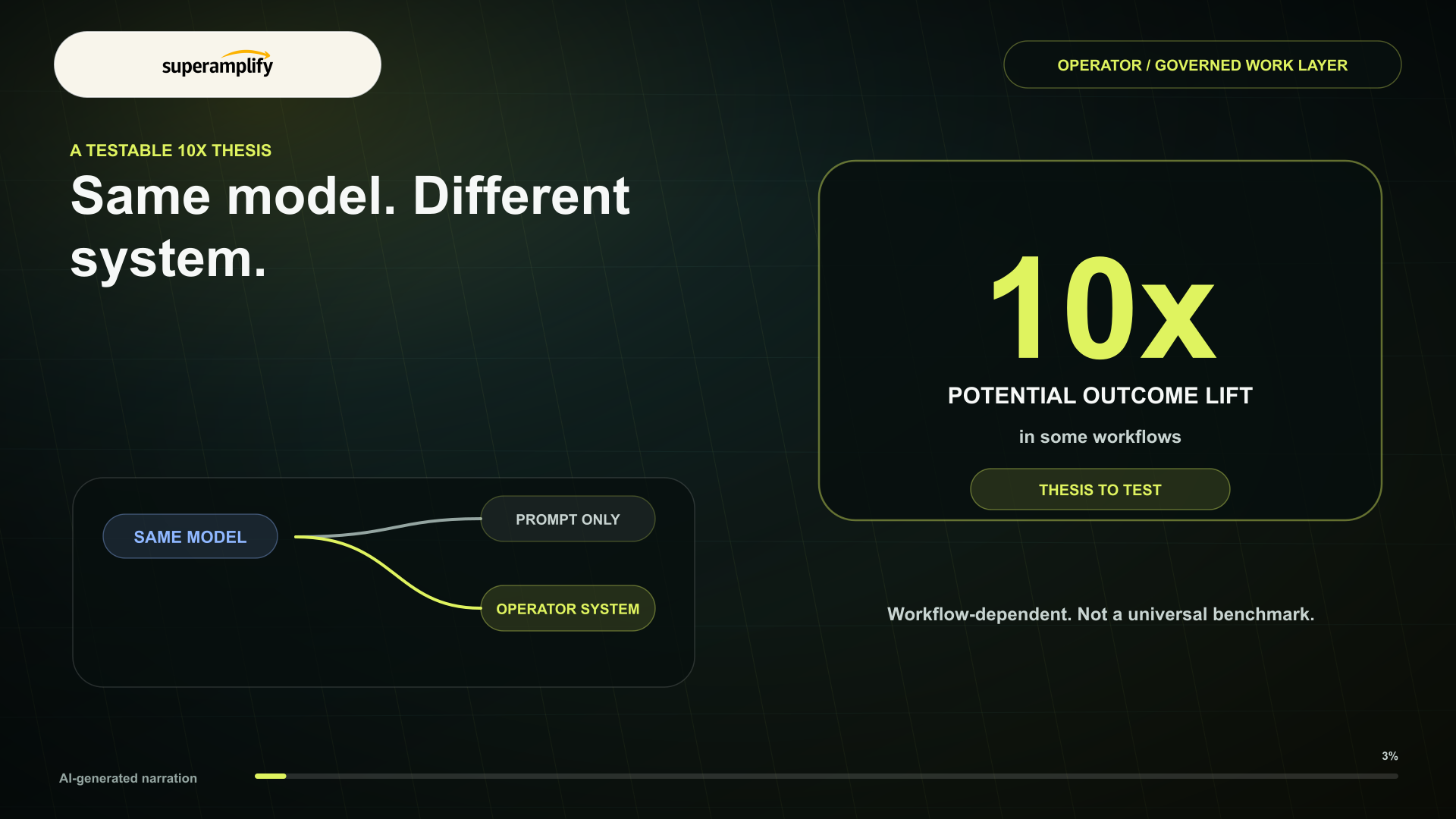
The model is the engine. The system around it determines whether that engine produces an answer—or a repeatable business outcome.
Operator - the future of work
Did you know that the same AI model can produce dramatically different results depending on how it is used?
In the right workflow, the difference in usable output can feel like an order-of-magnitude improvement. That is the useful idea behind the “10x” question. It is not a universal benchmark or a guarantee. It is a challenge: before replacing the model, improve everything around it and measure what changes.
Model access is becoming the starting point #
Take a leading open-weight or cloud-hosted model. Its raw capability matters, but the model never works in isolation. Its performance is shaped by the application, the instructions, the context, the tools it can use, the knowledge it can access, and the checks applied before the work is accepted.
As leading models become more capable across many everyday business tasks, simply having access to one is less differentiating. The durable advantage moves up the stack:
- Give the model the right company context.
- Connect it to the right tools and data.
- Guide it through a workflow designed for the outcome.
- Require approvals where consequences matter.
- Verify the result before calling the work complete.
- Preserve what worked so another person or team can reuse it.
This surrounding system is often called the harness. Think of the model as an engine. A powerful engine still needs steering, instrumentation, safety systems, a route, and a destination.
Super Amplify Operator is aimed at a different unit of work: a governed outcome that may cross documents, company knowledge, browser tasks, applications, analysis, connected tools, and code.
| Category | Primary strength | Typical unit of work |
|---|---|---|
| Codex and coding agents | Building, understanding, reviewing, and debugging software | A repository task, change, test, or review |
| General AI assistants | Answering, researching, brainstorming, and drafting | A prompt, conversation, or document |
| Super Amplify Operator | Coordinating governed work with company context, tools, approvals, and verification | A request carried through to a reviewable outcome |
This is not a winner-take-all comparison. The best system uses the right specialist for the job. Operator’s role is to turn models and tools into an operating layer for work that people can review, share, and scale.
From a blank prompt to a governed operating pattern #
A blank chat asks every user to invent the process again: find the context, choose the model, select the tools, define the steps, decide what requires approval, and determine how to check the result.
Operator makes that surrounding intelligence reusable. A person can describe the outcome in normal language. The system can then assemble relevant company knowledge, governed tools, execution steps, approval gates, and verification evidence around the request.
Super Amplify currently presents 37 selectable architecture options: 35 specialist execution patterns, General, and Best Fit automatic routing. The specialist patterns cover planning, retrieval, reflection, verification, memory, tool use, multi-agent work, browser activity, computer use, and specialized reasoning. Best Fit can select a governed executable route for the task, while an experienced user can choose an architecture directly.
The pattern is the bridge between possibility and practice. It can encode:
- the sequence of the work;
- the context and evidence required;
- which tools are allowed;
- where a person must approve an action;
- how the output will be verified; and
- how the finished work can be saved and reused.
The model supplies intelligence. The pattern gives that intelligence direction.
Company context needs boundaries, not just a bigger prompt #
Organization knowledge is valuable precisely because it is specific. It may include customer details, internal processes, product plans, operating metrics, or private source material. That context should not be treated as an undifferentiated block of text.
Operator is designed around protected, governed cloud workspaces with defined access boundaries. Runs can be constrained by company scope, approved tools, approval-gated actions, allowlisted network access, scoped credentials, isolation controls, and verification evidence. The goal is to give each task the context it needs without giving every task everything.
That distinction matters. More context is not automatically better context. The right context is relevant, authorized, current, and traceable.
The real advantage is organizational learning #
An individual AI answer disappears into a chat history. A successful operating pattern can become company capability.
Once a workflow produces a useful outcome, a team can preserve the pattern, improve its inputs, strengthen its controls, and reuse it. What began as one person’s experiment can become a shared way of working—without forcing every user to become a prompt engineer.
That is the shift Operator is designed to support:
- from isolated prompts to durable runs;
- from generic answers to company-aware outcomes;
- from tool sprawl to governed execution;
- from individual productivity to shared capability; and
- from an impressive demo to work that can be reviewed, improved, and scaled.
The better question #
The next phase of enterprise AI will not be decided only by which organization has access to the newest model. Models will continue to improve, and companies should retain the flexibility to use the right model for each job.
The more durable question is:
What have you built around the model?
Start with one real workflow. Give it the right context, tools, controls, and definition of done. Measure the result. Then scale the pattern that made it work.
Super Amplify Operator turns intelligence into company capability.
Editorial note: “10x” is presented as a hypothesis to test against a defined baseline, not as a guaranteed or independently benchmarked performance claim. The companion video uses AI-generated narration.