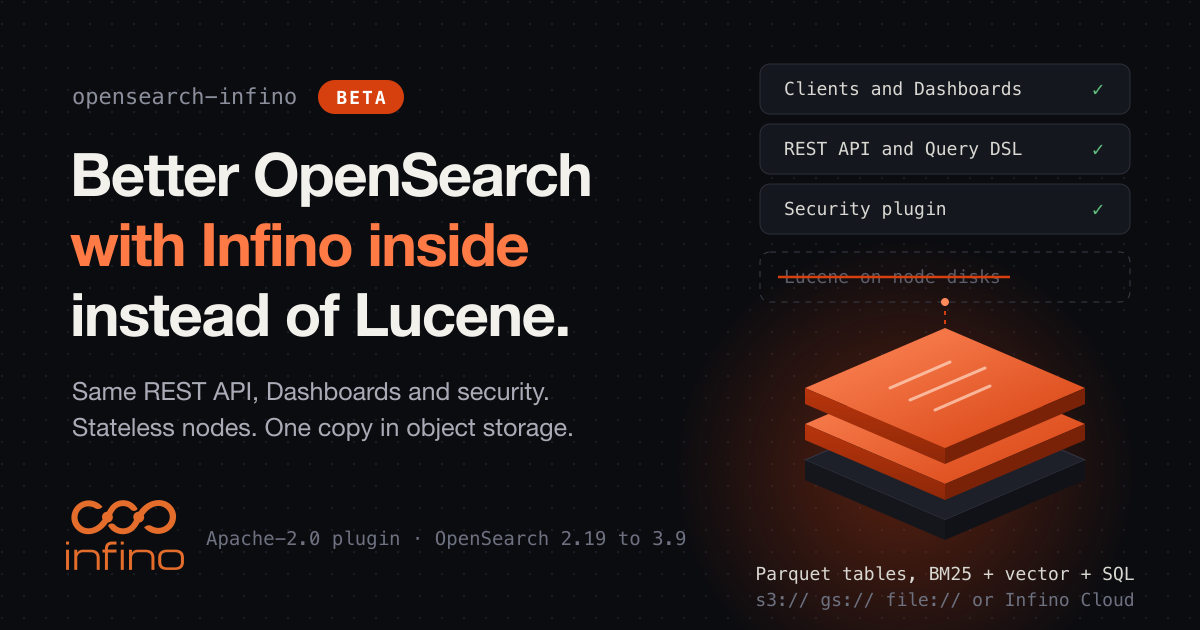
Today we’re opening the beta of Infino for OpenSearch, an Apache-2.0 plugin that replaces Lucene with Infino as the engine under OpenSearch. Indices are stored as Parquet tables on a local disk, in an S3 or GCS bucket, or in a hosted Infino account. Clients, Dashboards, the security plugin and cluster management work as they do today, and it is 10x cheaper than a similar-sized cluster.
The plugin installs into released OpenSearch 2.19.6, 3.0.0, 3.3.2, 3.6.0 and 3.9.0.
Growing beyond Lucene #
Most of what people use in OpenSearch sits above its core engine: the REST API, Query DSL, Dashboards, roles and tenants, index templates. Most of its resources are consumed by Lucene, its core engine, running across nodes. Each shard lives on a node’s own disk, every replica is another full copy on another SSD, snapshots add a third copy, and nodes have to be loaded with new shards before they can serve queries.
The plugin keeps the layers that deliver OpenSearch experience and swaps the engine with Infino. Each index is backed by an Infino table built from the index’s mapping. text fields get a BM25 index, keyword fields match by exact value, dates and numbers get range indexes, and knn_vector fields become vector columns. Full-text search, vector search (kNN and hybrid) and SQL all run on the same table.
You choose one of two modes when you create an index. One is default mode, where the existing data plane machinery of shards, replicas and a distributed query engine is used as normal and Infino replaces Lucene on each node. The other is proxy mode, where the existing machinery is bypassed and the index runs on Infino’s object-storage-native infrastructure behind a single shard.
What Infino adds
- SQL over your indices.
POST /_plugins/_infino/sqlruns read-only SQL over Infino-backed indices, with joins, CTEs andbm25_search,vector_searchandhybrid_searchas TVFs. Document- and field-level security still apply. - Graph walks. Mark an index of links with
index.infino.edges: true.graph_walkandgraph_rankthen follow those links from a set of seed documents, in the same SQL. - One shard, at any size. An index needs one shard and the engine scales reads itself, so you don’t plan or rebalance shard counts as an index grows. The trillion-row index below is a single shard.
- Tables you already have. An index can attach, read-only, to an existing Infino table loaded outside OpenSearch, so Discover and Dashboards work on it with no reindexing.
- Questions in plain English. On Infino Cloud, an agent turns a question into SQL over your tables and shows the rows behind its answer.
- Move from a snapshot. Infino loads an Elasticsearch or OpenSearch snapshot from your bucket into tables, and the plugin brings the indices across with their templates, pipelines, users and roles. The old cluster can then be stopped. Seehow it works .
Scale #
Nodes are ephemeral. When a node starts with an empty data directory, it reads the registry, restores every index, and cluster state is rebuilt from object storage at boot.
To add query capacity, you add a node. There are no shards to move onto it first. If a node dies, no data goes with it. Storage grows in the bucket regardless of node count.
The engine has been tested well beyond typical OpenSearch cluster sizes. A top-10 search over one billion web pages takes 78 ms on Infino and 536 ms on Lucene. On the Open Vector Database Benchmark, Infino has the highest QPS at recall ≥ 0.95 at both 1M and 10M vectors, and the lowest p99 latency at 1M.
Infino allows indexes to scale more cost-effectively. Our Wikipedia demo runs on a single index of every hourly pageview from December 2007 to March 2026, with one trillion rows stored as Parquet on object storage. Even at this scale, Infino’s query engine delivers subsecond latency: counting all its rows takes 50 ms, counting or summing a year of them takes 200 ms, and breaking a day down by top terms takes 500 ms.
Open format #
Infino tables are made of Parquet files with BM25 and vector search indexes stored inside them. The bucket holds one copy of the data in object storage instead of the primary, replica and snapshot that a traditional OpenSearch cluster carries.
Because the format is valid Parquet, there is no data lock-in. All OpenSearch data is now readable by warehouses like Snowflake and Databricks without an ETL job running between them.
With a hosted Infino account, the hosted service manages the bucket and the compute. Tables live in an Infino bucket or in your own bucket, encrypted with keys you manage, and there is no storage tier for you to size or patch.
Cost #
Infino for OpenSearch costs about 10x less than a similar-sized cluster. At scale, the bill for search is driven by replicas on SSD, nodes sized to hold data, and snapshots. Keeping the index in object storage has very different economics. At 1 PB (a trillion 1 KB rows, with 50 billion ingested and 100 million queries a month), our pricing calculator estimates full-text search on Infino at about $398K a month. A Lucene-backed OpenSearch cluster that keeps the same petabyte on its own nodes with one replica runs from about $0.9M a month on demand, sized for storage alone, to about $3.8M sized for this write and query load. The methodology shows how each number is built.
You still run OpenSearch nodes with the plugin, but they are ephemeral and grow slowly with query load, because most of the resources that serve a query are consumed by the data plane running in Infino at object storage economics.
Performance #
Infino is already faster than Lucene on many queries. Aggregations that read every document, such as sums, averages, range totals and top terms, are where a columnar engine is fastest. The table below shows median latency through OpenSearch for eight of them, on synthetic data at 10M documents per index, on one OpenSearch 3.9.0 node (16 cores, 31 GB).
| Query shape | With Lucene (ms) | With Infino (ms) |
|---|---|---|
| sum + avg(price) | 55.85 | 0.53 |
| range price > 500 + total | 11.76 | 0.92 |
| terms(category) | 0.22 | 0.14 |
| match + scoped sum | 9.50 | 7.87 |
| sum where price > 500 | 10.81 | 3.38 |
| count price > 500 | 0.28 | 0.10 |
| range aggregation | 0.34 | 0.22 |
| match + exact total | 0.40 | 0.30 |
Infino is faster on every query in the table, and closest on a match with a scoped sum. For ranked search, Infino is 54% faster than Lucene 10.5 on top-k and 61% faster on counts in Search Benchmark, the Game (962 queries over 5M English Wikipedia documents, single-threaded).
However, Infino does not beat Lucene on every query, and on some searches Lucene is still faster. Among those, the largest gaps today are sorts on a keyword field, hourly date histograms and text search with a time filter. These performance gaps will be closed before GA.
Current status #
The beta is ready to try on your own data, with the following notes.
- Query coverage. Not all Lucene queries are supported by Infino yet, for example
fuzzy,function_score, geo andsuggestqueries, HDR percentiles and sliced search. - Cloud providers. Testing needs to be extended to cover object storage across more cloud providers.
- Releases. Testing needs to be extended across more OpenSearch releases.
Infino for OpenSearch is Apache-2.0 open source. We take bug reports, feature requests and pull requests. Open an issue, or see the contributing guide to send a change.
What’s next #
We’re targeting general availability in mid-December. Before GA we want:
- Performance parity with Lucene on most of the questions in the big5 log benchmark, starting with keyword sorts, date histograms and time-filtered text search.
- S3, GCS and Azure Blob tested end to end.
- Snapshot and restore, and rolling upgrades between plugin versions.
- Published releases, with a compatibility guarantee for settings and stored tables.
Try it #
Docker Compose is the fastest way to start. It builds the plugin and its native bridge inside the image, so Docker is the only requirement:
git clone https://github.com/infino-ai/opensearch-infino && cd opensearch-infino
cp env.example .env           # set OPENSEARCH_ADMIN_PASSWORD
docker compose up --build -d  # the first build takes about 15 minutes
The README covers local builds, installing on a cluster, and every setting. Its Try it section creates an index, loads documents and searches them, and Hosted account moves the node onto a free Infino account. If something breaks, please open an issue.
Keep OpenSearch. Replace Lucene with Parquet in your bucket.
or run it yourself: pip install infino · Apache-2.0 · quickstart →
Deeper: the Lucene swap, side by side.