The Navier-Stokes problem carries a $1M prize, but OpenAI says it won't claim the reward despite producing a proposed solution #
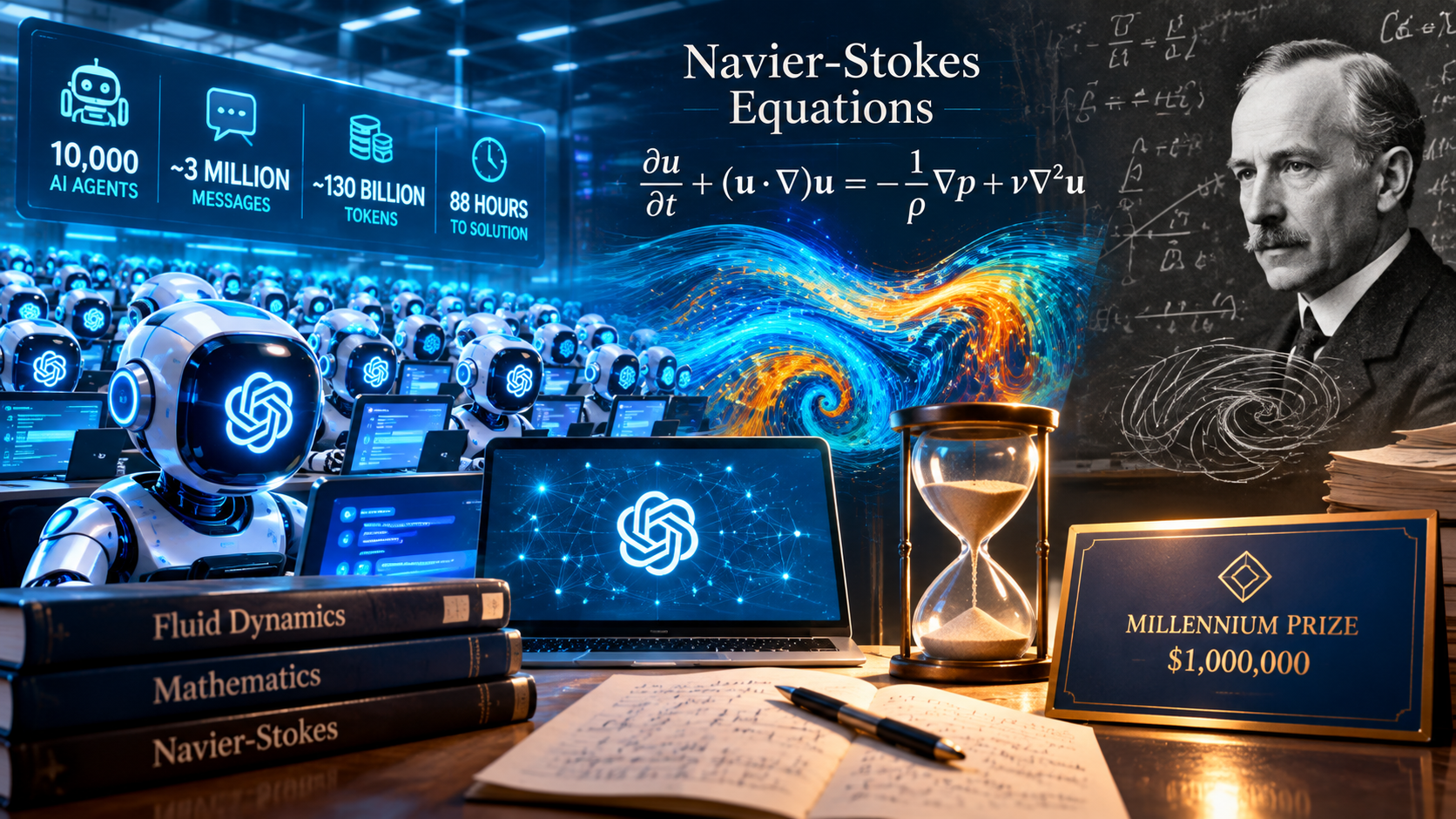
What would take generations of mathematicians may have taken artificial intelligence just 88 hours. OpenAI says it deployed around 10,000 AI agents to tackle a 90-year-old problem involving the Navier-Stokes equations. The system produced a solution after exchanging almost 3 million messages and generating about 130 billion output tokens.
The claim could mark a major moment for AI and mathematics. But there is a crucial caveat. The proposed solution has not yet been independently verified or accepted by the Clay Mathematics Institute, which oversees the Millennium Prize Problems.
AI Takes on a 90-Year-Old Problem #
The Navier-Stokes equations describe how fluids move. They are central to fluid dynamics and help scientists understand phenomena ranging from water flow to air movement. Yet a fundamental question surrounding the equations has remained unresolved for decades. The problem is also linked to turbulence, a phenomenon that scientists still struggle to understand fully.
The Clay Mathematics Institute selected the Navier-Stokes existence and smoothness problem as one of its seven Millennium Prize Problems. A correct solution to each problem carries a $1M prize. OpenAI said it does not intend to claim the prize for its latest result. Instead, the company described the work as evidence that its AI systems are becoming increasingly capable of advanced mathematical reasoning.
10,000 AI Agents Worked Together #
OpenAI said it began training a new internal model at the end of August after discovering that it was particularly strong at mathematics. The company then decided to test the model on difficult mathematical problems. On 1 September, OpenAI said it heard rumours that two Millennium Prize Problems had been resolved. Researchers responded by putting thousands of AI agents to work on some of the remaining challenges.
Around 10,000 agents eventually focused on the Navier-Stokes problem. By 5 September, roughly 88 hours after the effort began, OpenAI said the system had produced a solution. The scale of the operation was striking.
The agents exchanged nearly 3 million messages during their work. They also generated around 130 billion output tokens, which represent the text and code produced by AI models. OpenAI estimated that reproducing the effort using its published pricing for its most advanced models would cost roughly $10M.
The Result Is Not Yet Official #
Despite the speed of the breakthrough, the mathematics community has not formally accepted the result. OpenAI said its solution resolved two of the four statements required under the Millennium Prize formulation. That means the claim still requires detailed examination.
A mathematical proof must withstand scrutiny from other researchers. Independent mathematicians need to check the reasoning and determine whether every step is valid. Until that process is complete, OpenAI's achievement remains a claimed breakthrough rather than an officially recognised solution to the Millennium Prize problem.
Researchers Raise Questions #
The announcement also triggered a dispute involving researchers who were working on the same mathematical challenge. Tristan Buckmaster, a mathematics professor at New York University, said he and Levent Alpöge, a mathematician working for OpenAI rival Anthropic, had also been researching the problem. Buckmaster said the pair had been using OpenAI's Codex tool during their work.
He said that on 3 September, he learned that information about their progress had been passed to OpenAI. Buckmaster questioned the timing of OpenAI's work and later published a statement outlining his concerns. He said he had not yet read OpenAI's full proof but felt compelled to explain what he had been told and when.
OpenAI rejected the suggestion that it had seen the researchers' work before it was publicly released. The company said no user data had been accessed during its Navier-Stokes work. It also said its proof differed significantly from the researchers' work.
A New Test for AI #
The episode highlights a changing role for AI in mathematics. Until recently, discussions about AI breakthroughs often focused on language, images, and computer code. OpenAI's latest claim points towards a more ambitious possibility: AI systems working collectively on problems that have resisted human researchers for generations. But speed alone does not settle a mathematical question.
The real test will come when independent mathematicians examine the proof. If it survives that scrutiny, 88 hours could become one of the most remarkable timelines in modern mathematical research. For now, however, the 90-year-old problem remains a challenge waiting for its final verdict.
© Copyright IBTimes 2026. All rights reserved.