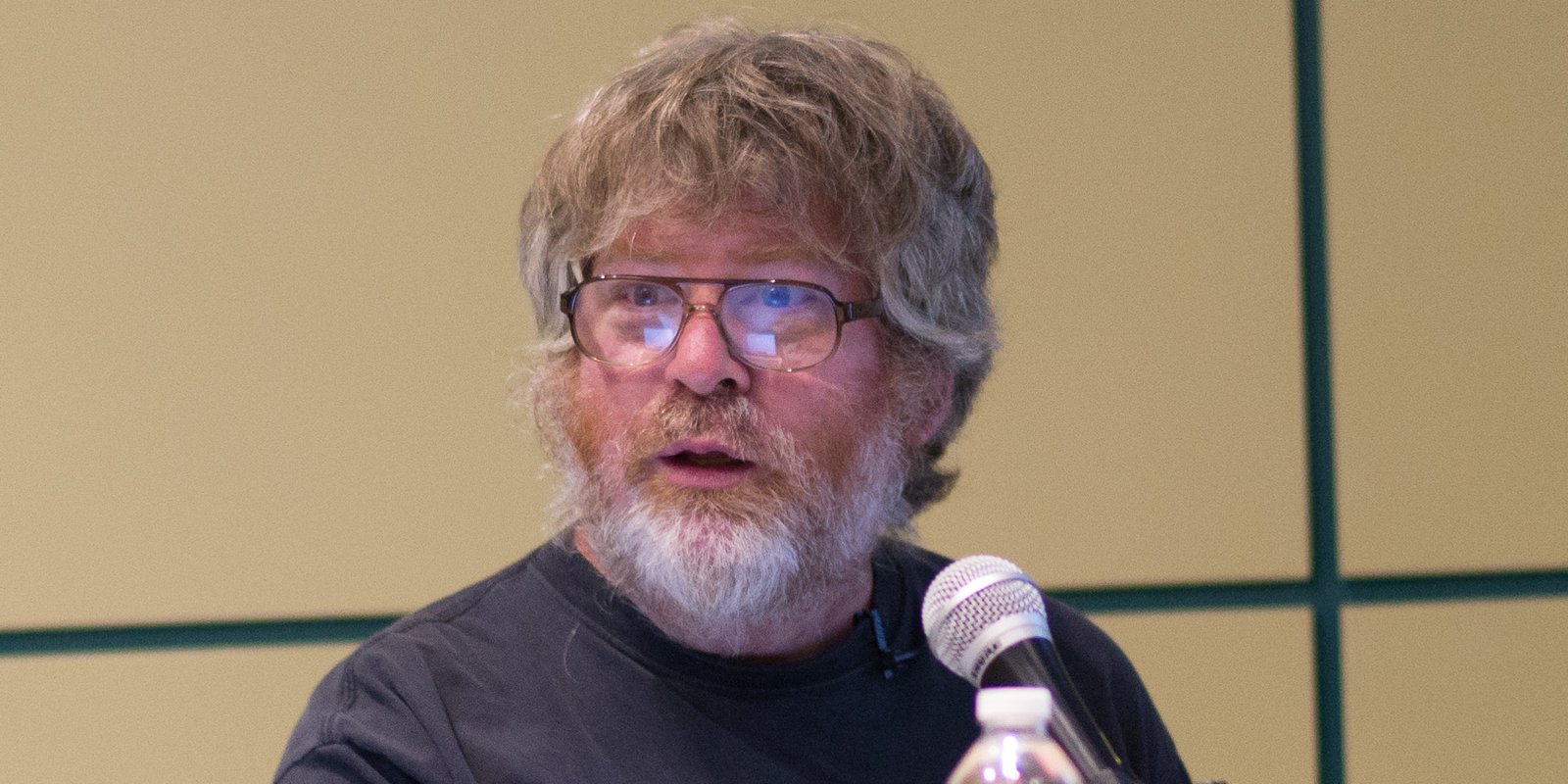
Russell Impagliazzo, who proposed the Exponential Time Hypothesis with Ramamohan Paturi, speaking at a DIMACS workshop at Rutgers University in July 2016. Image: BöhmMartin / Wikimedia Commons, CC BY-SA 4.0, cropped

OpenAI says its internal AI models have produced proofs of three results that have beaten mathematicians and physicists for decades. In a post on Monday, the company claimed a proof of the Kakeya conjecture in every dimension, an algorithm that refutes a cornerstone of computer science called the Exponential Time Hypothesis (ETH), and a rigorous existence proof for the theory of the strong nuclear force.
The same day, Anthropic posted a paper written by Claude claiming to refute ETH too. Anthropic says Claude found it on October 16, the same day OpenAI says its model did. None of the results has been peer reviewed.
What OpenAI claims, in plain words #
- Kakeya: imagine a shape that holds a one-unit needle pointing in every direction. Such shapes can have zero volume, but the conjecture says they are never “thinner” than the space they sit in. Hong Wang and Joshua Zahl proved the 3D case in 2025. OpenAI’s59-page paper says it settles every dimension by proving Christopher Sogge’s 1991 local smoothing conjecture, about how briefly a focused wave can stay sharply focused, which OpenAI says also resolves Stein’s restriction conjecture.
- ETH: proposed by Russell Impagliazzo and Ramamohan Paturi in 1999, it says the logic puzzle 3-SAT can’t be solved much faster than by trying an exponential number of possibilities. Hundreds of papers rely on it.OpenAI’s paper gives an algorithm that is slightly, but provably, faster than exponential.
- Physics: a mathematically rigorous proof that quantum chromodynamics, the theory of quarks and gluons, and the simplest grand unified extension of the Standard Model exist in four dimensions. Along the way it claims existence of pure Yang-Mills theory, part of aClay Millennium Prize problem . The prize also asks for a “mass gap”, which OpenAI does not claim, and the physics material has not been released.
Claude got to ETH too #
Anthropic’s 49-page paper, credited to “Claude, Anthropic”, claims the same running time for counting solutions as OpenAI’s. Its provenance note says the core algorithm “was found on October 16 by an internal Claude research model with 14M output tokens and no human input”. It adds that “independently and concurrently” an OpenAI model claims a similar result.
Both papers stress the speed-up is theoretical: Anthropic’s says it “says nothing about solving formulas in practice”.
“Our involvement should not be taken as certification” #
OpenAI asked outside experts to act as “shepherds”, says it seeks no academic credit, and says nobody signed a non-disclosure agreement. Impagliazzo, Paturi and MIT’s Ryan Williams will organise an open examination of the ETH claim, and OpenAI has agreed to fund a conference on it. In a letter to fellow researchers, which links both labs’ papers, the three wrote:
Our involvement should not be taken as certification of the claim. A result of this significance requires careful, independent scrutiny and an understanding that others can reconstruct, question, and build upon.
Russell Impagliazzo, Ramamohan Paturi and Ryan Williams, open letter
Williams said on Bluesky that the group has no access to OpenAI’s internal models and was given only the PDF. Later he added:
If true, it should make every computer scientist put at least a little more weight on the possibility of P=NP. Ryan Williams, MIT, on Bluesky
Scott Aaronson of the University of Texas at Austin wrote on his blog that his students had just told him the news: “Even as we struggle to digest the previous courses, the endless buffet continues!”
The physics work will be shepherded by Nobel laureate David Gross with Michael Douglas, Arthur Jaffe, Igor Klebanov and Nikita Nekrasov, who will write it up before anything is released. For the maths result, an expert advised OpenAI simply to publish the AI’s output, as it did with its 722 maths papers this month, three of which it withdrew a day later.
A machine check is not the last word #
OpenAI says it checked the maths and ETH proofs in Lean, software that verifies every logical step, within a day of the AI output. But Lean can’t confirm that the formal theorem says what the paper claims. Anthropic’s README warns that “no machine checks that this file says what the paper says”. No outside mathematician had publicly confirmed any of the three results by Tuesday morning.
Terence Tao warned this month that solutions to open problems “are now being harvested at large scale in an unsustainable fashion”, and Fields medallists have asked labs to stop testing maths on models nobody else can use. Yet mathematicians can’t stop using AI, and Microsoft researchers used AI agents to crack the KLS conjecture.
Why it matters #
If they hold, these are among the biggest results any AI has produced, and two rival labs reaching the same refutation of a 27-year-old hypothesis on the same day makes the claim hard to dismiss. The models that did it are still internal, so for now the checking falls to unpaid academics working from PDFs. Sources: OpenAI announcement; OpenAI, Local smoothing for the Euclidean wave equation and The Exponential Time Hypothesis is False (GitHub); Anthropic, A 2^o(n) Time Algorithm for 3-SAT (GitHub); Impagliazzo, Paturi and Williams, letter to the community; Ryan Williams on Bluesky; Shtetl-Optimized; Terence Tao on Mathstodon.