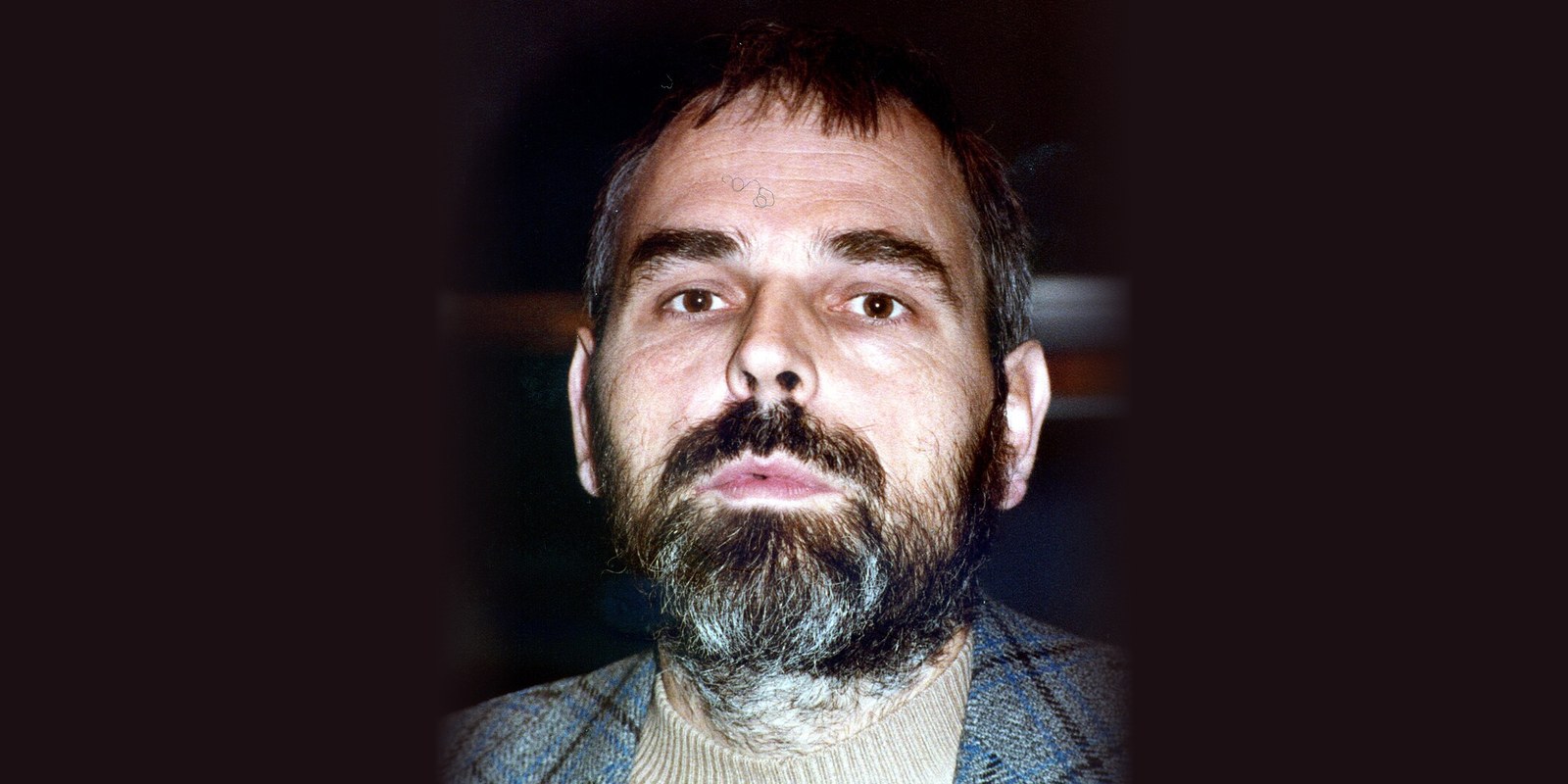
Volker Strassen, whose 1969 algorithm started the hunt for faster matrix multiplication, at an Oberwolfach complexity theory meeting in October 1979. Image: Peter van Emde Boas / Wikimedia Commons, CC BY-SA 4.0, cropped

OpenAI says one of its AI models has settled a question computer scientists have chased since 1969: how fast, in principle, two big grids of numbers can be multiplied. A 111-page preprint dated November 24 claims the answer is exactly n<sup>2.25</sup> steps, and that the long-hoped-for n<sup>2</sup> is impossible. No one outside OpenAI has checked the new proof yet.
What the matrix multiplication exponent is #
A matrix is a grid of numbers, and multiplying matrices is the basic operation that AI chips spend most of their time on, as well as graphics, physics simulations and much of science. The schoolbook method for two n by n matrices takes about n<sup>3</sup> multiplications: a billion for two 1,000 by 1,000 grids.
In 1969 the German mathematician Volker Strassen showed that two 2 by 2 matrices can be multiplied with seven multiplications instead of eight, and that the trick, repeated, beats n<sup>3</sup>. Ever since, researchers have pushed down the best known exponent, written ω (omega). By 2024 it stood at about 2.371. The answer can never be below 2, since the result alone has n<sup>2</sup> entries, and many theorists suspected ω was exactly 2: that multiplying matrices could be almost as cheap as writing the answer down.
What OpenAI claims #
The paper, credited simply to “OpenAI” and titled “The matrix multiplication exponent is nine fourths”, states that over every field ω = 9/4. Its new part is the lower bound: for every n of 2 or more, any formal arithmetic circuit that multiplies two n by n matrices needs at least n<sup>9/4</sup>/2 multiplication or division steps, rounded up, even if additions cost nothing. The paper says the result “exceeds the exponent of the output size by exactly one quarter”, which would refute the ω = 2 conjecture.
The matching upper bound is older and has had outside eyes on it. OpenAI first claimed ω ≤ 9/4 over the complex numbers in an October 2 preprint. The computer scientist Rafael Pass posted an independent, constructive proof of the same bound on October 20, and Alimzhan Amanov, Maxim van den Berg and Jeroen Zuiddam extended it to every field, building on work by Houxi Lü.
The lower bound works by contradiction. The paper argues that any method faster than n<sup>2.25</sup> could be used to shrink certain networks that test whether the entries of several lists are all different, below a size that is already known to be impossible. It leans on two companion OpenAI papers posted the same day, one on the geometry of tensors and one on circuit lower bounds for the permanent, the problem behind the VP versus VNP question that both Anthropic and OpenAI claimed to settle this week.
Not yet checked by people #
The paper has not been peer reviewed, and no mathematician has yet commented on it publicly. OpenAI’s Lean formalisation, a machine-checked proof, covers a narrower claim: the 9/4 exponent for circuits that never divide. The paper’s main theorem also covers circuits that can divide, and that extra step has not been checked by machine.
The repository holding it says its manuscripts come from “an unnamed internal OpenAI model” and are “best understood as a form of raw research data, rather than polished academic papers”. It adds: “Some of the unformalized results could have issues.” OpenAI has already pulled three papers from the same collection a day after posting them.
Even if the proof holds, nothing gets faster or slower tomorrow. The result counts arithmetic steps in an idealised model, not time on real hardware, and the fast methods with exponents well below 3 carry overheads so large that chips rarely use them.
A run of claimed AI proofs #
This is the latest in a string of claims from AI labs on problems people have worked on for decades. In October OpenAI said its models had proved the Kakeya conjecture and broken the Exponential Time Hypothesis, and the new paper cites Anthropic’s Claude-credited 3-SAT preprint from that week among its references. Fields medallists have urged labs to stop showing off maths from models nobody else can use, and mathematicians have described the flood of AI results as both a threat and a tool they cannot put down.
Why it matters #
If it survives checking, this would close one of the central open problems in theoretical computer science and say the dream of ω = 2 was never reachable. It would also be the first time a question this famous was answered in full by an AI model, which is exactly why the unchecked part of the proof deserves careful scrutiny before anyone calls it settled. Sources: OpenAI, The matrix multiplication exponent is nine fourths (preprint, November 24, 2026) and its Lean formalisation scope; OpenAI, An Upper Bound of 9/4 for the Matrix Multiplication Exponent (October 2, 2026); openai/math repository README; Rafael Pass, Matrix Multiplication from Polynomial Packings (arXiv); Amanov, van den Berg and Zuiddam, Multiplying matrices via polynomials: exposition and barriers (arXiv).