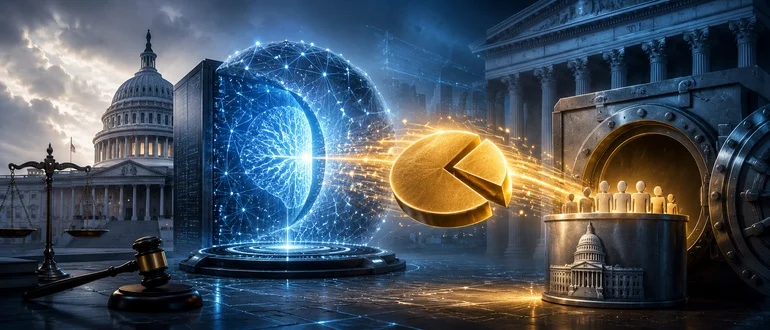
In a bold bid to defuse intensifying regulatory scrutiny and address public anxiety over the economic disruptions of artificial intelligence (AI), OpenAI has proposed granting the U.S. government a 5% equity stake in the company, according to reports published Thursday.
Based on the $852 billion valuation OpenAI reached during a record-breaking funding round in March, the proposed equity slice carries an approximate value of $42.6 billion.
OpenAI CEO Sam Altman recently pitched the concept directly to President Donald Trump, Commerce Secretary Howard Lutnick, and Treasury Secretary Scott Bessent, according to sources familiar with the matter. Altman has also discussed the framework with Sen. Bernie Sanders (I-Vt.).
The proposal envisions a broader arrangement under which all leading American AI developers — including Anthropic, Google, and Meta Platforms Inc. — would cede a similar 5% stake to the government.
The equity would be held in a sovereign wealth fund vehicle modeled after the Alaska Permanent Fund, which historically channels state oil revenues into annual dividends for residents. OpenAI’s pitch aims to create a “public wealth fund” that distributes the economic benefits of AI directly to citizens, particularly targeting Americans who lack traditional market investments.
The aggressive maneuvering comes as Washington exerts unprecedented control over the sector. Last week, a Trump administration request prompted OpenAI to delay the wide release of its latest flagship model, GPT-5.6.
That intervention closely followed a federal order that forced rival Anthropic to temporarily disable global access to its advanced Fable 5 and Mythos 5 models over national security fears regarding foreign adversaries. While the restrictions on Anthropic were lifted Tuesday after the company implemented robust defensive filters, the halts signaled a new era of state-mandated oversight.
OpenAI and Anthropic have filed confidential IPO plans, making the management of regulatory risk vital ahead of their public debuts.
While Trump has previously called a government ownership stake in tech giants “a beautiful thing” that would make Americans “partners in this revolution,” the proposal may face a steep uphill battle. It remains unclear whether tech rivals would agree to cede equity, and any such arrangement would likely require an act of Congress. Furthermore, some lawmakers argue a 5% stake is insufficient; Sen. Sanders has advocated for a more sweeping 50% public stake to compensate for the industry’s unauthorized use of human data.
If enacted, the deal would expand Washington’s growing portfolio of private corporate equity. Under a broader mandate to secure critical supply chains against China, the administration took a 10% stake in Intel Corp. nearly a year ago through an $8.9 billion investment, alongside a 15% holding in MP Materials Corp.

While a pre-IPO government stake could soothe domestic investor anxieties regarding regulatory crackdowns, industry analysts warn it could backfire globally. Experts caution that international jurisdictions may demand analogous equity arrangements as a condition for market access, potentially forcing European and Asian enterprise buyers to entirely reassess the data sovereignty and neutrality of U.S. artificial intelligence providers.
The White House, OpenAI, Anthropic, Google, and Meta did not immediately respond to requests for comment.