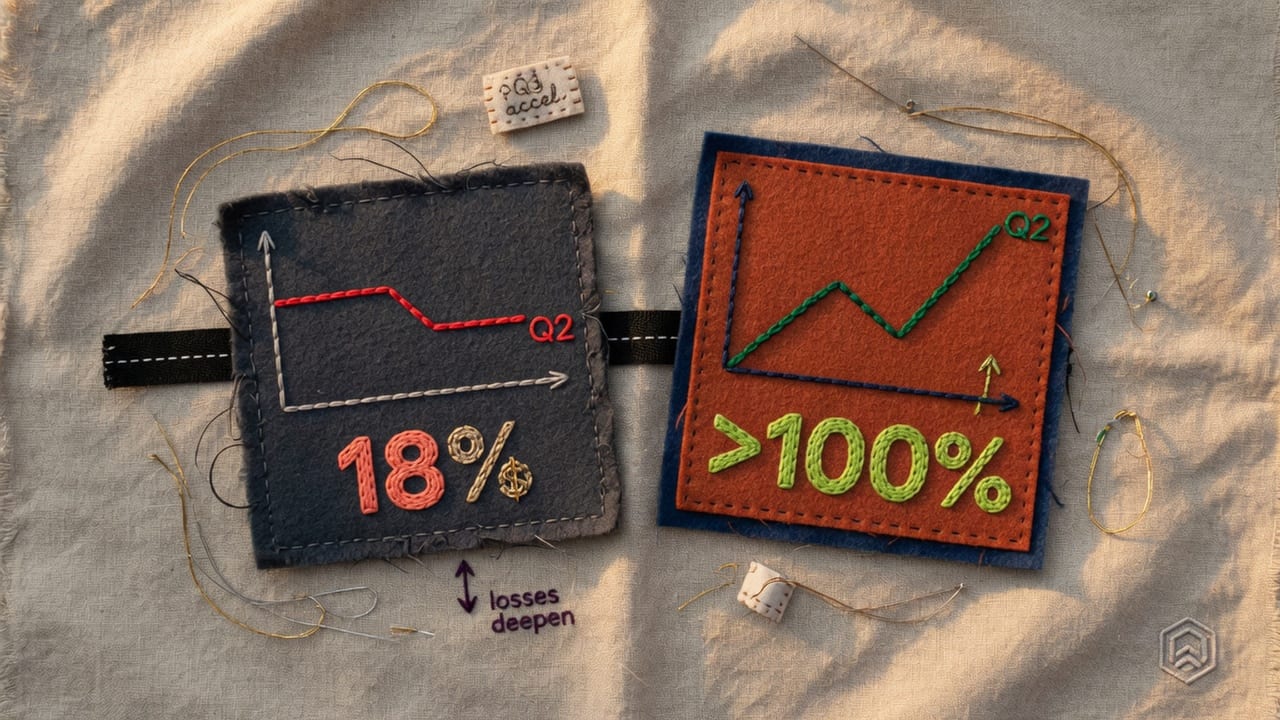
OpenAI told investors that second-quarter revenue rose 18% to $6.7 billion, a sharp slowdown beside Anthropic, which more than doubled sales and overtook the ChatGPT maker for the first time.
OpenAI generated $5.7 billion in the first quarter. Its operating margin deteriorated further in the three months ended June 30th, according to figures shared with investors. OpenAI did not provide a dollar figure for its second-quarter operating loss in the materials reviewed for this story.
Anthropic, led by siblings Dario and Daniela Amodei, generated about $11.6 billion during the quarter, up from roughly $4.7 billion in the first. Anthropic also recorded a small operating profit on the measure presented to investors. The result puts Anthropic's quarterly sales nearly $5 billion ahead of OpenAI's after trailing by about $1 billion three months earlier.
For Sam Altman, OpenAI's co-founder and CEO, the numbers expose the cost of arriving late to the most lucrative part of the current AI market. OpenAI built the category's dominant consumer product with ChatGPT. Anthropic concentrated on businesses and software developers, then turned Claude Code from an internal developer tool into the product driving its commercial expansion.
The accounting caveat does not close the gap
The comparison carries a material accounting difference. Anthropic recognizes sales made through cloud partners as revenue, while OpenAI does not, according to earlier financial documents shared with investors. The companies also present multiple profit measures depending on whether model-training costs are included.
Those differences complicate a direct margin comparison. They do not explain a quarter in which Anthropic added nearly $7 billion of sequential revenue and OpenAI added $1 billion.
Anthropic's growth has continued beyond the quarter. Preliminary figures reported this week put its annualized revenue pace above $65 billion at the end of July, compared with an internally shared figure of $40 billion for OpenAI. Annualized run rates extrapolate a short period of sales and should not be read as booked annual revenue, but investors use them to judge acceleration at companies whose growth can change significantly from month to month.
Claude Code has become the clearest commercial wedge in that acceleration. Anthropic said the coding product reached a $1 billion revenue run rate in November 2025, six months after its general release. Anthropic subsequently expanded Claude Code across business plans, raised usage limits and added compute capacity to serve heavier demand.
OpenAI has responded by putting more resources behind Codex and enterprise products. In April, OpenAI said business customers accounted for more than 40% of its revenue and that Codex had reached 3 million weekly active users. OpenAI also projected that enterprise revenue would catch consumer revenue by the end of 2026, although that forecast preceded the latest leadership changes.
OpenAI told investors that growth accelerated after new models and products arrived in July. Chief Financial Officer Sarah Friar separately told employees that OpenAI's annualized recurring revenue in July exceeded the total reported for the second quarter, attributing the increase to the GPT-5.6 model series, ChatGPT Work and Codex. That comparison mixes an annualized monthly pace with three months of recognized revenue, so it establishes direction rather than a like-for-like growth rate.
OpenAI is rebuilding its commercial operation mid-race
The weaker quarter arrived as Altman overhauled the executives responsible for turning OpenAI's consumer reach into enterprise revenue.
Fidji Simo, who had overseen OpenAI's applications business and was widely viewed as Altman's top deputy, stepped down on July 9th for health reasons. Former chief operating officer Brad Lightcap said on August 11th that he was leaving after eight years to start a new venture. Two days later, OpenAI replaced Denise Dresser, the former Slack CEO it had hired as its first chief revenue officer in December 2025.
Dresser's short tenure covered OpenAI's most explicit push into enterprise sales. OpenAI launched a deployment business with more than $4 billion of initial investment, expanded its forward-deployed engineering operation and promoted a plan to combine ChatGPT, Codex and agent tools in a single workplace product. Her departure leaves that strategy under new leadership before investors have seen a full quarter of results from the July product releases.
The second-quarter figures change the burden of proof. OpenAI still has enormous consumer distribution and says its newer models have restored momentum. Anthropic has converted a focused developer product into greater quarterly revenue and, on its preferred operating measure, a profit. OpenAI's July acceleration must now persist long enough to show that its coding and enterprise response can narrow a gap that widened dramatically in three months.