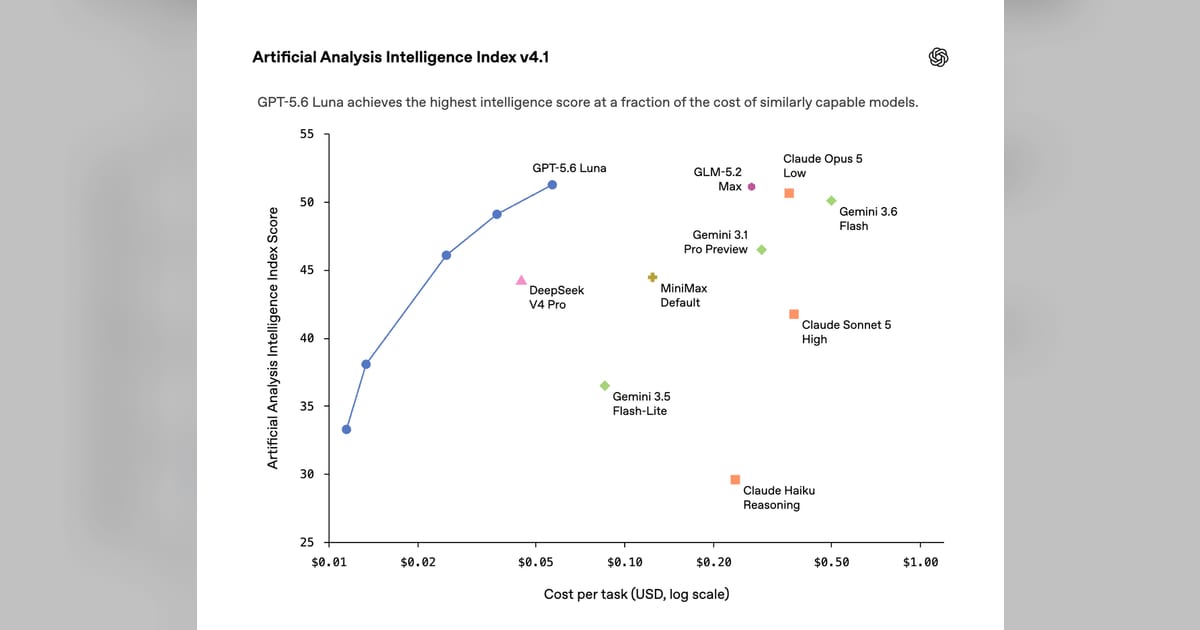
OpenAI (@OpenAI) cut API prices for GPT-5.6 Luna by 80% and GPT-5.6 Terra by 20% on July 30th, while introducing a faster processing option for its flagship GPT-5.6 Sol model. The reductions lower Luna to $0.20 per million input tokens and $1.20 per million output tokens, while Terra now costs $2 for input and $12 for output. (developers.openai.com)
For co-founder and CEO Sam Altman, the pricing move advances a distribution thesis he restated in April: OpenAI wants to put increasingly capable general-purpose AI into the hands of as many people as possible. The immediate commercial effect is narrower and easier to measure. Developers can run high-volume workloads on Luna for one-fifth of what OpenAI charged when the GPT-5.6 family became generally available on July 9th. (openai.com) OpenAI launched GPT-5.6 with three tiers: Sol for its highest-capability work, Terra for workloads balancing performance and cost, and Luna for cost-sensitive, high-volume applications. At launch, OpenAI priced Luna at $1 per million input tokens and $6 per million output tokens. Terra started at $2.50 and $15, respectively. Sol's standard price remains $5 for input and $30 for output. (openai.com)
What changed
The updated Luna documentation lists a $0.02 cached-input rate alongside the new $0.20 input and $1.20 output prices. The Terra documentation lists cached input at $0.20, standard input at $2 and output at $12. Both models retain a 1.05 million-token context window and a 128,000-token maximum output. Requests containing more than 272,000 input tokens remain subject to higher long-context rates. (developers.openai.com)
OpenAI also introduced Fast mode for GPT-5.6 Sol, promising up to 2.5x the speed of Standard processing with the same model intelligence. Fast mode costs twice the standard per-token rate, putting short-context Sol requests at $10 per million input tokens, $1 per million cached-input tokens and $60 per million output tokens. Developers can activate it with either service_tier: "fast"
or the older service_tier: "priority"
setting. OpenAI renamed Priority processing to Fast mode on July 30th. (developers.openai.com) That pricing creates a direct tradeoff for applications where response time affects conversion, completion rates or human review. Developers can keep Sol's standard processing for background work, then pay a premium for user-facing requests where latency carries a higher cost than tokens. OpenAI's documentation advises against sending large batch or data-processing jobs through Fast mode. (developers.openai.com)
OpenAI pushes Luna deeper into agent workflows
The company is also moving Auto-review in the ChatGPT app and Codex CLI from GPT-5.4 to GPT-5.6 Luna. OpenAI says the model change and price reduction should cut the cost of Auto-review by roughly 10x. That estimate is company-supplied, and the actual savings will depend on how many tokens a review consumes and whether a workload triggers long-context pricing.
The Auto-review change shows where OpenAI expects the largest pricing effect. Agent products can generate repeated model calls for planning, tool use, verification and review, so a workflow's cost can grow much faster than the price of a single prompt suggests. An 80% reduction gives developers more room to run secondary checks, maintain longer sessions or serve lower-value tasks without moving them away from the GPT-5.6 family.
OpenAI released a limited GPT-5.6 preview on June 26th and made the family generally available on July 9th. Cutting Luna's price only three weeks later indicates that inference economics have become part of the product release cycle itself. OpenAI is using lower-cost models to widen API distribution while preserving premium pricing for Sol and charging separately when customers need greater speed. (openai.com)