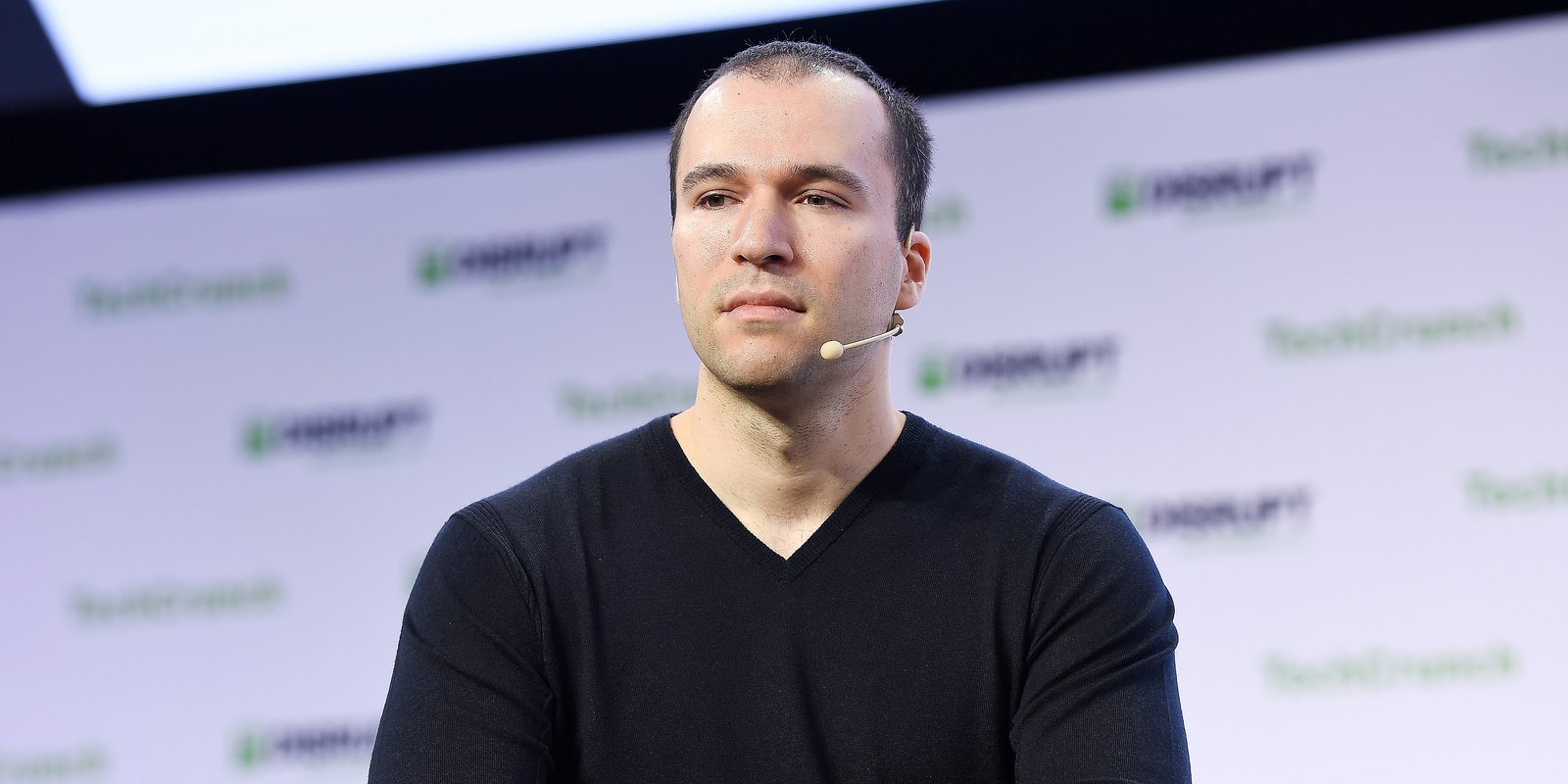
Greg Brockman, OpenAI’s president, whose Applied organisation now takes in the company’s robotics hardware staff, at TechCrunch Disrupt in San Francisco in 2019 (file photo). Image: TechCrunch / Wikimedia Commons, CC BY 2.0, cropped

OpenAI has broken up its standalone robotics team, betting that its general-purpose AI models can now run robots without one. The company confirmed the reorganisation to Fortune on Friday, saying its robotics researchers have moved into its main research group and its hardware staff into its product side, a change it says will speed up its robot plans rather than end them.
Where the robotics staff have gone #
According to OpenAI, the robotics research team now sits inside the company’s main research team, reporting to Chief Research Officer Mark Chen. The applied robotics and hardware teams have moved into the larger Applied organisation, which reports to President Greg Brockman.
A company spokesperson told Fortune that robotics remains a core part of OpenAI’s long-term vision, that the company is still committed to bringing general-purpose robots into the world, and that splitting the team up is the fastest way to get there. OpenAI hasn’t published a statement or blog post of its own about the change, and it hasn’t said how many people were affected.
The move came late enough that OpenAI had already booked a stand at CoRL, a leading academic robotics conference in Austin, Texas, this week. When Fortune visited booth #208, it was empty, with no OpenAI logo in sight, though a few former members of the team still drew a crowd there.
Why OpenAI changed course #
OpenAI told Fortune that at the start of 2026 its researchers assumed the best route to capable robots ran through models like Sora, its video generator, which has to grasp something of how the physical world works to make realistic clips. Since then, the spokesperson said, its general frontier models, including GPT-6 Astra, have turned out to work directly on robots.
Outside tests back part of that up. In an October 14 study, Nvidia researchers ran GPT-6 Astra as a robot’s controller on RoboLab-120, a simulated pick-and-place benchmark, with no special robot training. Running inside a Codex session, Astra succeeded on 74.8% of tasks, against 51.0% for the best dedicated robot model on the leaderboard, a system called Lakeside. That is the same benchmark Runway used for its Praxis-1 robot model last week.
The study also found the catch. That best setup cost about $36.40 in tokens per attempt, and even the simplest version took 18.56 seconds per model call, far too slow for most real robots. Guanya Shi, an assistant professor at Carnegie Mellon University’s Robotics Institute, told Fortune the reorganisation suggests OpenAI sees robotics as “no longer a special problem”, though he still sees a need for small models that run on a robot’s own computer without a constant internet connection.
OpenAI’s on-off history with robots #
This is the second time OpenAI has broken up a robotics team. It wound down its first in 2020, with cofounder Wojciech Zaremba later citing a shortage of robot data. It rebuilt one in 2024 alongside a partnership with humanoid maker Figure, which Figure ended in February 2025 to build its own robot AI. CEO Sam Altman has said OpenAI is building its own humanoid, with a first public demonstration targeted for 2027.
The change also lands as OpenAI is under pressure to cut costs and focus. Fortune notes that the company has already dropped some projects, including Sora, to free up computing power, and it lost a reported $10.9 billion on an adjusted operating basis in its latest quarter while it raises new money.
What it means for robot start-ups #
If a general model can drive a robot, the case for separate robot brains looks weaker, and robotics start-ups have raised billions on the opposite idea, from Agile Robots’ $500 million round to Google DeepMind’s own dedicated Gemini Robotics models. MIT professor Russ Tedrake, cofounder and chief executive of Walden Robotics, told Fortune that robot makers still have one edge the AI labs lack: their machines are already gathering experience on real factory floors, and better base models make that data more valuable, not less. Pete Florence, cofounder of Generalist, a start-up training general-purpose models for robots, said it was not yet clear which model would win out:
There may be different starting points for how to grow intelligence.
Pete Florence, cofounder of Generalist, to Fortune
Why it matters #
OpenAI is making a public bet that the same models behind ChatGPT and Codex will become the brains of robots, with no specialist team in between. If that holds up outside simulation, it puts pressure on every robotics start-up selling its own robot brain; if it doesn’t, OpenAI has just scattered the people it would need for its 2027 humanoid.
Sources: Fortune, Nvidia Research (Astranomy study).