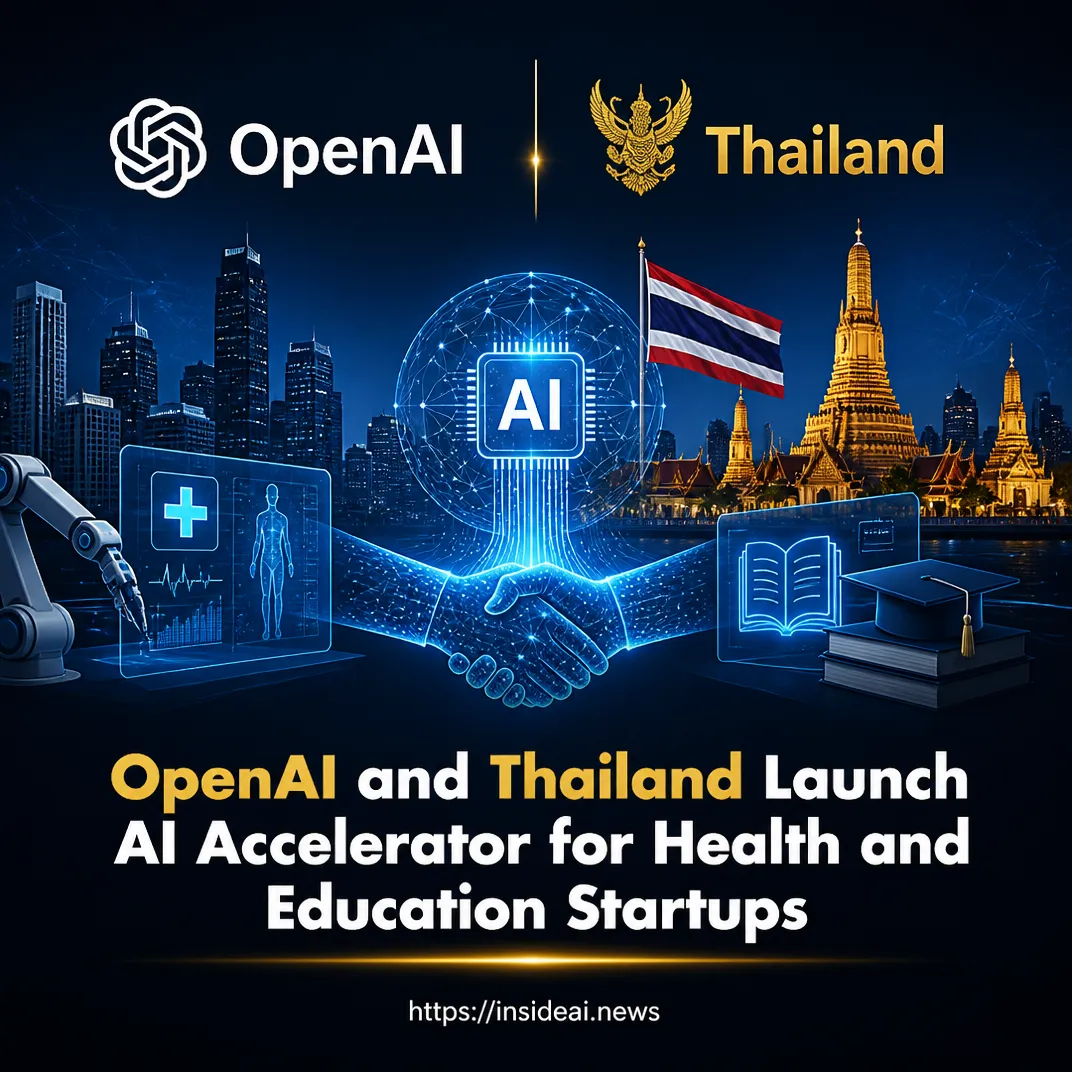
August 28, 2026, (Inside AI) — OpenAI and Thailand's Ministry of Higher Education, Science, Research and Innovation (MHESI) launched an eight-week accelerator in Bangkok today. The program targets ten local startups working in health, wellness, and education.
The OpenAI x MHESI AI Accelerator is OpenAI's first public-private partnership with the Thai government. Partners include the National Innovation Agency (NIA), Mahidol University, and Techsauce.
Each startup receives US$2,000 in API credits, one-on-one technical guidance, and access to frontier models. A dedicated mentor supports each team through weekly sessions on product design, engineering, evaluation, responsible AI, privacy, cost management, and fundraising.
The cohort includes CARIVA, Wello Food, Dietz, Precisionize, FitSloth, Curico, insKru, Floaino, EasyKids Robotics, and Globish. Five focus on medical and wellness AI; five work in education.
Thailand's ageing population drives demand for healthcare innovation. Digital economy preparation makes education AI equally urgent. OpenAI data shows Thailand ranks among the top 20 countries globally for ChatGPT weekly active users. Codex weekly active usage grew more than 350-fold since the start of 2026.
CARIVA builds a multilingual voice agent for hospital phone lines. It handles appointment scheduling and detects potential medical emergencies. The team will work on evaluation methods and steering strategies for real-time speech models. By Demo Day, CARIVA aims to deploy in a pilot hospital's live call flow.
Curico develops AI learning tools for children and educators. Plans include piloting in Bangkok Metropolitan Administration childcare centers, training over 200 teachers, testing AI-assisted grading at Chulalongkorn University, and growing its family platform to more than 1,000 monthly active users.
Why Thailand's AI Moment Needs More Than Prototypes #
A compelling demo is only the beginning. Building reliable products requires testing, user feedback, safeguards, and sustainable business models. Healthcare and education raise the stakes further. Reliability is non-negotiable.
OpenAI's internal data signals rapid adoption. Yet moving from early prototypes to trusted products remains the hard part. The accelerator bridges that gap with structured mentorship and deployment milestones.
MHESI connects teams with research and talent networks. NIA links them to funding and growth ecosystems. Mahidol University contributes academic expertise. Each startup sets a specific product, pilot, evaluation, or commercial milestone for the program.
By the end, teams must demonstrate a working product or substantial upgrade, evidence from representative users, initial evaluation findings, and a credible implementation path.
Demo Day Sets the Stage for Regional Expansion #
The accelerator concludes with a Demo Day in Bangkok in November. Startups will present what they built, share user evidence, and outline deployment plans. Investors, government agencies, universities, hospitals, and schools will attend.
The first cohort is the beginning of a longer-term effort. OpenAI aims to establish a repeatable model that helps Thai founders build trusted AI products and take solutions developed in Thailand to the world.
This partnership signals growing interest in Southeast Asia's AI startup ecosystem. Thailand's combination of technical talent and domain expertise in healthcare and education makes it a natural testbed for responsible AI deployment. The accelerator's focus on evaluation, safety, and real-world evidence could set a template for other emerging markets.