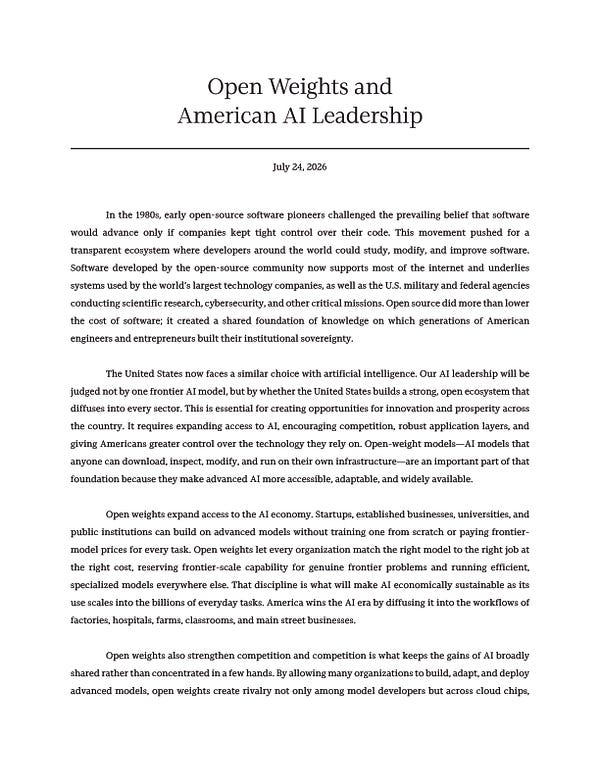
If you look at the signatory list, it reveals a lot about the current industry divide. The companies pushing for open weights are those whose business models benefit from a broad ecosystem of deployment—basically, those who want to avoid being locked into a single proprietary API.

For anyone building an AI workflow, this shift is critical. Open-weight models allow for local deployment and deep fine-tuning, which is the only way to truly ensure data privacy and reduce latency in real-world applications. When weights are open, we move from "prompt engineering" as a guessing game to actual model optimization.
It is a high-stakes move to prevent the industry from consolidating into two or three "black box" providers. Whether this leads to more truly open-source releases or just "open-ish" weights remains to be seen, but the momentum is clearly shifting toward accessibility.
Next AI Detection: Why Your Human Writing Gets Flagged →
source & further reading
promptcube3.com — original article
Claude Code and no-code agents are just making bad system design
Angular DataGrid is a solid MIT-licensed alternative if you are
Sparrow-2 proves that noise cancellation actually kills