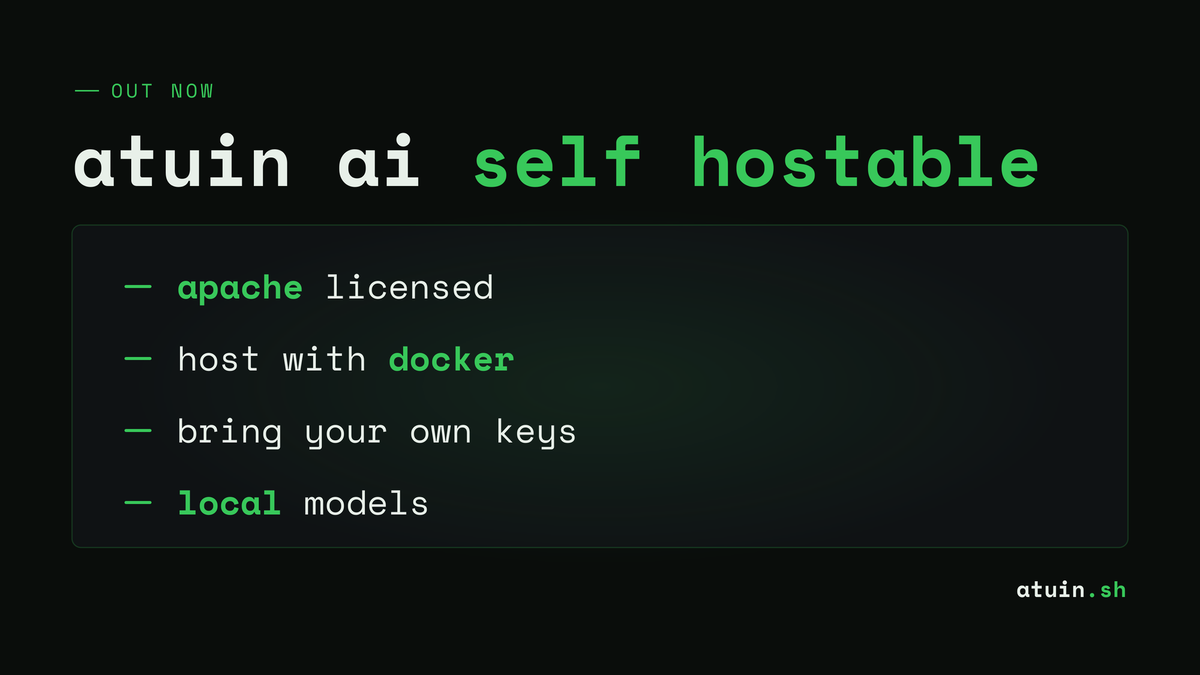
Self host your own server for Atuin AI - the agent that lives in your terminal, and knows how you work
Atuin AI is a fast terminal-focused agent right in your shell. It starts instantly and comes with all the agentic tools needed to help with work in your terminal.
Atuin offers a generous usage budget for free for all users, and we don't store your AI conversations, but we recognize some people would prefer to keep tighter tabs on their data, especially data that originates from terminal usage.
To that end, we're happy to be open sourcing the Atuin AI server.
The Atuin AI Server #
The Atuin AI server can be found on GitHub at atuinsh/atuin-ai-server; it's based on atuinsh/atuin-ai-core, the same library we use for the production Atuin AI server.
The Atuin AI server currently supports any OpenAI-compatible, chat completions-style endpoint. For local models, this includes Ollama, vLLM, LM Studio, llama.cpp, and LiteLLM, among others. You can also use OpenAI-compatible web services, like OpenRouter.
Getting Started #
After cloning the repository, copy the example config file, config.example.toml
, to config.toml
. Follow the configuration section of the readme to set up your instance.
Here's a very basic example of an Ollama-based setup:
port = 8080
endpoint = "http://localhost:11434/v1" # or host.docker.internal
api_key = "ollama"

default_model = "llama31"

[request.body]
stream_options = { include_usage = true }

[[models]]
alias = "llama31"
name = "Llama 3.1 70b"
description = "Ollama Llama 3.1 70b"
model = "llama3.1:70b"

[[models]]
alias = "gemma4"
name = "Gemma 4 r4b"
description = "Ollama Gemma 4 - Effective 4b"
model = "gemma4:e4b"
See the repository readme for more setup details, including configuring server-side tools, like web search and web content scraping.
Once done, you can start the server one of two ways:
Running from Source
If you have Erlang, Elixir, and Gleam installed, you can run the server natively:
mix deps.get
mix run --no-halt
If your config.toml
specifies API keys via environment variables, remember to set them when you start the server.
Running with Docker
To run the server with docker, run the following:
docker run \
  -v ./config.toml:/etc/atuin-ai/config.toml \
  -p 8080:8080 \
  ghcr.io/atuinsh/atuin-ai-server:latest
If you're running via Docker and want the Atuin AI server to connect with a local LLM service running on the host, like Ollama, use host.docker.internal
as the endpoint instead of localhost
(which would resolve to the container's own loopback interface).
Configuring Atuin AI #
Once your server is running, you can configure Atuin AI to connect to it by setting the endpoint config:
[ai]
endpoint = "http://localhost:8080"