Crusoe Energy and Redwood Materials have proven that repurposed electric vehicle batteries can run AI data centers at scale, and now GM, Ford, and a wave of supply-chain capital are following their lead into what may be the most unexpected infrastructure convergence of the decade.
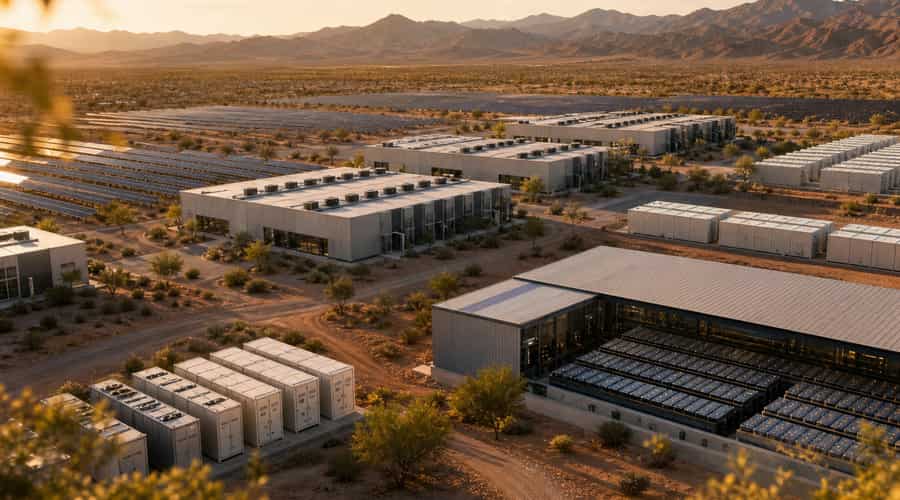
The project started as a proof of concept that most people in the industry quietly assumed would stay small. In mid-2025, Redwood Materials commissioned a 12 MW, 63 MWh microgrid in Sparks, Nevada, built almost entirely from retired EV battery packs, to power four of Crusoe Energy's modular data centers on site. The batteries retained roughly 80% of their original capacity. They cost a fraction of new lithium-ion grid storage. And in seven months of continuous operation, the system delivered 99.2% uptime. That is not a pilot result. That is a production result.
By March 2026, Crusoe and Redwood had announced they were scaling the campus from four modular units to 24, pushing total compute density to nearly seven times the original deployment. The partnership, which began as a bet on circular energy economics, had become a blueprint.
The economics of second-life batteries hinge on a simple fact: the most expensive part of building a battery, the cell itself, has already been paid for by the car buyer. What Redwood's new Redwood Energy division does is test, grade, integrate, and deploy those packs into grid-scale storage systems. Industry estimates put second-life systems at 30 to 60 percent cheaper than new lithium-ion storage on a per-kilowatt-hour basis, though Redwood hasn't published its own pricing. At 12 MW and 63 MWh, the Sparks project is the largest deployment of this kind ever built, and it didn't exist two years ago.
That timing matters. Goldman Sachs has forecast a 165% surge in global data center electricity demand by 2030 from 2023 levels, driven almost entirely by AI workloads. Grid interconnection timelines in the U.S. average two to four years, with full transmission upgrades sometimes running seven to ten. You can't build fast enough through the traditional utility queue. But you can drop a microgrid powered by repurposed EV batteries on a brownfield site and be online in months. That's the gap Crusoe and Redwood are threading.
The supply chain loop underneath all of this is the part most investors haven't priced in yet. EV adoption generates battery retirements at scale. Those retirements, which the industry once treated as a liability, are now feedstock for grid storage. Grid storage, in turn, is what unlocks faster AI infrastructure buildout. EV buyers are, in a roundabout way, subsidizing the compute capacity that trains the next generation of AI models. That is not a metaphor. GM and Redwood are already deploying roughly 10,000 retired GM EV battery packs into energy infrastructure, including the Crusoe campus in Nevada. A smaller batch of about 100 packs is headed to a GM plant in Michigan next year, where they're expected to generate $3 million in electricity savings over the life of the installation.
The bigger players are moving fast #
GM went further in June 2026, partnering with startup Peak Energy, backed by GM Ventures, to co-develop sodium-ion cells purpose-built for stationary storage. Sodium is roughly a thousand times more abundant than lithium, carries a lower environmental footprint, and doesn't require the same active cooling infrastructure. GM will develop the cell chemistry in its Michigan battery labs and retain exclusive manufacturing rights; Peak will integrate the cells into its storage systems. It's a parallel bet to the second-life play, not a replacement for it.
Ford moved in May 2026, launching Ford Energy as a standalone stationary storage subsidiary and signing a five-year framework agreement with EDF Power Solutions North America for up to 4 gigawatt-hours of annual battery system supply. Two of the three largest U.S. automakers are now building grid storage businesses. That's not a coincidence.
What's driving all of them is the same constraint Crusoe ran into: power availability is the binding limit on AI infrastructure expansion, not compute, not land, not capital. Hyperscalers have the money to build. They don't have the grid capacity to plug in. Second-life batteries and next-generation chemistries like sodium-ion don't solve the long-run transmission problem, but they compress the timeline from site selection to live compute by years. For a sector where every month of delay costs real revenue, that compression is worth real money.
The Sparks, Nevada campus is already proving it works. The question now isn't whether second-life battery economics can support AI infrastructure. It's how fast the supply of retired EV packs can grow to meet demand, and whether the companies building these systems can maintain their cost advantage as new lithium-ion storage prices continue to fall. Frankly, the EV adoption curve suggests the feedstock problem solves itself. What happens when millions of first-generation EV batteries reach end-of-vehicle-life in the next five years will look less like a waste management challenge and more like an infrastructure windfall.
Also read: Amazon moves Prime Day to June for the first time as AI takes over how shoppers discover deals • Google DeepMind's AI Control Roadmap treats its own agents as insider threats and sets the compliance bar for everyone else • Singapore puts S$48 million behind local media firms to build AI content skills and reach new audiences