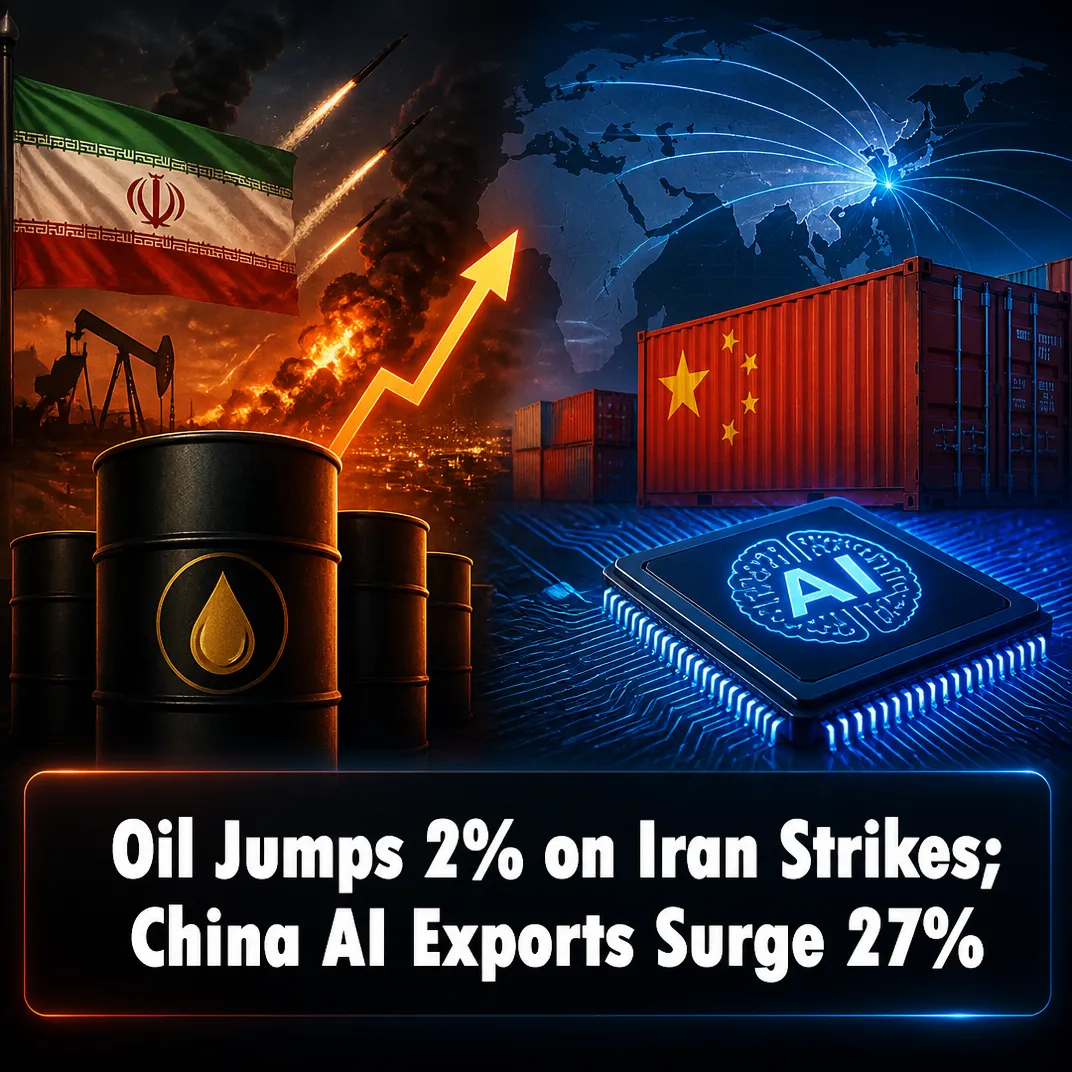
July 14, 2026, (Inside AI) — Oil prices surged over 2% early Monday after a third consecutive night of U.S. strikes on Iran escalated Middle East tensions. Two tankers were hit in the Strait of Hormuz, a critical chokepoint for global crude shipments.
Brent crude, the international benchmark, rose 2.2% to $85.15 a barrel, after touching $85.64 in early London trading. The spike came as former President Donald Trump announced the U.S. would reinstate its blockade of Iranian shipping in the Gulf, while vowing to keep the strait open.
Susannah Streeter, chief investment strategist at the Wealth Club, captured the market’s unease.
Stasis has taken over markets as investors wait for the latest twist in the Iran conflict and brace for higher energy prices to filter through to economies. Brent crude has surged even higher, topping $84 a barrel, while European gas prices have shot up to levels not seen in three months.
The military escalation directly threatens the flow of roughly 20 million barrels per day that transit the strait. Any prolonged disruption could squeeze global supply and reignite inflationary pressures just as central banks weigh further rate cuts.
Meanwhile, China’s export machine roared back in June, fueled by insatiable global demand for artificial intelligence hardware. Exports jumped 27% from a year earlier in dollar terms, the biggest gain in four months, smashing economists’ forecasts of 18.2%.
Imports surged 36%, a five-year high, driven largely by semiconductor purchases. The trade surplus widened to $125.6 billion from $105.4 billion in May, putting the country on track for a second consecutive year with a surplus above $1 trillion.
The numbers reveal an economy deeply split. Overseas orders for chips, servers, and computing gear are offsetting the drag from the Middle East conflict, while domestic consumption remains anemic. Retail sales are flat, and fixed-asset investment turned negative last month.
Xu Tianchen, a senior economist at the Economist Intelligence Unit in Beijing, pointed to AI as the linchpin.
Continued export strength, mostly driven by AI, points to a better second half, coupled with a more expansionary policy mix, accelerated fiscal spending and mild monetary easing, as well as a de-escalation of the situation in the Middle East, which will benefit China through lower oil prices.
That reliance on external demand is historically extreme. A recent report by consultancy Gavekal Dragonomics found that exports accounted for 24% of total manufacturing sales in the first four months of 2026, the highest since China joined the World Trade Organization in 2001. In 2019, the ratio was just 18.3%.
That would be considered high for a small export-focused country; for the world's second-largest economy, it is remarkable.
The AI boom is also inflating import values. Surging semiconductor prices pushed purchases from South Korea up 85% last month, while imports from Taiwan climbed 41.1%. These components are then assembled into finished goods and re-exported, amplifying both sides of the trade ledger.
Zhiwei Zhang, chief economist at Pinpoint Asset Management, told Reuters the export momentum would persist but warned of blowback.
I think exports will remain strong in the second half of the year. Meanwhile, it also puts further pressure on the trade tensions between China and its trading partners, Europe in particular.
Customs vice minister Wang Jun expressed confidence that tech-led exports would remain resilient into the second half, despite external pressures. But the combination of geopolitical turmoil and China’s lopsided growth model leaves the global economy walking a tightrope.