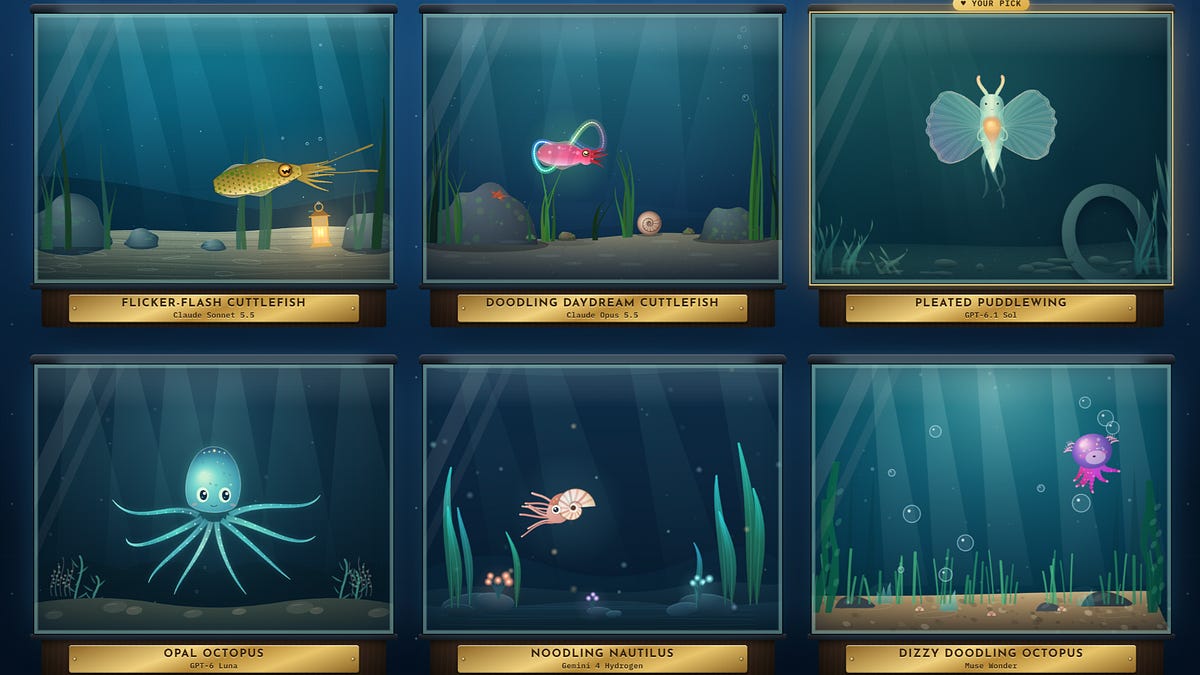
I built a virtual Aquarium and asked twelve different AI models to create an aquarium tank with one creature inside of it: “Your tank holds exactly one creature, and both the creature and its tank should be an expression of you: your personality, your sensibilities, what you find delightful.” I hoped these whimsical creatures could reveal something about each model’s creative tendencies.
Of all the fish in the sea (!), the models seemed to converge on a few common sea creatures. In the screenshot above, you might notice there are two cuttlefish (created by two different Claude models) and two octopuses.
This reminded me of a phenomenon called mode collapse, which is when a model produces repetitive outputs that lack diversity. I wanted to know how often these models gravitated toward the same creative ideas, so I decided to investigate.
A mini-experiment: how different models display different creative habits #
To better understand how often particular animals and descriptors appeared, I asked each of the twelve models to imagine an underwater creature representing its personality, 50 times each (yielding 600 named creatures in total). Rather than having each model create an entire aquarium, I simplified the task to focus just on the creature names.
In the prompt, each AI model was asked to describe its creature with adjectives using alliteration or onomatopoeia, which led to some fun monikers, such as “Sputtering Scribblefish,” “Pensive Puffling Pipfish,” and “Blooping Bellfish.”
Some models kept returning to almost identical names, sometimes changing only a word or two. But there were plenty of wonderfully strange creations that appeared only once.
For this analysis, I separated each creature type (e.g. cuttlefish, pufferfish) from its descriptors (e.g. spluttering, blubbering).
AI models have favorite creatures
You’d expect some repetition, of course, but what we see is a disproportionate amount of cuttlefish and a few other creatures. Across 600 answers, the models came up with 156 unique creatures, but just 12 of them make up half of all answers. Meanwhile, 89 creatures were named only once.
Cuttlefish appeared 112 times, accounting for 18.7% of all responses across all models.
Some models seemed to have favorite creatures they repeatedly returned to, such as Muse Wonder with octopus and Grok 4.7 with pipefish. Other creatures, like cuttlefish, were popular across multiple models.
Not every model had a favorite creature, though. Some explored a wider range of possibilities, suggesting that these creative tendencies aren’t uniform across models.
AI models also gravitate toward similar descriptors for their creatures
Different models also had their own favorite descriptors: Claude Sonnet likes “whispering”, GPT 6.1 Sol likes “puttering”, and Muse Wonder likes “doodling.” The models weren’t just converging on the same animals. They also seemed to draw from a surprisingly similar vocabulary to describe them.
Curious about the descriptors used by each model? I made (cough … had Claude Code make) a series of fishbowl-themed word clouds. Not all models were equally repetitive, though. GPT-6.1 Sol used just 14 distinct descriptors across 50 responses, while Mistral used 68. I found it interesting that some models gravitated toward a handful of familiar words, while others did not display that tendency quite as strongly.
The patterns extend beyond the aquarium #
So far, I’ve only looked at imaginary sea creatures. But I started wondering whether these recurring patterns were specific to the aquarium prompt, or whether they might appear in entirely different creative tasks. As it turns out, the aquarium wasn’t the only place where I kept encountering familiar motifs.
I extended the Aquarium gallery to other creative domains, such as carnivorous plants, bonsai trees, fairy tarot cards, and a fungarium. I invite you to take a look and vote on your favorite creations!
Some themes, like lanterns and lamplight, appear across different domains
One thing you may notice, like with the aquarium, is the repetition of certain themes, archetypes, or adjectives. In the Carnivora above, there are multiple mentions of “lantern” or “lamplight”, even though I never mentioned these words in the prompt! These themes pop up across all models.
This repetition of the same themes and motifs occurs across different tasks. Below is a planetarium, where each model is asked to generate a nighttime constellation. Not only do we see recurring cranes and moths (both GLM and Grok created “The Thousandth Crane”), but the “lantern” and “lamplight” motifs appear again — this time, in a totally different domain! Laterns and lamps also appear in the names of the fungi and mermaids as well.
Appearance of visual motifs or quirks
I noticed some other patterns, such as that the creations for some models seemed to have some sort of signature or trademark. Take, for example, a mushroom and a potion, each created by Muse Wonder. Both share a frenetic, almost chaotic visual style, almost like a signature aesthetic or fingerprint.
What does this mean for AI creativity? On convergence and divergence #
What started as a whimsical aquarium experiment ended up revealing some curious patterns in how AI models generate creative ideas. Across hundreds of imaginary sea creatures (as well as several entirely different creative tasks), I kept encountering certain recurring animals, descriptors, and motifs.
I am not saying that these models are incapable of creativity (I mean, the aquarium ended up looking quite nice!), nor that they all exhibit mode collapse. It’s more complicated than that. Some models seem to have strong preferences for certain motifs, while others explore a much wider variety of possibilities. Even within the same model, some creative elements seem more repetitive than others. Why these patterns emerge is a fascinating question I will leave for a future article.
When using any of these AI tools to assist you in your next creative endeavor, I would use some caution before being swept away by their impressive-looking outputs. Many questions that people ask AI models tend to have, if not one right answer, a bounded set of mostly correct answers: math problems, queries about tax codes, how to take care of a plant. For these sorts of questions, we generally want the answers to converge.
But prompts like “Can you tell me a story?” or “Create me a fish to fit in this virtual fish tank” do not have a single correct answer, nor a bounded set of such answers. Rather, we as users may delight in or seek out the variety and randomness of the answers. In these more creative domains, convergence isn’t necessarily better. Sometimes, divergence is exactly what we’re looking for.